APIs pour la recherche et les impuretés
Sous-catégories appartenant à la catégorie "APIs pour la recherche et les impuretés"
- Acides Aminés et Dérivés(12.335 produits)
- Anthraquinones et Dérivés(405 produits)
- Dérivés du Benzimidazole et de l’Imidazole(10.445 produits)
- Dérivés des Benzodiazépines(335 produits)
- Glucides et Glycoconjugués(5.027 produits)
- Esters et Dérivés(42.247 produits)
- Acides Gras et Dérivés Lipidiques(32.404 produits)
- Flavonoïdes et Polyphénols(17.087 produits)
- Radicaux Libres et Agents Oxydants/Réducteurs(213 produits)
- Cétones et Dérivés(2.404 produits)
- Antibiotiques Naturels et Semi-Synthétiques(6.391 produits)
- Nitriles et Dérivés Cyano(3.068 produits)
- Nitrosamines et Dérivés(55 produits)
- Nucléosides et Nucléotides(3.454 produits)
- Phosphates et Phosphonates Organiques(1.202 produits)
- Sulfonates et Sulfates Organiques(10.437 produits)
- Composés Organométalliques(4.422 produits)
- Autres(6.295 produits)
- Peptides et Protéines(3.148 produits)
- Polymères et Dérivés(100 produits)
- Dérivés des Purines et Pyrimidines(8.955 produits)
- Dérivés de Quinazoline et de Quinoléine(66.023 produits)
- Quinones et Dérivés(24.356 produits)
- Sels et Dérivés d’API(79.837 produits)
- Stéroïdes et Dérivés(4.978 produits)
- Sulfamides et Dérivés(2.598 produits)
- Terpénoïdes et Dérivés(3.849 produits)
- Thiazolidinediones et Thiopyranes(2.753 produits)
- Composés β-Adrénergiques(230 produits)
57127 produits trouvés pour "APIs pour la recherche et les impuretés"
Fonofos
CAS :Fonofos is a potent inhibitor that has been shown to induce apoptosis in Chinese hamster ovary cells. It is also known to inhibit chitin kinase, a protein that plays an important role in the biosynthesis of chitin, which is essential for the formation of cell walls in fungi and insects. Fonofos has medicinal properties and has been studied as a potential anticancer agent due to its ability to inhibit tumor growth. In vitro studies have shown that Fonofos can inhibit the growth of human cancer cells by inhibiting heparin-binding proteins. Additionally, it has been found to have inhibitory effects on several other enzymes involved in cancer development and progression. Although not approved for use in humans, Fonofos may hold promise as a therapeutic agent for the treatment of certain cancers.
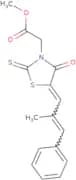
Formule :C10H15OPS2Degré de pureté :Min. 95%Masse moléculaire :246.3 g/mol(E,Z)-Epalrestat methyl ester
CAS :(E,Z)-Epalrestat methyl ester is a drug product that is custom-synthesized for research and development purposes. It is a natural metabolite of (E,Z)-epalrestat acid. The chemical name for this compound is 3-[(2-chlorophenyl)methyl]-N-(1H-indol-3-ylmethylene)malonamide. The molecular weight of this compound is 284.87 g/mol and it has an empirical formula of C24H27ClN2O2. It has been found to inhibit the activity of phosphodiesterase (PDE), which plays a role in the breakdown of cyclic nucleotides such as cAMP and cGMP. This product has high purity and analytical data that can be used for metabolism studies or clinical trials.
Formule :C16H15NO3S2Degré de pureté :Min. 95%Masse moléculaire :333.43 g/mol2-[[[3-Methyl-4-(methylthio)-2-pyridinyl]methyl]sulfinyl]-1H-benzimidazole
CAS :2-[[[3-Methyl-4-(methylthio)-2-pyridinyl]methyl]sulfinyl]-1H-benzimidazole is a synthetic, nonsteroidal anti-inflammatory drug. It is soluble in methanol and ethanol, not soluble in water. The impurity standard of 2-[[[3-Methyl-4-(methylthio)-2-pyridinyl]methyl]sulfinyl]-1H-benzimidazole is 3-[2-[(3,4,5-trimethoxyphenyl)amino]-1H-benzimidazolium methyl sulfate].
Formule :C15H15N3OS2Degré de pureté :Min. 95%Masse moléculaire :317.43 g/mol(4R)-1-(4-O-b-D-Galactopyranosyl-b-D-glucopyranosyl)-4-(2-methylpropyl)-2-pyrrolidinone
CAS :(4R)-1-(4-O-b-D-Galactopyranosyl-b-D-glucopyranosyl)-4-(2-methylpropyl)-2-pyrrolidinone is a synthetic, impurity standard and research and development compound. (4R)-1-(4-O-b-D-Galactopyranosyl-b-D-glucopyranosyl)-4-(2-methylpropyl)-2pyrrolidinone is used as an analytical reference in the synthesis of other compounds. It is also used in drug development for the treatment of tuberculosis. This product has a high purity level and is pharmacopoeia grade.
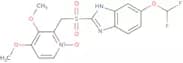
Formule :C20H35NO11Degré de pureté :Min. 95%Masse moléculaire :465.49 g/molPantoprazole sulfone N-oxide
CAS :Pantoprazole sulfone N-oxide is a prodrug that is converted to the active form pantoprazole in the stomach where it inhibits gastric acid secretion. Pantoprazole sulfone N-oxide has been shown to be genotoxic, and can cause polyvinyl chloride to degrade when stored together. Reconstituted solution of this drug should be used within 24 hours after reconstitution, as the chemical stability of this drug decreases rapidly. Validation studies have been conducted on different analytical methods for determining pantoprazole concentrations in reconstituted solutions, and these methods have been harmonized with those published by the United States Pharmacopeia (USP). The pump inhibitor activity of pantoprazole sulfone N-oxide has been demonstrated in dogs, and it is also useful for treating acid reflux disease in humans. Pantoprazole sulfone N-oxide is unstable at high temperatures (>25°C), so should not be refrigerated or
Formule :C16H15F2N3O6SDegré de pureté :Min. 95%Masse moléculaire :415.37 g/molEsomeprazole Impurity Q
Esomeprazole Impurity Q is a drug product. It is an impurity standard of esomeprazole, CAS No. 131428-60-1, which is used in the development of drugs and as an analytical reagent. It is synthesized from natural materials and has a purity of 99%. The metabolite can be found in animal and human metabolism studies. Esomeprazole Impurity Q is used for niche purposes such as HPLC standards, analytical reagents, or pharmacopoeia reference substances.
Degré de pureté :Min. 95%6-o-Desmethyl moxonidine
CAS :6-O-Desmethyl moxonidine is a drug product that is a metabolite of the parent compound, moxonidine. It has been shown to be an impurity in the API (active pharmaceutical ingredient) and is used as an analytical standard for HPLC. 6-O-Desmethyl moxonidine is synthetically prepared and can be found in natural sources, such as plants or animals. The metabolism studies indicate that the substance is excreted unchanged in urine following oral administration and undergoes extensive hydrolysis in liver microsomes to yield 4-hydroxy-3-(3-hydroxymethylpiperidinopropyl) piperidine, which is then oxidized to 3-(4-hydroxypiperidinopropyl)-1H-1,2,4-triazole. This product may cause skin irritation.
Formule :C8H10ClN5ODegré de pureté :Min. 95%Masse moléculaire :227.65 g/mol


![2-[[[3-Methyl-4-(methylthio)-2-pyridinyl]methyl]sulfinyl]-1H-benzimidazole](/_next/image/?url=https%3A%2Fstatic.cymitquimica.com%2Fproducts%2F3D%2Fthumb-webp%2FIM21229.webp&w=3840&q=75)