Substrats d'enzymes
Sous-catégories appartenant à la catégorie "Substrats d'enzymes"
1433 produits trouvés pour "Substrats d'enzymes".
5-Bromo-3-indolyl-a-D-galactopyranoside
5-Bromo-3-indolyl-a-D-galactopyranoside (5BIG) is a bioluminescent substrate that is used in various applications, including environmental testing, diagnostics, and the detection of bacterial activity. 5BIG is a ligand for luciferase enzymes and is used as a chromogenic substrate. It also has the ability to be conjugated with other molecules for use in enzyme substrates or fluorescence assays. 5BIG has been shown to be an effective fluorogenic substrate for enzymes such as alkaline phosphatase and beta-glucuronidase.Degré de pureté :Min. 95%N-α-CBZ-L-citrulline-p-nitroanilide
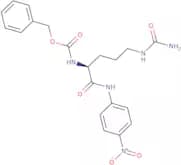
CAS :Nalpha-CBZ-L-Citrulline-p-nitroanilide is a synthetic chromogenic enzyme substrate used in protease enzymatic stutides. After hydrolysis, p-nitroaniline is released, which produces a yellow color detectable spectrophotometrically at 405 nm.
Formule :C20H23N5O6Degré de pureté :Min. 95%Masse moléculaire :429.43 g/molD-Luciferin Firefly, sodium salt monohydrate
CAS :Water soluble substrate for firefly luciferase.Formule :C11H9N2NaO4S2Degré de pureté :Min. 99.0 Area-%Masse moléculaire :320.32 g/mol2-Nitrophenyl-beta-D-galactopyranoside - non-animal origin
CAS :2-Nitrophenyl-beta-D-galactopyranoside is a non-animal origin chromogenic substrate for the detection of beta-galactosidase activity. It is used in food testing, diagnostics, and environmental testing. 2-Nitrophenyl-beta-D-galactopyranoside is also used as a ligand in enzyme assays and a fluorogenic substrate for chemiluminescent reactions. This product is conjugated to HRP.Formule :C12H15NO8Degré de pureté :Min. 98 Area-%Masse moléculaire :301.25 g/mol4-Methylumbelliferyl nonanoate
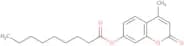
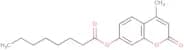
CAS :4-Methylumbelliferyl nonanoate is a fluorogenic substrate for lipase. After enzymatic cleaveage, free 4-methylumbelliferone (also known as hymecromone) is released, exhibiting blue fluorescence upon excitation with UV light. The strongest fluorescence of 4-methylumbelliferone requires deprotonation of the hydroxyl group (thus requires alkaline pH), with a maximal fluorescence intensity obtained with excitation at 350 to 370 nm and emission at 440 to 470 nm. The use of 4-methylumbelliferyl nonanoateas a substrate for measuring the lipase activity is used for the detection of lipase deficiency that could lead to pancreatic insufficiency.Formule :C19H24O4Degré de pureté :Min. 95%Couleur et forme :PowderMasse moléculaire :316.39 g/molL-Proline 7-amido-4-methylcoumarin hydrobromide salt
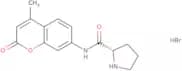
CAS :L-Proline 7-amido-4-methylcoumarin hydrobromide salt is a fluorogenic peptide substrate for proline-specific peptidase. This AMC peptide substrate is normally used to rapidly profile the N-terminal specificity of proteases.Formule :C15H17BrN2O3Degré de pureté :Min. 95%Couleur et forme :PowderMasse moléculaire :353.22 g/molAldol® 470 acetate, Biosynth Patent: EP 2427431 and US 8940909
CAS :Produit contrôléAldol® 470 acetate is a Fluorogenic substrate that is used in enzymatic reactions to produce a fluorescent product. Aldol® 470 acetate can be used as a ligand or a chromogenic substrate. This product is also used in diagnostic tests, such as conjugates and chemiluminescence, to detect the presence of certain enzymes or microorganisms. It can be used in culture media to measure the amount of certain enzymes, such as phosphatases or proteases, and has been shown to have high purity and quality. This product has CAS No. 1318785-37-3, 1318785-38-4, 1318785-39-5, 1318785-40-6 and 1318785-41-7.
Formule :C25H21NO5Degré de pureté :Min. 95%Couleur et forme :PowderMasse moléculaire :415.44 g/mol4-Methylumbelliferyl a-L-idopyranosiduronic acid sodium salt
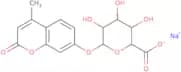
CAS :PAIRED PRODUCT AVAILABLE: alpha-L-iduronidase Enzyme, FI179383.
4MU-alpha-L-idopyranosiduronic acid is a fluorogenic substrate for alpha-L-iduronidase. Active alpha-L-iduronidase cleaves the MU moiety from the synthetic substrate, which results in release of a fluorescent signal (Ex 360 nm / Em 455 nm). The reaction is stopped by the addition of sodium carbonate. 4MU-alpha-L-idopyranosiduronic acid is used in alpha-L-iduronidase assays in the context of biochemical characterisation of samples from patients affected by lysosomal storage disease mucopolysaccharidosis I (MPS I).Formule :C16H15NaO9Degré de pureté :Min. 98 Area-%Couleur et forme :White PowderMasse moléculaire :374.27 g/mol4-Methylumbelliferyl-beta-D-glucopyranoside
CAS :Fluorogenic substrate for beta-glucosidase yielding a blue fluorescent solution. Used for the detection of beta-glucosidase as an indicator of Enterococci.Formule :C16H18O8Degré de pureté :Min. 99 Area-%Masse moléculaire :338.32 g/molL-Luciferin, potassium salt
CAS :L-Luciferin is an enzyme substrate that is used in the detection of bioluminescence. It is a fluorogenic substrate that can be used to detect the presence of glucose in urine. L-Luciferin is also a chemiluminescent substrate that can be used to detect ATP, which is required for cell metabolism. L-Luciferin has been shown to be stable at pH levels ranging from 2.5 to 9 and can be stored for up to 3 years when stored at 4°C with no light or oxygen exposure. This product has CAS No. 754978-59-1, indicating high purity and quality. L-Luciferin will not stain or react with other compounds, making it highly suitable for use as a conjugate in diagnostic tests or as a ligand in fluorescent staining reactions.Formule :C11H7KN2O3S2Degré de pureté :Min. 98.0 Area-%Masse moléculaire :318.42 g/mol(+)-Biotin 4-amidobenzoic acid sodium salt
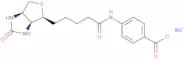
CAS :(+)-Biotin 4-amidobenzoic acid sodium salt, often referred as (+)-biotin PABA, is a fluorogenic substrate used to measure biotinidase activity, especially in newborn screening programs.
Formule :C17H20N3NaO4SDegré de pureté :Min. 95%Couleur et forme :White Slightly Yellow PowderMasse moléculaire :385.41 g/mol4-Methylumbelliferyl caprylate
CAS :Used for identification of Salmonella spp. by detection of caprylate esteraseFormule :C18H22O4Degré de pureté :Min. 95%Couleur et forme :White PowderMasse moléculaire :302.36 g/mol4-Methylumbelliferyl phosphate, free acid
CAS :A sensitive fluorogenic substrate for fluorometric and UV-spectrophotometric assays of phosphatases. It is used for the detection of C. perfringens because acid phosphatase is a highly specific indicator for C. perfringens.Formule :C10H9O6PMasse moléculaire :256.15 g/mol4-Methylumbelliferyl palmitate
CAS :4-Methylumbelliferyl palmitate, commonly names as 4-MUP, is a fluorescent probe that binds to lipases, enzymes responsible to assist on the hydrolysis of fats. In diagnosis, 4-MUP is used for screening of lysosomal storage diseases (LSD) caused by a deficiency of a single enzyme involved in the metabolism of glycoproteins, lipids or mucopolysaccharides.
Formule :C26H38O4Degré de pureté :Min. 95%Couleur et forme :White PowderMasse moléculaire :414.58 g/mol4-Nitrophenyl 4,6-benzylidene-α-D-maltoheptaoside
CAS :4-Nitrophenyl 4,6-benzylidene-alpha-D-maltoheptaoside is a chromogenic substrate for alpha-amylase. Upon hydrolysis, para-nitrophenol is released yielding a yellowish colour. 4-Nitrophenyl 4,6-benzylidene-alpha-D-maltoheptaoside is used in different applications such as the Starch digestion studies, industrial enzyme optimizationFormule :C55H79NO38Degré de pureté :Min. 95%Couleur et forme :PowderMasse moléculaire :1,362.2 g/mol4-Nitrophenyl phosphate disodium hexahydrate
CAS :4-Nitrophenyl phosphate disodium salt hexahydrate is a substrate of the hydrolase alkaline phosphatase. The products of the enzymatic reaction are 4-nitrophenol and phosphate.Formule :C6H16NNa2O12PCouleur et forme :PowderMasse moléculaire :371.15 g/mol4-Methylumbelliferyl-β-L-fucopyranoside
CAS :4-Methylumbelliferyl-beta-L-fucopyranoside is a fluorogenic substrate that is used in food testing. It also has uses as a chromogenic substrate and a ligand for biological studies. 4-Methylumbelliferyl-beta-L-fucopyranoside is a conjugate of 4-methylumbelliferone and beta-D-fucopyranosyl ester, which is an enzyme substrate for the detection of phosphatases. This product can be used to detect the activity of phosphatase enzymes in various media, including culture media, environmental testing, and staining. 4MUFBPY also has chemiluminescent properties that can be used for bioluminescence assays.Formule :C16H18O7Masse moléculaire :322.31 g/molRef: 3D-M-5541
-Unit-ggÀ demander1gÀ demander5gÀ demander250mgÀ demander500mgÀ demander2500mgÀ demanderLuc-coliforms
CAS :Luc-coliforms is a food testing kit that can be used to test for coliforms. It is composed of a series of enzyme substrates, culture media, and ligands specific to the bacteria being tested. The kit uses chromogenic or fluorogenic substrates that react with coliforms to produce a color change in the reaction mixture. Luc-coliforms is designed for use on solid foods such as meat, eggs, and vegetables.
Formule :C17H18N2O8S2Degré de pureté :Min. 95 Area-%Masse moléculaire :442.46 g/mol4-Nitrophenyl 2-acetamido-2-deoxy-a-D-glucopyranoside
CAS :4-Nitrophenyl 2-acetamido-2-deoxy-a-D-glucopyranoside is a chromogenic pNP substrate specifically designed for the analysis of N-acetylglucosaminidase activity. Upon enzyme action, the substrate releases 4-nitrophenol, a yellow compound that can be detected by spectrophotometric methods, providing a reliable and sensitive means of quantifying enzyme activity. This versatile substrate is widely used in biochemical studies, disease diagnostics, and the enzyme production industry.Formule :C14H18N2O8Couleur et forme :White Off-White PowderMasse moléculaire :342.3 g/mol5-Bromo-6-chloro-3-indolyl acetate
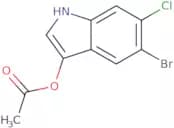
CAS :5-Bromo-6-chloro-3-indolyl acetate is a chromogenic substrate that yields a magenta-colored product after cleavage. The chromophore 5-bromo-6-chloro-indoxyl is released, generating the observable color. It is used in bacterial esterase detection (e.g. Staphylococcus spp.).
Formule :C10H7BrClNO2Degré de pureté :Min. 98 Area-%Couleur et forme :PowderMasse moléculaire :288.52 g/mol