Substrats d'enzymes
Sous-catégories appartenant à la catégorie "Substrats d'enzymes"
1527 produits trouvés pour "Substrats d'enzymes"
4-Methylumbelliferyl 3-O-(N-acetylneuraminyl)-b-D-glucopyranoside
4-Methylumbelliferyl 3-O-(N-acetylneuraminyl)-b-D-glucopyranoside is a chromogenic substrate. It is used for the detection of glycoproteins and glycolipids in food testing, staining, environmental testing, and diagnostics. It can also be used as a fluorogenic substrate for the detection of glycoproteins and glycolipids in fluorescence microscopy. 4-methylumbelliferyl 3-O-(N-acetylneuraminyl)-b-D-glucopyranoside has been shown to be a ligand for the lectin receptor Galectin 9, which is involved in inflammation and cancer cell growth. 4-methylumbelliferyl 3-O-(N-acetylneuraminyl)-b-D-glucopyranoside has been shown to be an enzyme substrate for alkaline phosphatase, βDegré de pureté :Min. 95%4-Nitrophenyl-β-D-maltopyranoside
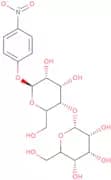
CAS :Chromogenic β-maltosidase substrate yielding a yellow solution upon cleavage.Formule :C18H25NO13Degré de pureté :Min. 99.0 Area-%Masse moléculaire :463.40 g/molRef: 3D-N-4492
1gÀ demander5gÀ demander10gÀ demander500mgÀ demander2500mgÀ demander-Unit-ggÀ demanderMethionine Assay Kit (Fluorometric)
The Methionine Assay Kit (Fluorometric) is a kit containing the fluorogenic substrate needed for the determination of total methionine content. The kit is used to detect and quantify methionine in various food products, as well as in environmental samples. This assay can be used to measure free or protein-bound methionine. The fluorometric kit contains a conjugate that binds to the methionine molecule and provides a fluorescent signal proportional to the amount of bound methionine. The fluorescence intensity is measured on a fluorometer and converted into concentrations of methionine per gram of sample.Degré de pureté :Min. 95%L-Ala-PAB-Resorufin
CAS :L-Ala-PAB-resorufin is a highly sensitive chromogenic and fluorogenic indicator for L-alanine aminopeptidase activity and related enzymes occurring in prokaryotic as well as eukaryotic organisms. After removal of the L-alanyl substructure by enzymatic hydrolysis and spontaneous elimination of the para-aminobenzyl spacer, the initially orange colored compound yields an intense pink color and red fluorescence.Formule :C22H19N3O4Degré de pureté :Min. 70 Area-%Couleur et forme :PowderMasse moléculaire :389.4 g/mol2,4-Dinitrophenyl β-D-glucopyranoside
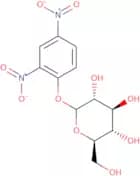
CAS :2,4-Dinitrophenyl-beta-D-glucopyranoside is a chromogenic substrate used to assay enzymes, such as glucosidases. These enzymes catalyze the hydrolysis of glycosidic bonds in sugars.Formule :C12H14N2O10Degré de pureté :Min. 95%Couleur et forme :PowderMasse moléculaire :346.25 g/molOstazin brilliant red H-3B galactomannan
Ostazin Brilliant Red H-3B Galactomannan is a chemiluminescent substrate used for the detection of β-1,4-galactomannans. It reacts with the glucose residues on the mannan backbone to produce a red fluorescent product. This product can be detected by spectrophotometry at an excitation wavelength of 395 nm and emission wavelength of 510 nm. The Ostazin Brilliant Red H-3B Galactomannan substrate is useful in detecting Staphylococcus aureus, Streptococcus pyogenes, Streptococcus pneumoniae, Group A streptococci, Group B streptococci, Group D streptococci, Group G streptococci, and Group C streptococci.
Degré de pureté :Min. 95%4-Methylumbelliferyl nonanoate
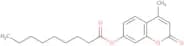
CAS :4-Methylumbelliferyl nonanoate is a fluorogenic substrate for lipase. After enzymatic cleaveage, free 4-methylumbelliferone (also known as hymecromone) is released, exhibiting blue fluorescence upon excitation with UV light. The strongest fluorescence of 4-methylumbelliferone requires deprotonation of the hydroxyl group (thus requires alkaline pH), with a maximal fluorescence intensity obtained with excitation at 350 to 370 nm and emission at 440 to 470 nm. The use of 4-methylumbelliferyl nonanoateas a substrate for measuring the lipase activity is used for the detection of lipase deficiency that could lead to pancreatic insufficiency.Formule :C19H24O4Degré de pureté :Min. 95%Couleur et forme :PowderMasse moléculaire :316.39 g/mol4-Methylumbelliferyl 2-acetamido-2-deoxy-β-D-glucopyranoside-6-sulfate potassium salt
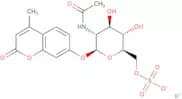
CAS :4-Methylumbelliferyl 2-acetamido-2-deoxy-beta-D-glucopyranoside-6-sulfate potassium salt is a fluorogenic substrate for beta-N-acetylglucosaminidase. After enzymatic cleaveage, free 4-methylumbelliferone (also known as hymecromone) is released, exhibiting blue fluorescence upon excitation with UV light. The strongest fluorescence of 4-methylumbelliferone requires deprotonation of the hydroxyl group (thus requires alkaline pH), with a maximal fluorescence intensity obtained with excitation at 350 to 370 nm and emission at 440 to 470 nm. The use of 4-methylumbelliferyl 2-acetamido-2-deoxy-beta-D-glucopyranoside-6-sulfate potassium saltas a substrate for measuring the beta-N-acetylglucosaminidase activity is used for diagnosis of Mucopolysaccharidosis IIIB (MPS IIIB) (a rare lysosomal storage disorder) and Sanfilippo B syndrome screening.
Formule :C18H20KNO11SDegré de pureté :Min. 95%Couleur et forme :White Off-White PowderMasse moléculaire :497.52 g/molBCM® Histamine-producing bacteria Broth
Growth medium for the detection of histamine-producing bacteria in food and water samples. The medium contains an indicator that turns orange/red (absorbance at 555 nm) due to metabolites released by histidine decarboxylase. The BCM® Histamine-producing bacteria Broth contains tryptone (FT09555) and yeast extract, together with the chromogenic agent. High-level histamine-producing bacteria yield orange to red coloration in less than 2 days and even after 24 hours, while cultures of other bacteria remain yellow.Degré de pureté :Min. 95%5-Bromo-6-chloro-3-indoxyl-beta-D-glucuronic acid, cyclohexylammonium salt
CAS :Chromogenic substrate for β-D-glucuronidase (GUS) yielding a magenta precipitate. It is used fordetection of GUS+ bacterial colonies as analternative to 5-bromo-4-chloro-3-indoxyl-β-D-glucuronide (X-GlcA).
Formule :C20H26BrClN2O7Degré de pureté :Min. 99 Area-%Masse moléculaire :521.80 g/mol4-Nitrophenyl a-D-thiomannopyranoside
CAS :4-Nitrophenyl a-D-thiomannopyranoside is a chemiluminescence substrate that can be used to measure the activity of β-galactosidase, an enzyme involved in the hydrolysis of lactose. This product is available as a white to yellowish powder and has been shown to have high purity and quality. It also displays strong fluorescence when reacted with hydrogen peroxide and has been used for diagnostics tests such as staining, food testing, and enzyme substrate reactions.Degré de pureté :Min. 95%Masse moléculaire :317.32 g/molAldol® 515 palmitate, Biosynth Patent: EP 2427431 and US 8940909
CAS :Aldol® 515 palmitate is a chromogenic substrate that is used in food testing, diagnostics, and other applications. It has a high purity and is conjugated to various ligands for specific applications. Aldol® 515 palmitate is an excellent chemiluminescent substrate for the detection of ATP and other nucleotides. It also has high bioluminescence activity for the detection of adenosine-5'-triphosphate (ATP) or luciferin as well as enzyme substrates to measure β-galactosidase or β-glucuronidase activity.Formule :C39H50N2O3Degré de pureté :Min. 95.0 Area-%Masse moléculaire :594.83 g/molLuciferin-alpha-D-galactoside, sodium salt
Luciferin-alpha-D-galactoside, sodium salt is a fluorogenic substrate for use in food testing and environmental testing. It can be used as a chromogenic substrate for the detection of conjugates of bile acids and cholesterol. This product is also used in diagnostic medical tests, such as ligand binding assays, chemiluminescence, and bioluminescence.Degré de pureté :Min. 95%5-Nitro-3-indoxyl-β-D-galactopyranoside
For the detection of beta-galactosidase activityFormule :C14H16N2O8Masse moléculaire :340.29 g/mol6-Nitro-3-indoxyl-β-D-galactopyranoside
For the detection of beta-galactosidase activityFormule :C14H16N2O8Masse moléculaire :340.29 g/molL-Lysine 7-amido-4-methylcoumarin, acetate salt
CAS :Produit contrôléL-Lysine 7-amido-4-methylcoumarin, acetate salt is a fluorogenic peptide substrate for aminopeptidase. This AMC peptide substrate is normally used to rapidly profile the N-terminal specificity of proteases.Formule :C18H25N3O5Masse moléculaire :363.42 g/mol6-Chloro-3-indolyl 2-acetamido-2-deoxy-b-D-galactopyranoside
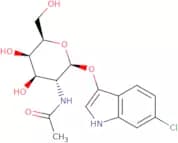
CAS :6-Chloro-3-indolyl 2-acetamido-2-deoxy-b-D-galactopyranoside is a chromogenic substrate for N-acetyl-beta-galactosaminidase. It produces a salmon-pink color after enzymatic cleavage.
Degré de pureté :Min. 95%Couleur et forme :White PowderMasse moléculaire :370.78 g/mol6'-(Diethylamino)spiro[isobenzofuran-1(3H),9'-[9H]xanthen]-3'-yl b-D-glucopyranoside
6'-(Diethylamino)spiro[isobenzofuran-1(3H),9'-[9H]xanthen]-3'-yl b-D-glucopyranoside is a fluorogenic substrate that is used in diagnostic applications. It has been shown to be a useful ligand for the determination of enzyme activity, and it can also be used to detect bacterial culture media contaminants. 6'-(Diethylamino)spiro[isobenzofuran-1(3H),9'-[9H]xanthen]-3'-yl b-D-glucopyranoside is used as an enzyme substrate in chemiluminescent assays, and with other reagents, it can be used for the detection of environmental contaminants. This product has a CAS number of 55426-02-8 and can be found on the website www.sigmaaldrich.com/catalog/productDegré de pureté :Min. 95%Masse moléculaire :494.49 g/molAldol® 584 β-D-glucuronic acid, triethylammonium salt, Biosynth Patent: EP 2427431 and US 8940909
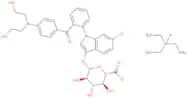
CAS :Aldol 584 is a chromogenic substrate that is used in enzymatic assays to detect the presence of an enzyme. It is a triethylammonium salt with beta-D-glucuronic acid. Aldol 584 is used in diagnostic procedures and can be used as a substrate for fluorogenic substrates and chemiluminescent substrates. This product has been shown to be effective in detecting the presence of bile in feces, erythrocyte hemolysis, and the presence of proteinases in human urine. It can also be used as a food testing agent or to measure bacterial activity in culture media.Formule :C37H46ClN3O10Degré de pureté :Min. 95%Couleur et forme :PowderMasse moléculaire :728.2 g/molBCM® O157:H7(+)
BIOSYNTH Culture Medium for the isolation andidentification of Escherichia coli O157:H7




![6'-(Diethylamino)spiro[isobenzofuran-1(3H),9'-[9H]xanthen]-3'-yl b-D-glucopyranoside](/_next/image/?url=https%3A%2Fstatic.cymitquimica.com%2Fproducts%2F3D%2Fthumb-webp%2FED139090.webp&w=3840&q=75)