Substrats d'enzymes
Sous-catégories appartenant à la catégorie "Substrats d'enzymes"
1527 produits trouvés pour "Substrats d'enzymes"
4-Nitrophenyl 2-acetamido-6-O-(2-acetamido-2-deoxy-b-D-glucopyranosyl)-3-O-(b-D-galactopyranosyl)-2-deoxy-a-D-galactopyranoside
CAS :4-Nitrophenyl 2-acetamido-6-O-(2-acetamido-2-deoxy-b-D-glucopyranosyl)-3-O-(b-D-galactopyranosyl)-2-deoxy-a-D-galactopyranoside is a specific chromogenic substrate designed for the highly sensitive and accurate detection of glycosidase enzyme activity. Glycosidases are responsible for the cleavage of glycosidic bonds between saccharide units in various carbohydrates. The hydrolysis of this substrate by glycosidase enzymes produces 4-nitrophenol, a yellow-colored compound that can be easily monitored through spectrophotometric measurements due to its strong absorbance at 405 nm. This chromogenic substrate is widely used in the analysis of glycosidase activity in various biological samples, including bacterial, fungal, and plant tissues, as well as in environmental samples and biotechnological applications.Formule :C28H41N3O18Degré de pureté :Min. 95 Area-%Couleur et forme :White PowderMasse moléculaire :707.63 g/mol4-Methylumbelliferyl caprylate
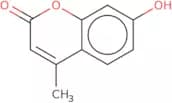
CAS :Fluorogenic substrate for esterase with C8 activity yielding a blue fluorescent solution upon cleavage. Used for the identification of Salmonella spp. based on the detection of caprylate esterase.Formule :C18H22O4Degré de pureté :Min. 98 Area-%Masse moléculaire :302.37 g/mol4-Methylumbelliferyl acetate
CAS :Fluorogenic substrate for carboxylesteraseFormule :C12H10O4Degré de pureté :Min. 95%Couleur et forme :White PowderMasse moléculaire :218.21 g/molL-Histidine 7-amido-4-methylcoumarin hydrochloride
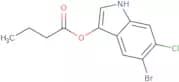
CAS :L-Histidine 7-amido-4-methylcoumarin hydrochloride is a fluorogenic substrate, which is a synthetic chemical that is used as a substitute for natural substrates. It reacts with enzymes in the presence of hydrogen peroxide to produce light. This product has been used as an enzyme substrate, a diagnostic tool and has been used to detect bacterial growth in culture media. L-Histidine 7-amido-4-methylcoumarin hydrochloride is also used for food testing and environmental testing, where it can be used as a chromogenic substrate or conjugate respectively. This product has CAS number 5981-00-6 and molecular weight of 254.27 g/mol.Formule :C16H17ClN4O3Masse moléculaire :348.79 g/mol5-Bromo-6-chloro-3-indoxyl butyrate
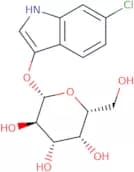
CAS :5-Bromo-6-chloro-3-indoxyl butyrate is a chromogenic substrate that yields a magenta-colored product after cleavage. The chromophore 5-bromo-6-chloro-indoxyl is released, generating the observable color. It is used in lipid digestion assays.Formule :C12H11BrClNO2Degré de pureté :Min. 95%Couleur et forme :PowderMasse moléculaire :316.58 g/mol6-Chloro-3-indoxyl-beta-D-galactopyranoside, plant origin
CAS :6-Chloro-3-indoxyl-beta-D-galactopyranoside is a chromogenic substrate for beta-galactosidase that yields a salmon or rose-coloured precipitate and hence is also known as Salmon-Gal. It can be used in conjunction with isopropyl-beta-D-thiogalactopyranoside (IPTG) as an alternative to the chromogenic substrate 5-bromo-4-chloro-3-indolyl beta-D-galactopyranoside (X-Gal) for detection of beta-galactosidase activity in bacterial colonies in colorimetric assays. Where beta-galactosidase expressed from a reporter gene in molecular biology experiments, recombinant colonies on growth plates are salmon-coloured while non-recombinants appear as white. Use of nitroblue tetrazolium salt (NBT) with Salmon-Gal may provide faster results, yielding a clear, purple precipitate, than for Salmon-Gal alone. In conjunction with 5-bromo-4-chloro-3-indolyl-beta-D-glucoside (X-Glc), Salmon-Gal is useful for simultaneous detection of GUS and Lac activities in the same medium.Formule :C14H16ClNO6Degré de pureté :Min. 98.0 Area-%Masse moléculaire :329.74 g/mol3-Indoxyl-beta-D-glucopyranoside anhydrous
CAS :The maunfacturing of blue jeans started 150 years ago as workwear, and are found nowadays in almost every wardrobe. Their renowned indigo color tone is truly unique; nevertheless, the high demand for the dye poses serious sustainability and environmental problems connected with its manufacturing process. Recently, a group of scientists presented an alternative indigo dyeing method inspired by the indoxyl glucoconjugate present in the plant P.tinctorium. The researchers proposed as an alternative approach a biocatalytic process using recombinant E.coli to access water soluble β-gluco-indoxyl (indican). At the point of coloring, indican gets hydrolyzed by β-glucosidase enzymes forming indoxyl, which suddenly undergoes oxidation to leucoindigo and further crystallizes to indigo giving the typical blue denim its signature character.Formule :C14H17NO6Degré de pureté :Min. 99.0 Area-%Masse moléculaire :295.29 g/molTyramine
CAS :Tyramine targets peroxidase to form a brown colorFormule :C8H11NOCouleur et forme :Off-White Slightly Brown PowderMasse moléculaire :137.18 g/mol4-(Bromomethyl)phenyl-β-D-triacetylglucuronic acid methyl ester
4-(Bromomethyl)phenyl-beta-D-triacetylglucuronic acid methyl ester, also known as 4-bromo-4'-(N,N-dimethylamino)biphenyl, is a bioluminescent substrate. It is used for the detection of beta-glucuronidase activity in biological samples and for the detection of bacterial β-glucuronidase activity in culture media. Beta-glucuronidase catalyzes the hydrolysis of glucuronic acid by breaking down a conjugate molecule into two smaller molecules, which can be detected using bioluminescence. 4-(Bromomethyl)phenyl-beta-D-triacetylglucuronic acid methyl ester is a chromogenic substrate that has been shown to be an excellent ligand in biomolecular research because it reacts with many different enzymes. This product is highly pure and
Formule :C20H23BrO10Degré de pureté :Min. 95 Area-%Masse moléculaire :503.29 g/mol2-Nitrophenyl b-D-fucopyranoside
CAS :2-Nitrophenyl b-D-fucopyranoside is a chromogenic substrate used in various enzymatic assays to detect the presence of fucosidase enzymes. It consists of a nitrophenyl group attached to a fucose sugar molecule. When acted upon by enzymes such as fucosidases, it releases the colored nitrophenyl group, which can be detected using spectrophotometry.Formule :C12H15NO7Degré de pureté :Min. 95%Couleur et forme :White Off-White PowderMasse moléculaire :285.25 g/mol6-Nitro-3-indoxyl-β-D-galactopyranoside
For the detection of beta-galactosidase activityFormule :C14H16N2O8Masse moléculaire :340.29 g/mol4-Nitrophenyl b-D-cellotetraoside
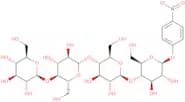
CAS :4-Nitrophenyl b-D-cellotetraoside is a chromogenic substrate utilized for the detection and quantification of cellulase enzyme activity. Cellulase enzymes hydrolyze the beta-1,4-glycosidic bonds of cellulose, a major component of plant cell walls. Upon cleavage by cellulase, it releases 4-nitrophenol, a compound that exhibits a yellow color and absorbs strongly at 405 nm, allowing for easy spectrophotometric measurements of cellulase activity levels in various sample types, including bacterial and fungal cultures, environmental samples, and industrial applications.Formule :C30H45NO23Degré de pureté :Min. 95%Couleur et forme :PowderMasse moléculaire :787.67 g/mol2-Nitrophenyl-beta-D-cellobioside
CAS :Chromogenic substrate for β-D-Cellobiosidase yielding a yellow solution upon cleavage.
Formule :C18H25NO13Degré de pureté :Min. 98.0 Area-%Masse moléculaire :463.4 g/mol5-Bromo-4-chloro-3-indoxyl oleate
CAS :5-Bromo-4-chloro-3-indoxyl oleate is a chromogenic substrate used to detect the specific enzymatic activity of lipase. After cleavage, 5-bromo-4-chloro-indoxyl is released, resulting in a blue to blue-green color change in bacterial colonies or media. 5-Bromo-4-chloro-3-indoxyl oleate is used in lipid metabolism disorder screening.Formule :C26H37BrClNO2Degré de pureté :Min. 95%Couleur et forme :PowderMasse moléculaire :510.93 g/mol6-Chloro-3-indolyl 2-acetamido-2-deoxy-b-D-galactopyranoside
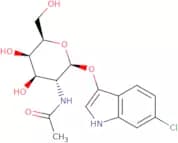
CAS :6-Chloro-3-indolyl 2-acetamido-2-deoxy-b-D-galactopyranoside is a chromogenic substrate for N-acetyl-beta-galactosaminidase. It produces a salmon-pink color after enzymatic cleavage.
Degré de pureté :Min. 95%Couleur et forme :White PowderMasse moléculaire :370.78 g/mol6'-(Diethylamino)spiro[isobenzofuran-1(3H),9'-[9H]xanthen]-3'-yl b-D-glucopyranoside
6'-(Diethylamino)spiro[isobenzofuran-1(3H),9'-[9H]xanthen]-3'-yl b-D-glucopyranoside is a fluorogenic substrate that is used in diagnostic applications. It has been shown to be a useful ligand for the determination of enzyme activity, and it can also be used to detect bacterial culture media contaminants. 6'-(Diethylamino)spiro[isobenzofuran-1(3H),9'-[9H]xanthen]-3'-yl b-D-glucopyranoside is used as an enzyme substrate in chemiluminescent assays, and with other reagents, it can be used for the detection of environmental contaminants. This product has a CAS number of 55426-02-8 and can be found on the website www.sigmaaldrich.com/catalog/productDegré de pureté :Min. 95%Masse moléculaire :494.49 g/mol2-Nitrophenyl b-D-arabinopyranoside
2-Nitrophenyl b-D-arabinopyranoside is a chemical compound that is used in the detection of ATP by chemiluminescence. It acts as a substrate for enzymes such as luciferase and catalase, which catalyze the oxidation of 2-nitrophenyl b-D-arabinopyranoside to phenol and carbon dioxide with the release of light. This reaction can be used in diagnostic applications such as detecting bacteria in culture media or diagnosing food spoilage. 2-Nitrophenyl b-D-arabinopyranoside can also be used as a conjugate to detect proteins or nucleic acids by fluorescence spectroscopy. The CAS number for this compound is 107772-06-1.
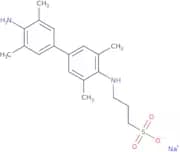
Degré de pureté :Min. 95%Masse moléculaire :271.22 g/molN-(3-Sulfopropyl)-3,3',5,5'-tetramethylbenzidine sodium
CAS :N-(3-Sulfopropyl)-3,3',5,5'-tetramethylbenzidine (TMB) sodium salt is a highly sensitive chromogenic substrate used for the detection and quantification of peroxidase enzyme activity. This water-soluble substrate undergoes a color change from colorless to blue upon oxidation by peroxidase enzymes in the presence of hydrogen peroxide. The reaction can be stopped by adding an acid, resulting in a yellow color that can be measured spectrophotometrically. TMB sodium salt is widely used in various applications, including enzyme-linked immunosorbent assays (ELISA), immunohistochemistry, and other diagnostic tests, due to its high sensitivity, low background signal, and excellent stability.
Degré de pureté :Min. 95%Couleur et forme :PowderMasse moléculaire :384.47 g/molMethionine Assay Kit (Fluorometric)
The Methionine Assay Kit (Fluorometric) is a kit containing the fluorogenic substrate needed for the determination of total methionine content. The kit is used to detect and quantify methionine in various food products, as well as in environmental samples. This assay can be used to measure free or protein-bound methionine. The fluorometric kit contains a conjugate that binds to the methionine molecule and provides a fluorescent signal proportional to the amount of bound methionine. The fluorescence intensity is measured on a fluorometer and converted into concentrations of methionine per gram of sample.Degré de pureté :Min. 95%L-Pyroglutamic acid 7-amido-4-methylcoumarin
CAS :Fluorogenic substrate for proglutamyl peptidase 1 yielding a blue fluorescent solution upon cleavage. Used in identification of Enterococcus spp. and group A streptococci (Streptococcus pyogenes).Formule :C15H14N2O4Degré de pureté :Min. 98 Area-%Masse moléculaire :286.29 g/mol







![6'-(Diethylamino)spiro[isobenzofuran-1(3H),9'-[9H]xanthen]-3'-yl b-D-glucopyranoside](/_next/image/?url=https%3A%2Fstatic.cymitquimica.com%2Fproducts%2F3D%2Fthumb-webp%2FED139090.webp&w=3840&q=75)