Substrats d'enzymes
Sous-catégories appartenant à la catégorie "Substrats d'enzymes"
1528 produits trouvés pour "Substrats d'enzymes"
4-Nitrophenyl b-D-cellobioside heptaacetate
4-Nitrophenyl b-D-cellobioside heptaacetate is a chromogenic substrate for enzymes that catalyze the hydrolysis of glycosidic bonds. This product is used as a diagnostic tool for identifying and characterizing glycosidases and other enzymes that degrade glycosidic bonds. 4-Nitrophenyl b-D-cellobioside heptaacetate is also used in culture media to measure the activity of cellulase enzymes by measuring the release of reducing sugars. The color change of this substrate can be detected at 405 nm, 490 nm, or 550 nm.Degré de pureté :Min. 95%Masse moléculaire :757.65 g/mol4-Methylumbelliferyl 3,4,6-tri-O-acetyl-2-O-(2,3,4-tri-O-benzoyl-a-L-fucopyranosyl)-b-D-galactopyranoside
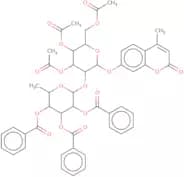
4-Methylumbelliferyl 3,4,6-tri-O-acetyl-2-O-(2,3,4-tri-O-benzoyl-a-L-fucopyranosyl)-b-D-galactopyranoside is a fluorogenic substrate that is used for the detection of β D -galactosidase. β D -Galactosidase is an enzyme that breaks down lactose in milk and is used as a diagnostic tool for identifying lactose intolerance. This substrate can be used as a conjugate in immunoassays to detect antibodies against the enzyme or it can be used to measure the activity of the enzyme in food samples. It also can be used to measure α1,3 galactosyltransferase activity in colorectal cancer cells or bacteria.Degré de pureté :Min. 95%Masse moléculaire :922.9 g/mol5-Bromo-6-chloro-3-indolyl b-D-cellobiopyranoside
5-Bromo-6-chloro-3-indolyl b-D-cellobiopyranoside is a fluorogenic substrate for the enzyme β-glucuronidase. It is used in diagnostic applications such as food testing, bacterial culture media and environmental testing. The product has CAS number: 123591-77-0.
Degré de pureté :Min. 95%2'-(4-Methylumbelliferyl)-a-D-N-glycolylneuraminic acid
CAS :2'-(4-Methylumbelliferyl)-a-D-N-glycolylneuraminic acid is a fluorogenic substrate that is used for enzymatic labeling of glycolipids. It can be used as a diagnostic or food testing agent, and also has applications in environmental testing. The CAS number for this product is 1434265-32-3.Degré de pureté :Min. 95%Masse moléculaire :483.42 g/mol1-Naphthyl 2-acetamido-3,4,6-tri-O-acetyl-2-deoxy-b-D-glucopyranoside
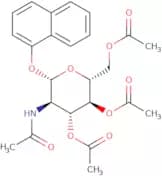
CAS :1-Naphthyl 2-acetamido-3,4,6-tri-O-acetyl-2-deoxy-b-D-glucopyranoside is a fluorogenic substrate for bacterial beta D glucosidase. It is used for measuring the enzyme activity in different types of culture media and in the detection of bacterial contamination in food and environmental samples. This product can be used to detect the presence of beta D glucosidase by measuring luminescence with a luminometer. 1NAAG can also be used as a chromogenic substrate or to conjugate with antibodies for use in immunoassays.br>Degré de pureté :Min. 95%Masse moléculaire :473.47 g/mol4-Methylumbelliferyl N,N',N'',N'''-tetraacetyl-b-D-chitotetraoside
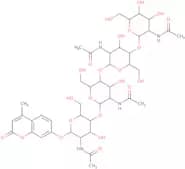
CAS :4-Methylumbelliferyl N,N',N'',N'''-tetraacetyl-beta-D-chitotetraoside is a fluorogenic substrate for chitinase. After enzymatic cleaveage, free 4-methylumbelliferone (also known as hymecromone) is released, exhibiting blue fluorescence upon excitation with UV light. The strongest fluorescence of 4-methylumbelliferone requires deprotonation of the hydroxyl group (thus requires alkaline pH), with a maximal fluorescence intensity obtained with excitation at 350 to 370 nm and emission at 440 to 470 nm. The use of 4-methylumbelliferyl N,N',N'',N'''-tetraacetyl-beta-D-chitotetraosideas a substrate for measuring the chitinase activity is used for fungal infection detection and Gaucher disease screening.Formule :C42H60N4O23Degré de pureté :Min. 95%Couleur et forme :PowderMasse moléculaire :988.94 g/mol6,8-Difluoro-4-methylumbelliferyl 2-acetamido-3-O-(b-D-galactopyranosyl)-a-D-galactopyranoside
6,8-Difluoro-4-methylumbelliferyl 2-acetamido-3-O-(b-D-galactopyranosyl)-a-D-galactopyranoside is a chemiluminescent substrate that reacts with oxygen in the presence of luciferase to produce light. This product is an excellent replacement for luminol, especially in applications where aqueous solvents are not suitable. 6,8-Difluoro-4-methylumbelliferyl 2-acetamido-3-O-(b-D-galactopyranosyl)-a-D-galactopyranoside has been extensively tested and shown to be nonhazardous in a variety of different culture media. It is also nonhazardous to the environment, as it can be easily degraded by microorganisms.
Degré de pureté :Min. 95%7-((4'-L-Alaninamido)-rac-(3'-octanoyloxy)butyloxy) coumarin trifluoroacetate salt
CAS :This Clips-O substrate 7-(4'-L-Alaninamido)-rac-(3'-octanoyloxy)butyloxy) coumarin allows the detection of three enzymatic activities (L-alanine aminopeptidase, C8-esterase and oxidation of 4-amino-3-hydroxybutyloxy either enzymatically or by exposure to sodium periodate) with one single substrate and give a positive fluorescent signal only in presence of all activities. The main virtues of Clips-O substrates are an increased stability towards non-enzymatic hydrolysis that results in a reduced background and high sensitivity.
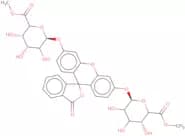
Formule :C26H35F3N2O8Degré de pureté :Min. 95.0 Area-%Masse moléculaire :560.56 g/molFluorescein di-b-D-glucuronide dimethyl ester
Fluorogenic substrate for beta-glucuronidaseDegré de pureté :Min. 95%Couleur et forme :PowderMasse moléculaire :712.61 g/mol4-Methylumbelliferyl 2,3,6-tri-O-benzoyl-b-D-galactopyranoside
CAS :4-Methylumbelliferyl 2,3,6-tri-O-benzoyl-b-D-galactopyranoside is a fluorogenic substrate that can be used in food testing. This compound is also a chromogenic substrate that can be used for environmental testing. This product is a ligand and chemiluminescent reagent that can be used in diagnostics. It is also an enzyme substrate that has high purity and high quality.Degré de pureté :Min. 95%Masse moléculaire :650.63 g/molp-Nitrophenylphosphorylcholine
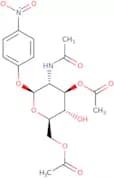
CAS :p-Nitrophenylphosphorylcholine is a substrate molecule for enzymes that catalyze phospholipid biosynthesis. It is the most common substrate used to study the enzyme activity of phosphatidylcholine synthase and phospholipase A2 in human serum. The reaction mechanism is not well understood, but it appears to involve autocatalysis and an initial nucleophilic attack by p-nitrophenolate on the carbonyl carbon atom of the choline moiety. p-Nitrophenylphosphorylcholine has been shown to exhibit receptor activity on cells, which may be due to its ability to bind with basic proteins. This compound can also inhibit meiosis in Drosophila melanogaster and increase levels of natriuretic peptides in rats, as well as cause cell lysis and polymerase chain reactions in mammalian cells.Formule :C11H17N2O6PMasse moléculaire :304.24 g/mol4-Nitrophenyl 2-acetamido-3,6-di-O-acetyl-2-deoxy-b-D-glucopyranoside
CAS :4-Nitrophenyl 2-acetamido-3,6-di-O-acetyl-2-deoxy-b-D-glucopyranoside is a versatile chromogenic pNP enzyme substrate designed to offer superior results for detecting enzyme activity in research and diagnostic applications. This substrate enables faster, more accurate, and reliable detection of hydrolase enzymes, making it ideal for various research and testing needs, such as studying enzyme kinetics, screening inhibitors, and profiling enzyme specificity.Degré de pureté :Min. 95%Masse moléculaire :426.37 g/molAquaSpark® alpha-D-galactoside, 10 mM in DMSO, Ramot at Tel-Aviv University Ltd. Patent family WO 2017/130191
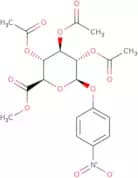
CAS :Substrate for alpha-galactosidaseFormule :C34H39ClO12Degré de pureté :Min. 95%Couleur et forme :Clear LiquidMasse moléculaire :675.12 g/mol4-Nitrophenyl 2,3,4-tri-O-acetyl-b-D-glucuronide methyl ester
CAS :4-Nitrophenyl 2,3,4-tri-O-acetyl-b-D-glucuronide methyl ester is a fluorescent substrate for the beta-glucuronidase enzyme. It can be used to detect the presence of this enzyme in bacteria and other microorganisms by means of fluorometric or colorimetric assays. It has been shown to have an excellent stability in a variety of culture media and food testing applications. This product is available in high purity and quality, with a CAS number of 18472-49-6.Degré de pureté :Min. 95%Masse moléculaire :455.37 g/molAldol® 457 β-D-galactopyranoside, Biosynth Patent: EP 2427431 and US 8940909
CAS :Aldol 457 Beta-D-galactopyranoside is a chromogenic substrate for beta-galactosidase, which is an enzyme that catalyzes the hydrolysis of the terminal galactose residue in D-galactose to form D-galactitol and D-glucose. Aldol 457 Beta-D-galactopyranoside is used as a reagent for the detection of beta-galactosidase activity in biological samples, such as cultured cells or tissues, and has been shown to be a ligand in binding studies with Galectin 1. This product is also used in diagnostic applications such as food testing, culture media, fluorogenic substrates, environmental testing and more.Formule :C24H28N2O8Degré de pureté :Min. 95.0 Area-%Masse moléculaire :472.49 g/mol4-Nitrophenyl 3-O-(2,3,4,6-tetra-O-acetyl-a-D-mannopyranosyl)-2-O-benzoyl-a-D-mannopyranoside
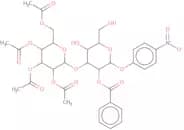
CAS :4-Nitrophenyl 2,3,4,6-tetra-O-acetyl-b-D-glucopyranoside enzyme substrate is a versatile and reliable reagent for measuring glucosidase activity. It is an ideal substrate for use in assays to detect β-glucosidase activity in a variety of applications, including for in vitro and in vivo studies, and it has been widely used in the pharmaceutical and biotechnology industries. This chromogenic pNP enzyme substrate is designed for effective and precise analysis with good sensitivity and low background signals.Degré de pureté :Min. 95%Masse moléculaire :735.64 g/mol3-HTC
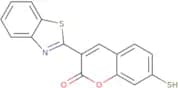
CAS :3-HTC reacts reversibly with thiols and disulfides, and can be used to measure dynamic GSH/GSSH ratios in vitro as well as to monitor the reversible redox status of whole cell lysates.(λmax: 448 nm in its reduced thiolate form, and a λmax 370-410 nm for the oxidized mixed disulfide).Formule :C16H9NO2S2Degré de pureté :Min. 95%Masse moléculaire :311.38 g/mol4-Nitrophenyl 2-O-(2,3,4,6-tetra-O-acetyl-b-D-glucopyranosyl)-b-D-glucopyranoside
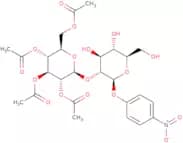
CAS :4-Nitrophenyl 2-O-(2,3,4,6-tetra-O-acetyl-b-D-glucopyranosyl)-b-D-glucopyranoside is a state-of-the-art chromogenic substrate designed for rapid and sensitive enzyme activity detection. As a versatile pNP substrate, it produces a noticeable color change upon enzyme-catalyzed hydrolysis, facilitating easy monitoring and quantification of enzyme levels in research and diagnostic applications. The substrate's acetylated glucose moiety ensures specificity and stability, allowing for precise and reliable results across a range of experimental conditions.Degré de pureté :Min. 95%Masse moléculaire :631.54 g/mol4-Nitrophenyl 2-acetamido-2-deoxy-6-O-trityl-b-D-glucopyranoside
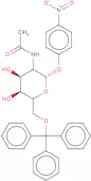
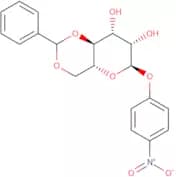
4-Nitrophenyl 2-acetamido-2-deoxy-6-O-trityl-b-D-glucopyranoside offers unmatched versatility as a chromogenic pNP substrate for detecting b-D-glucopyranosidase activity. The substrate is specifically designed to produce a yellow 4-nitrophenol product upon enzyme hydrolysis, which can be measured using absorbance spectroscopy. The unique tritylated glucopyranoside group ensures improved compound stability and selectivity while providing ease of handling. This versatile substrate is ideal for a broad range of biochemical, research, and diagnostic applications.Degré de pureté :Min. 95%Masse moléculaire :584.62 g/mol4-Nitrophenyl 4,6-O-benzylidene-a-D-mannopyranoside
CAS :4-Nitrophenyl 4,6-O-benzylidene-a-D-mannopyranoside is a chromogenic substrate for alpha-mannosidase and beta-glucosidase. It is used as a diagnostic tool for identifying the presence of these enzymes in certain bacteria. This product is also used in food testing, environmental testing, and bioluminescence.Degré de pureté :Min. 95%Masse moléculaire :389.36 g/mol