Substrats d'enzymes
Sous-catégories appartenant à la catégorie "Substrats d'enzymes"
1528 produits trouvés pour "Substrats d'enzymes"
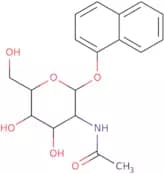
1-Naphthyl 2-acetamido-2-deoxy-b-D-galactopyranoside
CAS :1-Naphthyl 2-acetamido-2-deoxy-b-D-galactopyranoside (1NADG) is a fluorogenic substrate that reacts with an enzyme to produce light. It is used in diagnostic tests for the detection of bacteria, and can be used as a chromogenic substrate in biochemical assays. 1NADG has also been shown to be useful in staining bacterial cells grown on agar plates. Additionally, this compound is used as a bioluminescent probe for detecting bacteria with luciferase activity. br>br>Degré de pureté :Min. 95%Masse moléculaire :347.4 g/mol2-Nitrophenyl 2,2',3,3',4'-penta-O-acetyl-b-D-xylobioside
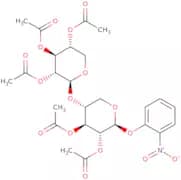
CAS :2-Nitrophenyl 2,2',3,3',4'-penta-O-acetyl-b-D-xylobioside is an oligosaccharide that is used as a substrate for the transport of nucleic acid molecules. It can be used to study the function of membrane transport proteins and their homologues. This compound has been shown to inhibit the growth of corynebacterium glutamicum and trisaccharide emissions.Degré de pureté :Min. 95%Masse moléculaire :613.52 g/mol4-Nitrophenyl 2,3,4,6-tetra-O-acetyl-b-D-thiogalactopyranoside
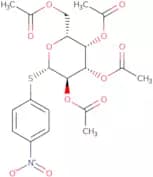
CAS :4-Nitrophenyl 2,3,4,6-tetra-O-acetyl-b-D-thiogalactopyranoside (NPG) is a fluorogenic substrate that can be used in the detection of beta-galactosidase activity. It reacts with 4-nitrophenol to form an orange product at pH 6.0. The fluorescence intensity increases with increasing concentrations of the substrate and enzyme. The reaction is inhibited by borax, which competes for the enzyme active site. This product has been used as a chromogenic substrate for beta-galactosidase and as an enzyme substrate for beta-galactosidase in diagnostic tests for galactosemia and other carbohydrate metabolism disorders. NPG has also been used in chemiluminescent assays to detect beta-galactosidase activity in culture media and as a bioluminescence substrate in the detection of bacterialDegré de pureté :Min. 95%Masse moléculaire :485.47 g/mol2-Nitrophenyl caprylate
CAS :2-Nitrophenyl caprylate is a potent inhibitor of gram-negative bacteria. It has been shown to inhibit the enzymatic activity of certain bacterial enzymes, such as the modification of cellular fatty acids. 2-Nitrophenyl caprylate has also been shown to inhibit in vitro growth of various gram-negative bacteria, including E. coli and Salmonella enterica serovar Typhimurium, through detergent compositions and enzymatic reactions (e.g., aminopeptidases). 2-Nitrophenyl caprylate may be useful for the treatment of pancreatitis due to its inhibition of pancreatic secretions and inhibition of pancreatic lipase activity. Transposable sequences have been found in the 2-nitrophenyl caprylate gene cluster, which may be related to its regulatory properties.Degré de pureté :Min. 95%Couleur et forme :PowderMasse moléculaire :265.31 g/mol6-Chloro-4-trifluoromethylumbelliferyl b-D-galactopyranoside
6-Chloro-4-trifluoromethylumbelliferyl b-D-galactopyranoside is a chromogenic substrate that can be used in enzyme assays to measure the activity of beta-glucuronidase. This compound is sold as a conjugate with an enzyme, which will not interfere with the assay. The compound has been tested to have high purity and quality.Degré de pureté :Min. 95%4-Nitrophenyl 2-O-(2,3,4-tri-O-acetyl-b-L-fucopyranosyl)-6-O-benzoyl-a-D-galactopyranoside
CAS :4-Nitrophenyl 2-O-(2,3,4-tri-O-acetyl-b-L-fucopyranosyl)-6-O-benzoyl-a-D-galactopyranoside is a chemiluminescent substrate with a CAS number of 104341548. It is used as a fluorescent probe for the detection of alpha amylase, beta amylase and glucose oxidase. It can be used to detect bacteria in food. This substrate can be used in the diagnostic industry and is an important component for the production of various enzymes.Degré de pureté :Min. 95%Masse moléculaire :677.61 g/mol6-Bromo-2-naphthalenyl-b-D-mannopyranoside
CAS :6-Bromo-2-naphthalenyl-b-D-mannopyranoside is a boronic acid that is used as a universal substrate for the detection of peroxidase activity. This product has been shown to be stable in most culture media and can be used to detect peroxidase activity in food, environmental, and other biological samples. 6-Bromo-2-naphthalenyl-b-D-mannopyranoside also has high purity and is conjugated with various fluorophores for use in chemiluminescence and bioluminescence assays.Formule :C16H17BrO6Degré de pureté :Min. 95%Masse moléculaire :385.21 g/mol2,4-Dinitrophenyl b-L-arabinofuranoside
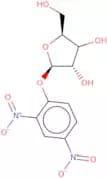
2,4-Dinitrophenyl b-L-arabinofuranoside is a high quality chromogenic substrate for dinitrophenylase. It is a ligand that reacts with an enzyme to form a product that can be detected by various methods, including colorimetry and fluorimetry. 2,4-Dinitrophenyl b-L-arabinofuranoside has shown to be useful for the detection of organic contaminants in water and air. 2,4-Dinitrophenyl b-L-arabinofuranoside is also used as a reagent for the preparation of conjugates for immunoassays.Degré de pureté :Min. 95%Masse moléculaire :628.54 g/mol4-Chloromethyl-6,8-difluoroumbelliferyl b-D-galactopyranoside
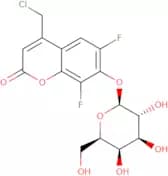
CAS :4-Chloromethyl-6,8-difluoroumbelliferyl b-D-galactopyranoside is a compound commonly used in biochemical research as a fluorescent substrate for the detection of sugar hydrolase enzymes. This compound can be cleaved by enzymes such as β-galactosidase, releasing a fluorescent molecule that can be easily detected using fluorescence spectroscopy. The compound is a member of the family of umbelliferyl glycosides, which have been widely used in the study of various biochemical pathways for many years. The advantage of using this particular substrate is that the fluorescent product has a high quantum yield, which means it produces a strong signal for detection. This substrate has been used in a wide variety of applications, including the study of microbial physiology and in the development of diagnostic assays for detecting bacterial and fungal infections.
Degré de pureté :Min. 95%Masse moléculaire :408.74 g/mol4-Nitrophenyl 2-O-(a-L-fucopyranosyl)-a-D-galactopyranoside
CAS :4-Nitrophenyl 2-O-(a-L-fucopyranosyl)-a-D-galactopyranoside is a chromogenic pNP enzyme substrate consisting of a fucose and galactose moieties. Upon enzymatic hydrolysis by specific fucosidases or galactosidases, it releases the highly chromogenic molecule 4-nitrophenol, which exhibits a distinct yellow color that can be monitored spectrophotometrically. This substrate is frequently used to study enzyme specificity, kinetics, and inhibition, and it plays a critical role in the investigation of carbohydrate active enzymes (CAZymes), the screening of enzyme inhibitors, and the development of novel analytical methods for the detection and quantitation of enzyme activities.Degré de pureté :Min. 95%Masse moléculaire :447.39 g/mol5-Bromo-3-indolyl decanoate
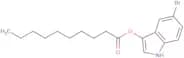
CAS :5-Bromo-3-indolyl decanoate (BID) is a chromogenic enzyme substrate often used for the detection of lipase activity. It is hydrolyzed by lipase to produce a blue-violet product, which can be detected visually or by spectrophotometry. BID is particularly useful for the detection of microbial lipases in food and environmental samples. It is commonly used in a wide range of biochemical, biological, and environmental testing applications that require precise lipase enzyme analysis.Formule :C18H24BrNO2Degré de pureté :Min. 95%Couleur et forme :PowderMasse moléculaire :366.29 g/mol4-Nitrophenyl b-D-cellopentaoside hexadecaacetate
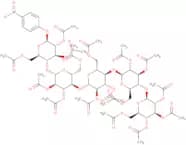
CAS :4-Nitrophenyl b-D-cellopentaoside hexadecaacetate is a fluorogenic substrate that is used to study the activity of various enzymes. It reacts with hydrolytic enzymes in the presence of hydrogen peroxide to produce light, and it can be used for food testing, environmental testing, and diagnostics. 4-Nitrophenyl b-D-cellopentaoside hexadecaacetate is a conjugate of 4-nitrophenol and cellobiose pentaacetate that has a high purity and high quality. The CAS number for this compound is 129411-66-1.Degré de pureté :Min. 95%Masse moléculaire :1,622.4 g/molN-Acetyl-L-glutamine p-nitroanilide
CAS :N-Acetyl-L-glutamine p-nitroanilide is a fluorogenic substrate that can be used in the diagnosis of bacterial infections. It is a ligand that can bind to enzymes involved in the production of bioluminescence, such as luciferase, and can be used for the detection of bacteria. It is also used for food testing, environmental testing, and diagnostics. N-Acetyl-L-glutamine p-nitroanilide has high purity and high quality, which makes it suitable for conjugation with other molecules.
Formule :C13H15N3O6Degré de pureté :Min. 95%Couleur et forme :PowderMasse moléculaire :309.27 g/mol4-Nitrophenyl O-(N-acetyl-a-neuraminosyl)-(2-3)-b-D-galactopyranosyl-(1-4)-2-acetamido-2-deoxy-b-D-glucopyranoside
CAS :4-Nitrophenyl O-(N-acetyl-a-neuraminosyl)-(2-3)-b-D-galactopyranosyl-(1-4)-2-acetamido-2-deoxybDglucopyranoside is a fluorescent compound that has been used as a substrate in enzyme assays. It has been shown to be an effective ligand for the enzyme beta galactosidase, which hydrolyzes the substrate to produce 4nitrophenol and o-(Nacetyl)a-neuraminic acid. This product is CAS No. 501427-92-5 and can be used as a high purity, high quality reagent for conjugation.Degré de pureté :Min. 95%Masse moléculaire :795.7 g/molResorufin oleate
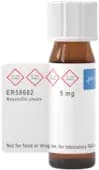
Resorufin oleate is a fluorogenic lipase substrate.Degré de pureté :Min. 95%Couleur et forme :PowderMasse moléculaire :477.64 g/molN-(12-Aminododecyl)-1-deoxynojirimycin dihydrochloride
CAS :N-(12-Aminododecyl)-1-deoxynojirimycin dihydrochloride is a human 12-aminododecanoic acid derivative of the antibiotic najomycin. It has been shown to have an inhibitory effect on the growth of bacteria and fungi, but its exact mechanism of action is unknown. N-(12-Aminododecyl)-1-deoxynojirimycin dihydrochloride can be used as a reagent in the study of polypeptides and other biological molecules. This compound also has potential applications in the diagnosis, prevention, or treatment of human diseases such as cancer, bacterial infections, or fungal infections.Formule :C18H38N2O4·2HClDegré de pureté :Min. 95%Couleur et forme :Yellow SolidMasse moléculaire :419.43 g/mol4-Nitrophenyl 2-acetamido-2-deoxy-4,6-O-benzylidene-b-D-glucopyranoside
CAS :4-Nitrophenyl 2-acetamido-2-deoxy-4,6-O-benzylidene-b-D-glucopyranoside is a fluorescent substrate for beta amylase and other glycosidases. It has been used as a fluorogenic substrate for food testing and as a chromogenic substrate for environmental testing. 4NPB has also been used in diagnostic applications such as enzyme substrates, ligands, and chemiluminescent substrates. This product is of high purity and quality with a conjugate that can be used in biotechnology applications.
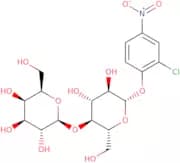
Degré de pureté :Min. 95%Masse moléculaire :430.41 g/mol2-Chloro-4-nitrophenyl b-D-lactoside
CAS :2-Chloro-4-nitrophenyl b-D-galactopyranoside is a chromogenic enzyme substrate used to study the activity of beta-lactoside. It produces a yellow color when cleaved by the enzyme, making it a useful tool in enzyme assays and screening experiments.Degré de pureté :Min. 95%Couleur et forme :PowderMasse moléculaire :497.83 g/mol2,4-Dinitrophenyl b-D-cellobioside
CAS :2,4-Dinitrophenyl b-D-cellobioside is a chemiluminescent substrate that is used to detect the activity of enzymes and other proteins. It can be conjugated with an antibody or other ligand for use in diagnostic purposes. 2,4-DNPBC is a pure compound with a high quality that does not contain any other impurities. Its CAS number is 157956-96-2.Degré de pureté :Min. 95%2-Chloro-4-nitrophenyl 2-acetamido-2-deoxy-a-D-glucopyranoside
L-2-Chloro-4-nitrophenyl 2-acetamido-2-deoxy-a-D-glucopyranoside is a chemiluminescent substrate for the detection of aminoglycoside antibiotics. It can be used to determine the concentration of aminoglycosides in blood, urine, and serum. The chemiluminescence reaction is dependent on the presence of oxygen. This product has been shown to have a high quality and purity with environmental testing and staining properties. L-2-Chloro-4-nitrophenyl 2-acetamido-2-deoxy--a--D--glucopyranoside has also been shown to bind ligands such as porphyrins, bilirubin, or hemin with bioluminescence or chromogenic substrates in diagnostics or culture media for food testing. L--2--Chloro--4--Degré de pureté :Min. 95%