Substrats d'enzymes
Sous-catégories appartenant à la catégorie "Substrats d'enzymes"
1527 produits trouvés pour "Substrats d'enzymes"
3,4-Cyclohexenoesculetine-N-acetyl-glucosamine
Please enquire for more information about 3,4-Cyclohexenoesculetine-N-acetyl-glucosamine including the price, delivery time and more detailed product information at the technical inquiry form on this page
5-Bromo-6-chloro-3-indoxyl choline phosphate
CAS :Please enquire for more information about 5-Bromo-6-chloro-3-indoxyl choline phosphate including the price, delivery time and more detailed product information at the technical inquiry form on this page
Formule :C13H17BrClN2O4PDegré de pureté :Min. 99 Area-%Masse moléculaire :411.63 g/molAquaSpark® 515 Singlet Oxygen Probe, Ramot at Tel-Aviv University Ltd. Patent family WO 2017/130191
CAS :The AquaSpark® 515 Singlet Oxygen Probe (SOCL) is a highly selective and sensitive chemiluminescence probe for the detection of singlet oxygen (1O2). The SOCL probe reacts specifically with 1O2 to form an intermediate dioxetane that spontaneously decomposes to emit green light with extraordinary intensity
Formule :C21H23ClO4Degré de pureté :Min. 95.0 Area-%Masse moléculaire :374.13 g/mol6-Chloro-3-indoxyl palmitate
CAS :6-Chloro-3-indoxyl palmitate is a high quality, pure chemical reagent that can be used as a substrate for enzyme activity. It is a chromogenic substrate that is used in the detection of esterase activity. 6-Chloro-3-indoxyl palmitate is also used as a fluorogenic substrate in the presence of horseradish peroxidase and hydrogen peroxide to produce chemiluminescence. 6-Chloro-3-indoxyl palmitate has been shown to be an effective bioluminescent substrate for luciferase enzymes, such as firefly luciferase and Renilla luciferase.
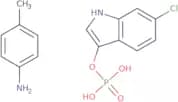
Formule :C24H36ClNO2Degré de pureté :Min. 98 Area-%Masse moléculaire :406.01 g/mol6-Chloro-3-indolyl phosphate p-toluidine salt
CAS :A substrate for visualising alkaline phosphatase activity. Produces a red colored insoluble end product that is detected visually, when used together with Nitroblue tetrazolium. The substrate system is versatile and functions in a variety of applications, including Northern, Southern, and Western blotting, in situ hybridization, ELISAs and immunohistochemistry. DMF soluble.
Formule :C15H16ClN2O4PDegré de pureté :Min. 98%Couleur et forme :White Off-White PowderMasse moléculaire :354.73 g/molAquaSpark® α-D-galactoside, 10 mM in DMSO, Ramot at Tel-Aviv University Ltd. Patent family WO 2017/130191
CAS :AquaSpark™ α-D-galactoside is a dioxetane-based substrate for the luminescence detection of α-galactosidase activity. It is the first single-compound chemiluminescent substrate commercially available for the detection of α-galactosidase activity. α-galactosidase assays are used in molecular biology to monitor the transcriptional activity of the GLA gene that is correlated with metabolic diseases or gene mutations. In microbiology the α-galactosidase activity is used to detect specific bacteria such as α-galactosidase positive Salmonella strains (Salmonella Enteritidis RKI 05/07992).
Formule :C34H39ClO12Masse moléculaire :675.12 g/mol2-Chloro-4-nitrophenyl-α-L-fucopyranoside
CAS :2-Chloro-4-nitrophenyl-alpha-L-fucopyranoside is a compound that is commonly used as an enzyme substrate for glycogen synthase kinase (GSK). It is activated by GSK-3β and has been shown to inhibit the activity of this enzyme. This compound has also been found to have inhibitory effects on other enzymes such as carbonic anhydrase and lactate dehydrogenase. Additionally, 2-Chloro-4-nitrophenyl-alpha-L-fucopyranoside exhibits antifungal activity against various fungi, including those resistant to other antifungal agents such as fluopyram and prothioconazole. Its mechanism of action involves interfering with ergosterol biosynthesis, an essential component of fungal cell membranes. Furthermore, this compound has potential applications in the development of new drugs targeting GSK-3β and β-catenin signaling pathways, which are implicated in various diseases including cancer and neuro
Formule :C12H14ClNO7Degré de pureté :Min. 98 Area-%Masse moléculaire :319.7 g/molBis(4-methylumbelliferyl)phosphate
CAS :Bis(4-methylumbelliferyl)phosphate is a fluorescent probe that can be used for the diagnosis of β-glucosidase. It has a phosphate group and can be used to study phosphodiesterases and phosphodiesters. Bis(4-methylumbelliferyl)phosphate is also a liposomal probe that can be used in kinetic studies. This compound has been shown to inhibit β-glucosidase, which is an enzyme found in human saliva and pancreatic juice, at high concentrations. The inhibition of this enzyme leads to the accumulation of glucose and galactose in the blood, which can lead to diabetes mellitus or cancer.
Formule :C20H15O8PMasse moléculaire :414.31 g/molResorufin b-D-cellobioside
CAS :Resorufin b-D-cellobioside is a fluorogenic substrate for measurement of cellulase activity. The product of enzyme reaction, resorufin, exhibits fluorescence emission at 585 nm with excitation at 571 nm at or near physiological pH values.
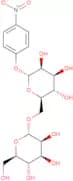
Formule :C24H27NO13Degré de pureté :Min. 95 Area-%Couleur et forme :Brown Orange PowderMasse moléculaire :537.47 g/mol4-Nitrophenyl 6-O-(a-D-mannopyranosyl)-a-D-mannopyranoside
CAS :4-Nitrophenyl 6-O-(alpha-D-mannopyranosyl)-alpha-D-mannopyranoside is a chromogenic substrate for alpha-mannosidase. Upon hydrolysis, para-nitrophenol is released yielding a yellowish colour. 4-Nitrophenyl 6-O-(alpha-D-mannopyranosyl)-alpha-D-mannopyranoside is used in different applications such as the Lysosomal storage disorder diagnosis (e.g., alpha-mannosidosis)
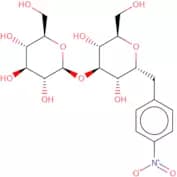
Degré de pureté :Min. 95%Couleur et forme :PowderMasse moléculaire :463.39 g/mol4-Nitrophenyl 3-O-(β-D-glucopyranosyl)-α-D-glucopyranoside
4-Nitrophenyl 3-O-(beta-D-glucopyranosyl)-alpha-D-glucopyranoside is a chromogenic substrate for alpha-glucosidase. Upon hydrolysis, para-nitrophenol is released yielding a yellowish colour. 4-Nitrophenyl 3-O-(beta-D-glucopyranosyl)-alpha-D-glucopyranoside is used in different applications such as the Gaucher disease screening, carbohydrate metabolism studies
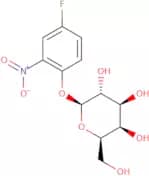
Formule :C18H25NO13Degré de pureté :Min. 95%Masse moléculaire :463.39 g/mol4-Fluoro-2-nitrophenyl b-D-galactopyranoside
CAS :4-Fluoro-2-nitrophenyl beta-D-galactopyranoside, a fluorinated analog of ONPG, is a chromogenic enzyme substrate specifically used to detect beta-galactosidase in bacterial media. 4-Fluoro-2-nitrophenyl beta-D-galactopyranoside is used in Lactose intolerance screening, bacterial beta-galactosidase detection (E. coli)
Degré de pureté :Min. 95%Couleur et forme :PowderMasse moléculaire :319.24 g/molEthyl umbelliferone-3-carboxylate-α-D-glucopyranoside
Ethyl umbelliferone-3-carboxylate-a-D-glucopyranoside is a fluorogenic substrate used for detecting alpha-glucosidase activity in enzymatic assays. When alpha-glucosidase cleaves , the glycosidic bond, umbelliferone-3-carboxylate is released, which exhibits strong fluorescence. This substrate is commonly utilized in glycobiology research, diagnostic tests, and high-throughput screening of enzyme inhibitors.
Formule :C18H20O10Degré de pureté :Min. 95%Couleur et forme :Off-white to yellow solid.Masse moléculaire :396.35 g/mol4-Methylumbelliferyl a-D-mannopyranoside
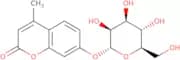
CAS :4-Methylumbelliferyl alpha-D-mannopyranoside (4-MU-a-D-Man) is a fluorogenic substrate used in activity assays for alpha-mannosidase. When it is hydrolyzed by alpha-mannosidase, it produces a fluorescent compound, 4-methylumbelliferone (4-MU). 4-MU-a-D-Man is often used in medical research to monitor the activity of alpha-mannosidase, which is important in lysosomal storage diseases. In addition, 4-Methylumbelliferyl alpha-D-mannopyranoside has been used to study the the activity of concanavalin A, a lectin that specifically binds to alpha-D-mannopyranosyl and alpha-D-glucopyranosyl residues on various glycoproteins. The use of this fluorogenic enzyme substrate permits study the degree of alpha-D-mannosidic linkage cleavage by the enzyme.Formule :C16H18O8Degré de pureté :Min. 98 Area-%Couleur et forme :White Off-White PowderMasse moléculaire :338.31 g/mol5-Bromo-4-chloro-3-indoxyl-alpha-L-fucopyranoside
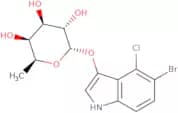
CAS :5-Bromo-4-chloro-3-indoxyl-alpha-L-fucopyranoside is a chromogenic substrate for alpha-L-Fucosidase. It produces a green-blue color.
Formule :C14H15BrClNO5Degré de pureté :Min. 98 Area-%Couleur et forme :PowderMasse moléculaire :392.63 g/molCoelenterazine 400a
CAS :Coelenterazine 400a is a light-emitting molecule that is used in bioluminescence assays. It is a subunit of the luciferin family and has been shown to have some effects on blood pressure, growth factor, and protein–protein interactions. Coelenterazine 400a can be used as a test compound for cancer research. This molecule emits light when it interacts with other molecules, such as NADPH and cytochrome P450 reductase. The luminescence signal can be detected with a fluorescence resonance energy transfer (FRET) assay.
Formule :C26H21N3ODegré de pureté :Min. 95.0 Area-%Masse moléculaire :391.46 g/molRef: 3D-C-7011
Produit arrêtéBis-(4-methylumbelliferyl)phosphate
CAS :Bis-(4-methylumbelliferyl)phosphate, or bis-4MU-phopshate, is a fluorogenic substrate used to study phosphatase activity, particularly in enzyme-linked immunosorbent assays (ELISAs).
Formule :C20H15O8PDegré de pureté :Min. 95 Area-%Couleur et forme :White PowderMasse moléculaire :414.3 g/mol4-Trifluoromethylumbelliferyl b-D-glucuronide potassium salt
CAS :4-Trifluoromethylumbelliferyl b-D-glucuronide potassium salt is a fluorogenic substrate for beta-glucuronidase. Upon hydrolysis, the fluorogenic moiety (blueish) 4-trifluoromethylumbelliferone (also known as TFMU) is released. 4-Trifluoromethylumbelliferyl b-D-glucuronide potassium salt is commonly used in bacterial detection and for drug metabolism studies as well as lysosomal storage disorder screening.Formule :C16H12F3O9KDegré de pureté :Min. 95 Area-%Couleur et forme :White PowderMasse moléculaire :444.35 g/mol5-Bromo-4-chloro-3-indoxyl-alpha-D-galactopyranoside
CAS :Chromogenic substrate for α-galactosidase yielding a blue precipitate. Used for species differentiation within the family Enterobacteriaceae and differentiation of Bifido bacteria species from Lactobacillus species.
Formule :C14H15BrClNO6Degré de pureté :Min. 99 Area-%Masse moléculaire :408.64 g/molRef: 3D-B-7141
Produit arrêté5-Bromo-3-indoxyl choline phosphate
Please enquire for more information about 5-Bromo-3-indoxyl choline phosphate including the price, delivery time and more detailed product information at the technical inquiry form on this page
Formule :C13H18BrN2O4PMasse moléculaire :377.18 g/mol