Substrats d'enzymes
Sous-catégories appartenant à la catégorie "Substrats d'enzymes"
1527 produits trouvés pour "Substrats d'enzymes"
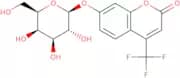
4-Trifluoromethylumbelliferyl β-D-galactopyranoside
CAS :4-Trifluoromethylumbelliferyl β-D-galactopyranoside is a fluorogenic substrate for beta-galactosidase . Upon hydrolysis, the fluorogenic moiety (blueish) 4-trifluoromethylumbelliferone (also known as TFMU) is released. 4-Trifluoromethylumbelliferyl β-D-galactopyranoside is commonly used in bacterial detection and in LacZ gene expression assays.
Formule :C16H15F3O8Degré de pureté :Min. 95%Couleur et forme :PowderMasse moléculaire :392.28 g/molL-Proline 7-amido-4-methylcoumarin hydrobromide salt
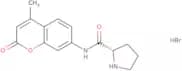
CAS :L-Proline 7-amido-4-methylcoumarin hydrobromide salt is a fluorogenic peptide substrate for proline-specific peptidase. This AMC peptide substrate is normally used to rapidly profile the N-terminal specificity of proteases.Formule :C15H17BrN2O3Degré de pureté :Min. 95%Couleur et forme :PowderMasse moléculaire :353.22 g/mol[2-(2-Thiazolylazo)-4-cresyl]-β-D-galactopyranoside
CAS :Please enquire for more information about [2-(2-Thiazolylazo)-4-cresyl]-β-D-galactopyranoside including the price, delivery time and more detailed product information at the technical inquiry form on this page
Formule :C16H19N3SO6Degré de pureté :Min. 95%Couleur et forme :PowderMasse moléculaire :381.41 g/molBoc-Val-Pro-Arg-PAB-Resorufin
Boc-Val-Pro-Arg-PAB-Resorufin is fluorogenic substrate for thrombin and the thrombin-staphylocoagulase complex.
Formule :C40H50N8O8Degré de pureté :Min. 97 Area-%Masse moléculaire :770.87 g/mol5-Bromo-4-chloro-3-indoxyl-1,3-diacetate
CAS :5-Bromo-4-chloro-3-indoxyl-1,3-diacetate (BCID) is a potent and selective inhibitor of the tyrosine kinase enzyme. BCID has been shown to inhibit the growth of various cell cultures in vitro including murine and human cells. BCID has been shown to be an effective inhibitor of TNF-α production in murine models for asthma and allergic rhinitis. The drug has also been shown to reversibly inhibit the activity of the enzyme without affecting its ability to bind substrate or to regenerate active enzyme form inactive enzyme, indicating that it does not act as a suicide inhibitor.
Formule :C12H9BrClNO3Degré de pureté :Min. 98.0 Area-%Masse moléculaire :330.56 g/molLuc-Enterococcus K
Luc-Enterococcus K is a conjugate of the bacterial luciferase enzyme and Enterococcus faecalis. It is used in food testing, environmental testing and diagnostics. Luc-Enterococcus K can be used as a replacement for the fluorogenic substrate luminol, which is difficult to handle because it has to be kept cold during use and is explosive. Luc-Enterococcus K produces light when it reacts with the chromogenic substrate luciferin, which can be stored at room temperature without degrading. The light produced by Luc-Enterococcus K is blue green in color, making it easy to detect with a camera or eye.
Degré de pureté :Min. 95%4-Methylumbelliferyl-beta-D-glucuronic acid methyl ester, Biosynth Patent: EP 2718458 and US 9127303
4-Methylumbelliferyl-beta-D-glucuronic acid methyl ester is a chromogenic substrate for β-glucuronidase. It is used in diagnostic applications and as a substrate in enzyme kinetics experiments. 4-Methylumbelliferyl-beta-D-glucuronic acid methyl ester has fluorescence properties that allow it to be detected by chemiluminescence and bioluminescence.
Degré de pureté :Min. 95%5-Bromo-4-chloro-3-indoxyl-alpha-L-fucopyranoside
CAS :Chromogenic substrate for α-D-Fucosidase yielding a blue precipitate.
Formule :C14H15BrClNO5Degré de pureté :Min. 98.0 Area-%Masse moléculaire :392.64 g/mol1-Fluoro-2,4,6-trimethylpyridinium triflate
CAS :Please enquire for more information about 1-Fluoro-2,4,6-trimethylpyridinium triflate including the price, delivery time and more detailed product information at the technical inquiry form on this page
Formule :C9H11F4NO3SDegré de pureté :Min. 95 Area-%Masse moléculaire :289.24 g/molAquaSpark® Alkaline Phosphatase Detection Solution, Ramot at Tel-Aviv University Ltd. Patent family WO 2017/130191
CAS :Ready-to-use chemiluminescence substrate solution for AP detection
Formule :C21H24NaO9PCouleur et forme :Clear LiquidMasse moléculaire :474.37 g/molCrimson-Gal
Crimson-Gal (Crimson-beta-D-galactopyranoside) is a chromogenic indicator for beta-galactosidase activity. The colorless product is cleaved by lactose-utilizing bacteria in liquid media or on agar plates and yields a crimson colored precipitate. Crimson-Gal can also be used as detecting agent for beta-galactosidase activity in reporter gene assays or for identification of positive transformants on agar plates when using the α-complementation approach. Read more in the Application Notes.
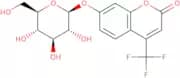
Degré de pureté :Min. 95%4-Trifluoromethylumbelliferyl b-D-glucopyranoside
CAS :4-Trifluoromethylumbelliferyl b-D-glucopyranoside is a fluorogenic substrate for beta-glucosidase. Upon hydrolysis, the fluorogenic moiety (blueish) 4-trifluoromethylumbelliferone (also known as TFMU) is released. 4-Trifluoromethylumbelliferyl b-D-glucopyranoside is commonly used in bacterial detection and in Gaucher disease diagnosis.
Degré de pureté :Min. 95%Couleur et forme :White To Off-White SolidMasse moléculaire :392.28 g/molResorufin b-D-glucopyranoside
CAS :Resorufin b-D-glucopyranoside is a stable red fluorogenic galactosidase substrate.
Degré de pureté :Min. 95%Couleur et forme :Orange PowderMasse moléculaire :375.33 g/mol5-Amino-3-indoxyl-β-D-galactopyranoside
5-Amino-3-indoxyl-b-D-galactopyranoside is a chromogenic substrate for the enzyme galactosidase. 5-Amino-3-indoxyl-b-D-galactopyranoside is used in diagnostic tests to identify the presence of lactose intolerance. It can also be used to detect traces of blood in food, water, and other substances. This product has a high purity that makes it suitable for conjugation applications.
Formule :C14H18N2O6Degré de pureté :Min. 95%Masse moléculaire :310.31 g/molTrimethyl phosphonoacetate
CAS :Please enquire for more information about Trimethyl phosphonoacetate including the price, delivery time and more detailed product information at the technical inquiry form on this page
Formule :C5H11O5PMasse moléculaire :182.11 g/molAlizarin-2-β-D-galactopyranoside
CAS :Chromogenic substrate targeting beta- galactosidase and whose color is dependent on the metal chelating.Alizarin-2-beta-D-galactopyranoside is a chromogenic substrate for enzymes based on alizarin and has been reported for the detection of bacterial beta-galactosidase by researchers at the University of Northumbria and the Freeman Hospital, Newcastle upon Tyne in the UK (James, 2000).
Formule :C20H18O9Degré de pureté :Min. 98.0 Area-%Masse moléculaire :402.36 g/molD-Luciferin Firefly, sodium salt monohydrate
CAS :Luciferin is a product that will react with oxygen in the presence of luciferase BX180145 to release energy in the form of light. UV wavelength - 383 to 387 nmMolar extinction coefficient - min. 17500 L/(mol cm)
Formule :C11H9N2NaO4S2Degré de pureté :Min. 95%Masse moléculaire :320.3 g/molAc-DEVD-6-amino-D-luciferin
Ac-DEVD-6-amino-D-luciferin is a substrate for luciferase that can be used in diagnostic, bioluminescence, and chemiluminescence assays. Ac-DEVD-6-amino-D-luciferin is a high quality compound that has been conjugated with various ligands. The CAS number for Ac-DEVD-6-amino-D-luciferin is 612061–87–8.
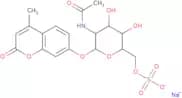
Formule :C31H37N7O13S2Degré de pureté :Min. 95%Couleur et forme :PowderMasse moléculaire :779.79 g/mol4-Methylumbelliferyl 2-acetamido-2-deoxy-a-D-glucopyranoside-6-sulfate sodium salt - Moscerdam™ biochemical purity
CAS :A substrate used for the diagnosis of Sanfilippo disease type D (MPS IIID).
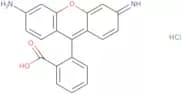
Formule :C18H20NNaO11SDegré de pureté :Min. 95%Couleur et forme :White PowderMasse moléculaire :481.41 g/molRhodamine 110 chloride
CAS :Fluorescent dye substrate for flow cytometric measurements
Formule :C20H15O3N2ClDegré de pureté :Min. 95 Area-%Couleur et forme :Red PowderMasse moléculaire :366.8 g/mol

![[2-(2-Thiazolylazo)-4-cresyl]-β-D-galactopyranoside](/_next/image/?url=https%3A%2Fstatic.cymitquimica.com%2Fproducts%2F3D%2Fthumb-webp%2FFT172198.webp&w=3840&q=75)