Substrats d'enzymes
Les substrats enzymatiques sont des molécules sur lesquelles les enzymes agissent pour catalyser des réactions chimiques. Le substrat se lie au site actif de l'enzyme, où il subit une transformation spécifique pour former le produit de la réaction. Les substrats enzymatiques sont des outils essentiels dans la recherche pour étudier la cinétique enzymatique, la spécificité et le mécanisme d'action. Ils sont également utilisés dans les essais diagnostiques et les études biochimiques. Chez CymitQuimica, nous offrons une sélection diversifiée de substrats enzymatiques de haute qualité pour soutenir vos recherches en enzymologie et biochimie.
Sous-catégories appartenant à la catégorie "Substrats d'enzymes"
1527 produits trouvés pour "Substrats d'enzymes"
Trier par
Degré de pureté (%)
0
100
|
0
|
50
|
90
|
95
|
100
3-(4,4-Difluoro-5,7-dimethyl-4-bora-3a,4a-diaza-s-indacene-3-propionamido)propyl b-D-lactoside
<p>3-(4,4-Difluoro-5,7-dimethyl-4-bora-3a,4a-diaza-s-indacene-3-propionamido)propyl b -D -lactoside (FDPBP) is a substrate for alkaline phosphatase. It reacts with the enzyme to produce a blue color. FDPBP is used in diagnostic applications such as food testing and bioluminescence.</p>Degré de pureté :Min. 95%Couleur et forme :PowderMasse moléculaire :675.48 g/mol4-Methylumbelliferyl phosphate, bis(cyclohexylammonium) salt, trihydrate
CAS :<p>Sensitive fluorogenic substrate for fluorometric and UV-spectrophotometric assays of phosphatases. This may also be used for in-gel assays</p>Formule :C22H41N2O9PMasse moléculaire :508.55 g/molLuc-S.aureus K
<p>Luc-S.aureus K is a fluoro-ligand that is used as a diagnostic to detect and quantify the activity of S.aureus in any given sample. It is a detection substrate for the enzyme β-galactosidase, which catalyzes the hydrolysis of the luciferin. When luciferin is cleaved by β-galactosidase, it emits light that can be detected using a luminometer to measure the amount of light produced and calculate the quantity of bacteria present in the sample. Luc-S.aureus K has been approved for use as a detector for bioluminescence in food testing, environmental testing, and other diagnostic applications.</p>Degré de pureté :Min. 95%4-Nitrophenyl laurate
CAS :<p>4-Nitrophenyl laurate is a chromogenic substrate for lipase. Upon hydrolysis, para-nitrophenol is released yielding a yellowish colour. 4-Nitrophenyl laurate is used in different applications such as the Lipase activity screening, clinical diagnostics</p>Formule :C18H27NO4Degré de pureté :Min. 95%Couleur et forme :White PowderMasse moléculaire :321.41 g/molDehydroluciferin
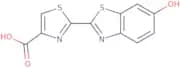
CAS :<p>Dehydroluciferin is a bioluminescence probe that is a potent inhibitor of the firefly luciferase reaction. It is a byproduct of the oxidation of luciferin, the substrate for firefly luciferase, which catalyzes the bioluminescence reaction. It can also form during the synthesis or storage of luciferin. Its presence can potentially lead to issues in bioluminescent assays.</p>Formule :C11H6N2O3S2Degré de pureté :Min. 97 Area-%Couleur et forme :PowderMasse moléculaire :278.31 g/mol5-Bromo-4-chloro-3-indolyl b-L-fucopyranoside
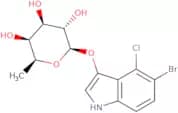
CAS :<p>5-Bromo-4-chloro-3-indolyl β-L-fucopyranoside (X-Fuc) is a chromogenic substrate specifically designed for the identification and detection of fucosidase enzyme activity. Upon cleavage by fucosidase, it generates a blue-colored 5-Bromo-4-chloro-3-hydroxy-indole precipitate, which can be easily observed under a microscope or spectrophotometer. This feature makes X-Fuc an invaluable tool across various applications, such as biochemical analysis, histochemical staining, cell biology, and enzyme kinetic assays. By providing a fast, sensitive, and reliable readout for fucosidase activity, 5-Bromo-4-chloro-3-indolyl β-L-fucopyranoside facilitates essential research in the understanding of biological processes and the development of therapeutic interventions.</p>Formule :C14H15BrClNO5Degré de pureté :Min. 95%Couleur et forme :White PowderMasse moléculaire :392.63 g/molα-N-Bz-L-Arg-aminoluciferin
<p>alpha-N-Bz-L-Arg-aminoluciferin is a modified form of D-luciferin used as a luminescent enzyme substrate for protease.</p>Formule :C24H25N7O4S2Degré de pureté :Min. 95 Area-%Masse moléculaire :539.63 g/mol4-Nitrocatechol sulfate dipotassium salt
CAS :<p>Chromogenic sulfatase substrate</p>Formule :C6H3NO7SK2Degré de pureté :Min. 98 Area-%Couleur et forme :PowderMasse moléculaire :311.35 g/molAldol® 467 β-D-galactopyranoside, Biosynth Patent: EP 2427431 and US 8940909
CAS :<p>Aldol® 467 beta-D-galactopyranoside is a chromogenic and fluorogenic enzyme substrate used for detection of beta-galactosidase activity. The colorless product is cleaved by lactose-utilizing bacteria grown in liquid or solid media, yielding yellow coloration and green fluorescence. Aldol® 467 beta-D-galactopyranoside can also be used in beta-galactosidase gene reporter assays or immunoassay applications (ELISA). Aldol® 467 beta-D-galactopyranoside can be used under aerobic and anaerobic conditions.</p>Formule :C29H28ClNO9Degré de pureté :Min. 95%Couleur et forme :PowderMasse moléculaire :570 g/mol4-Methylumbelliferyl phosphate bis(cyclohexylammonium) salt
CAS :<p>Sensitive fluorogenic substrate for fluorometric and UV-spectrophotometric assays of phosphatases. This may also be used for in-gel assays</p>Formule :C22H35N2O6PDegré de pureté :Min 99%Couleur et forme :White to off-white solid.Masse moléculaire :454.50 g/mol4-Methylumbelliferyl-α-D-mannopyranoside
CAS :<p>4-Methylumbelliferyl alpha-D-mannopyranoside (4-MU-a-D-Man) is a fluorogenic substrate used in activity assays for alpha-mannosidase. When it is hydrolyzed by alpha-mannosidase, it produces a fluorescent compound, 4-methylumbelliferone (4-MU). 4-MU-a-D-Man is often used in medical research to monitor the activity of alpha-mannosidase, which is important in lysosomal storage diseases. In addition, 4-Methylumbelliferyl alpha-D-mannopyranoside has been used to study the the activity of concanavalin A, a lectin that specifically binds to alpha-D-mannopyranosyl and alpha-D-glucopyranosyl residues on various glycoproteins. The use of this fluorogenic enzyme substrate permits study the degree of alpha-D-mannosidic linkage cleavage by the enzyme.</p>Formule :C16H18O8Degré de pureté :Min. 98 Area-%Masse moléculaire :338.32 g/molRef: 3D-M-5730
1gÀ demander5gÀ demander10gÀ demander500mgÀ demander2500mgÀ demander-Unit-ggÀ demanderEsculetin-7-β-D-galactopyranoside
<p>Esculetin-7-beta-D-galactopyranoside, also known as 6,7-Dihydroxycoumaryl-7-beta-D-galactopyranoside, is a fluorogenic substrate used in the detection of beta-galactosidase activity. This coumarin derivative, when hydrolyzed, yields esculetin (6,7-dihydroxycoumarin) which, in the presence of iron salts, forms a brown-black complex.</p>Formule :C15H16O9Degré de pureté :Min. 95%Masse moléculaire :340.28 g/molD-Luciferin sodium salt
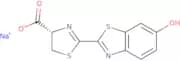
CAS :<p>Bioluminescent substrate for luciferase</p>Formule :C11H7N2NaO3S2Degré de pureté :Min. 99 Area-%Couleur et forme :PowderMasse moléculaire :302.3 g/mol4-Methylumbelliferyl a-D-glucosaminide
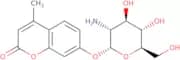
CAS :<p>4-Methylumbelliferyl alpha-D-glucosaminide is a fluorogenic substrate for alpha-N-acetylglucosaminidase. After enzymatic cleaveage, free 4-methylumbelliferone (also known as hymecromone) is released, exhibiting blue fluorescence upon excitation with UV light. The strongest fluorescence of 4-methylumbelliferone requires deprotonation of the hydroxyl group (thus requires alkaline pH), with a maximal fluorescence intensity obtained with excitation at 350 to 370 nm and emission at 440 to 470 nm. The use of 4-methylumbelliferyl alpha-D-glucosaminideas a substrate for measuring the alpha-N-acetylglucosaminidase activity is used for Sanfilippo syndrome B and Mucopolysaccharidosis IIIB (MPS IIIB) diagnosis.</p>Formule :C16H19NO7Degré de pureté :Min. 90 Area-%Couleur et forme :White PowderMasse moléculaire :337.32 g/molAminoseleno-D-luciferin
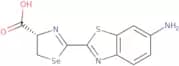
CAS :<p>Selenium analogue of firefly luciferin with red-shifted bioluminescence</p>Formule :C11H9N3O2SSeDegré de pureté :Min. 95%Masse moléculaire :326.23 g/mol6-Bromo-2-naphthyl α-D-mannopyranoside
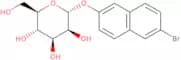
CAS :<p>Chromogenic substrate to visualize the activity of alpha-D-mannopyranoside; red color produced</p>Formule :C16H17BrO6Degré de pureté :Min. 95%Couleur et forme :PowderMasse moléculaire :385.21 g/mol4-Methylumbelliferyl dodecanoate
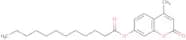
CAS :<p>4-Methylumbelliferyl dodecanoate is a fluorogenic substrate for lipase. After enzymatic cleaveage, free 4-methylumbelliferone (also known as hymecromone) is released, exhibiting blue fluorescence upon excitation with UV light. The strongest fluorescence of 4-methylumbelliferone requires deprotonation of the hydroxyl group (thus requires alkaline pH), with a maximal fluorescence intensity obtained with excitation at 350 to 370 nm and emission at 440 to 470 nm. The use of 4-methylumbelliferyl dodecanoateas a substrate for measuring the lipase activity is used for detecting pancreatic insufficiency in diagnosis assays as well as the screening of lipase deficiency.</p>Formule :C22H30O4Degré de pureté :Min. 95%Couleur et forme :PowderMasse moléculaire :358.47 g/molPhosphoric acid, mono(4-nitrophenyl) ester
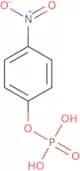
CAS :<p>Phosphatase substrate</p>Formule :C6H6NO6PDegré de pureté :Min. 95%Couleur et forme :White PowderMasse moléculaire :219.09 g/molCelluchrome
<p>Celluchrome (short name for remazol brilliant blue carboxymethyl cellulose or RBB-CMC) is a chromogenic substrate for cellulases. With a higher sensitivity, RBB-CMC allows for the detection of the enzyme activity even when small amounts are present.</p>Degré de pureté :Min. 95%Couleur et forme :Powder4-Methylumbelliferyl a-L-idopyranosiduronic acid 2-sulphate disodium salt - Moscerdam™ biochemical purity
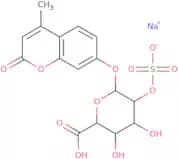
CAS :<p>PAIRED PRODUCT AVAILABLE: alpha-L-iduronidase Enzyme, FI1793834MU-alpha-L-iduronide-2-sulphate (M2) is a fluorogenic substrate of iduronate-2-sulphatase (IDS), used in a 2-step assay coupled with alpha-L-iduronidase. The assay is used in biochemical testing for Hunter syndrome (mucopolysaccharidosis II / MPS II). In a first step, IDS from biological samples cleaves the sulphate group from M2. In a second step, exogeneous alpha-L-iduronidase which cleaves the 4-MU moiety is added to the reaction, resulting in release of a fluorescent signal (Ex 360 nm / Em 455 nm). The reaction is stopped by the addition of sodium carbonate.</p>Formule :C16H14Na2O12SDegré de pureté :Min. 99 Area-%Couleur et forme :White PowderMasse moléculaire :476.32 g/mol