Substrats chromogènes
712 produits trouvés pour "Substrats chromogènes"
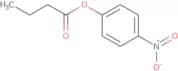
4-Nitrophenyl butyrate
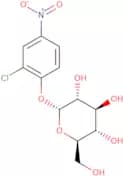
CAS :Chromogenic substrate for esterasesFormule :C10H11NO4Degré de pureté :Min. 98%Couleur et forme :Slightly Yellow Yellow Green Clear LiquidMasse moléculaire :209.2 g/mol2-Chloro-4-nitrophenyl a-D-glucopyranoside
CAS :2-Chloro-4-nitrophenyl a-D-glucopyranoside is an an enzyme-activated irreversible inhibitor of alpha-glucosidase. The substrate 2-Chloro-4-nitrophenyl a-D-glucopyranoside is covalently attached to the enzyme enabling mechanistic studies of glycosidase activity, especificallyt in carbohydrate metabolism studies.Degré de pureté :Max. 97 Area-%Couleur et forme :White Off-White PowderMasse moléculaire :335.69 g/molβ-Naphthyl stearate
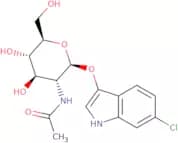
CAS :Beta-naphthyl stearate is a chromogenic substrate for measuring enzymatic activity.Degré de pureté :Min. 95%Couleur et forme :PowderMasse moléculaire :410.63 g/mol6-Chloro-3-indolyl 2-acetamido-2-deoxy-β-D-glucopyranoside
CAS :6-Chloro-3-indolyl 2-acetamido-2-deoxy-b-D-glucopyranoside is a pink enzyme substrate commonly used in biochemical research and diagnostic applications. This compound is a derivative of indolyl glucopyranoside, which is known for its ability to produce a colored product upon enzymatic hydrolysis. 6-Chloro-3-indolyl 2-acetamido-2-deoxy-b-D-glucopyranoside is particularly useful for studying glycosidases, enzymes that cleave glycosidic bonds in complex carbohydrates. Its pink coloration makes it an ideal choice for colorimetric assays, enabling researchers to monitor enzyme activity in real-time and facilitating the development of new diagnostic tools and therapeutic strategies.
Formule :C16H19ClN2O6Degré de pureté :Min. 95%Couleur et forme :White to off-white solid.Masse moléculaire :370.78 g/molN,N,N',N'-Tetramethyl-p-phenylenediamine dihydrochloride
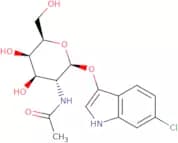
CAS :Reducing co-substrate for heme peroxidases; test reagent in microbiologyFormule :C10H16N2·2HClDegré de pureté :Min. 95%Couleur et forme :White PowderMasse moléculaire :237.17 g/mol6-Chloro-3-indolyl 2-acetamido-2-deoxy-b-D-galactopyranoside
CAS :6-Chloro-3-indolyl 2-acetamido-2-deoxy-b-D-galactopyranoside is a chromogenic substrate for N-acetyl-beta-galactosaminidase. It produces a salmon-pink color after enzymatic cleavage.
Degré de pureté :Min. 95%Couleur et forme :White PowderMasse moléculaire :370.78 g/molN-(3-Sulfopropyl)-3,3',5,5'-tetramethylbenzidine sodium
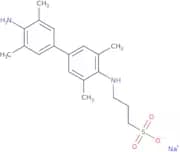
CAS :N-(3-Sulfopropyl)-3,3',5,5'-tetramethylbenzidine (TMB) sodium salt is a highly sensitive chromogenic substrate used for the detection and quantification of peroxidase enzyme activity. This water-soluble substrate undergoes a color change from colorless to blue upon oxidation by peroxidase enzymes in the presence of hydrogen peroxide. The reaction can be stopped by adding an acid, resulting in a yellow color that can be measured spectrophotometrically. TMB sodium salt is widely used in various applications, including enzyme-linked immunosorbent assays (ELISA), immunohistochemistry, and other diagnostic tests, due to its high sensitivity, low background signal, and excellent stability.
Degré de pureté :Min. 95%Couleur et forme :PowderMasse moléculaire :384.47 g/mol2-Nitrophenyl b-D-galactopyranoside-6-phosphate cyclohexylammonium salt
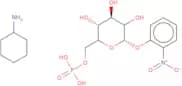
CAS :2-Nitrophenyl beta-D-galactopyranoside-6-phosphate cyclohexylammonium salt is a chromogenic substrate used to detect the enzymatic activity of beta-galactosidase-6-phosphatase. After cleavage, the nitrophenyl moiety is released exhibiting a light yellowish color. 2-Nitrophenyl beta-D-galactopyranoside-6-phosphate cyclohexylammonium salt is used in diagnostic assays such as lysosomal storage disorder.Degré de pureté :Min. 95%Couleur et forme :PowderMasse moléculaire :480.4 g/molAldol® 458 nonanoate, Biosynth Patent: EP 2427431 and US 8940909
CAS :Produit contrôléAldol 458 nonanoate is a fluorogenic substrate that can be used in the detection of enzyme activity particularly C8/C9-esterases, lipases activity producing a yellow/green-orange color. Aldol 458 nonanoate reacts with enzymes, such as oxidoreductases and hydrolases, to produce light. This product is a conjugate of aldol 458 nonanoate and an enzyme substrate for the detection of these enzymes. It has been shown to be useful in food testing, staining, fluorogenic substrate, environmental testing, chromogenic substrate, conjugate, high purity, enzyme substrate for diagnostics and ligand.
Formule :C25H29NO4Degré de pureté :Min. 95%Masse moléculaire :407.5 g/mol6-Chloro-3-indoxyl-3-acetate
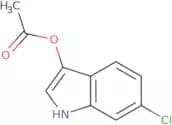
CAS :6-Chloro-3-indoxyl-3-acetate is a chromogenic substrate for carboxylesterase yielding a salmon colored precipitate upon cleavage. Mainly used in histochemistry.Degré de pureté :Min. 95%Couleur et forme :White PowderMasse moléculaire :209.63 g/mol4-Nitrocatechol sulfate dipotassium salt
CAS :Chromogenic sulfatase substrateFormule :C6H3NO7SK2Degré de pureté :Min. 98 Area-%Couleur et forme :PowderMasse moléculaire :311.35 g/molAldol® 484 beta-D-galactopyranoside, Biosynth Patent: EP 2427431 and US 8940909
CAS :Aldol® 484 beta-D-galactopyranoside is a chromogenic enzyme substrate for beta-galactosidase activity. The colorless product is cleaved by lactose-utilizing bacteria in liquid or solid media, yielding intense red color. Aldol® 484 beta-D-galacto-pyranoside can also be used in beta-gal reporter gene assays or for identification of beta-gal positive transformants on agar. Aldol® 484 beta-D-galactopyranoside can be used under aerobic and anaerobic conditions.Formule :C26H24ClFN2O7Degré de pureté :Min. 95%Couleur et forme :PowderMasse moléculaire :530.93 g/molNaphthol AS-MX acetate
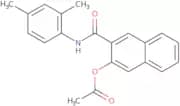
CAS :Modified naphtol AS substrate used in histochemical and cytochemical staining
Formule :C21H19NO3Degré de pureté :Min. 80%Couleur et forme :White Off-White PowderMasse moléculaire :333.38 g/mol4-Chloro-1-naphthol
CAS :Substrate for horseradish peroxidase
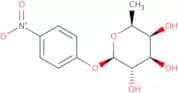
Formule :C10H7ClODegré de pureté :Min. 96.0 Area-%Couleur et forme :Brown PowderMasse moléculaire :178.61 g/mol4-Nitrophenyl-beta-L-fucopyranoside
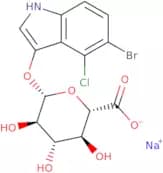
CAS :4-Nitrophenyl-beta-L-fucopyranoside is a high-quality pNP enzyme substrate developed for the sensitive detection and quantification of Beta-L-fucosidase activity. The enzymatic hydrolysis of the substrate generates 4-nitrophenol, a yellow chromogenic component that can be conveniently measured spectrophotometrically, allowing for accurate determination of enzyme concentration and kinetics. This substrate finds applications in various research fields, diagnostics, and industrial enzyme production.Formule :C12H15NO7Degré de pureté :Min. 95%Couleur et forme :White PowderMasse moléculaire :285.25 g/mol5-Bromo-4-chloro-3-indolyl b-D-glucuronide sodium salt
CAS :Chromogenic substrate for beta-glucuronidase
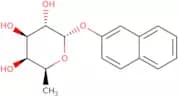
Formule :C14H12BrClNNaO7Degré de pureté :Min. 98 Area-%Couleur et forme :White Off-White PowderMasse moléculaire :444.59 g/mol2-Naphthyl-alpha-L-fucopyranoside
CAS :Chromogenic substrate for α-L-Fucosidase. 2-naphthol is released upon hydrolyzation. By simultaneous coupling with a suitable staining reagent, such as hexazonium p-rosaniline, the corresponding azo-dye is formed. Naphthols can also be detected by fluorescence analysis.Formule :C16H18O5Degré de pureté :Min. 98 Area-%Masse moléculaire :290.32 g/mol2-Naphthyl caprylate
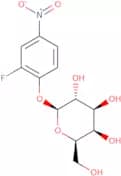
CAS :2-Naphthyl caprylate is a substrate that is employed in an assays for carboxylesterase and lipase and when hydrolyzed, produces 2-naphthol, a compound that can also be identified via fluorescence analysis. By combining it with a diazonium salt, the formation of the corresponding azo dye occurs. In particular, this substrate is used to detect the extracellular lipase of Pseudomonas fluorescens B52.Formule :C18H22O2Degré de pureté :Min. 95%Couleur et forme :White PowderMasse moléculaire :270.37 g/mol2-Fluoro-4-nitrophenyl b-D-galactopyranoside
CAS :2-Fluoro-4-nitrophenyl b-D-galactopyranoside is a chromogenic substrate in enzymatic assays with β-galactosidase. Commonly abbreviated as PFONPG, it is a hydrophilic compound that can be dissolved in saline and blood samples, which makes it a suitable candidate for diagnostic applications as a gene reporter probe by simple analytic methodologies. 2-Fluoro-4-nitrophenyl b-D-galactopyranoside have been used to detect and monitor the growth of prostate tumor cells.Degré de pureté :Min. 95%Couleur et forme :PowderMasse moléculaire :319.24 g/molAldol® 495 phosphate, disodium salt, Biosynth Patent: EP 2427431 and US 8940909
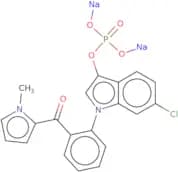
CAS :Aldol® 495 phosphate is a chromogenic and fluorogenic enzyme substrate used for detection of phosphatase activity. The colorless enzyme substrate is cleaved by acid and alkaline phosphatases secreted by bacteria in liquid or solid media, yielding orange color and green fluorescence. Aldol® 495 phosphate can also be used in Western blots and other immunoassay applications with phosphatase-coupled secondary antibodies. Aldol® 495 phosphate can be used under aerobic and anaerobic conditions.Formule :C20H14ClN2Na2O5PDegré de pureté :Min. 98%Couleur et forme :PowderMasse moléculaire :474.74 g/mol