Substrats chromogènes
712 produits trouvés pour "Substrats chromogènes"
4-Nitrophenyl-beta-D-xylopyranoside
CAS :Chromogenic β-xylosidase substrate yielding a yellow solution upon cleavage.Formule :C11H13NO7Degré de pureté :Min. 99 Area-%Masse moléculaire :271.23 g/molAldol® 470 beta-D-galactopyranoside, Biosynth Patent: EP 2427431 and US 8940909
CAS :Aldol® 470 beta-D-galactopyranoside is a chromogenic and fluorogenic enzyme substrate used for detection of beta-galactosidase activity. The colorless enzyme substrate is cleaved by lactose-utilizing bacteria grown in liquid or solid media, yielding yellow coloration and green fluorescence. Aldol® 470 beta-D-galactopyranoside can also be used in beta-galactosidase gene reporter assays or immunoassay applications (ELISA). Aldol® 470 beta-D-galactopyranoside can be used under aerobic and anaerobic conditions.Formule :C29H29NO9Degré de pureté :Min. 95 Area-%Couleur et forme :PowderMasse moléculaire :535.54 g/mol5-Bromo-6-chloro-3-indolyl acetate
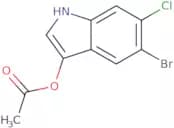
CAS :5-Bromo-6-chloro-3-indolyl acetate is a chromogenic substrate that yields a magenta-colored product after cleavage. The chromophore 5-bromo-6-chloro-indoxyl is released, generating the observable color. It is used in bacterial esterase detection (e.g. Staphylococcus spp.).
Formule :C10H7BrClNO2Degré de pureté :Min. 98 Area-%Couleur et forme :PowderMasse moléculaire :288.52 g/mol3-Nitrophenyl b-D-galactopyranoside
CAS :Chromogenic substrate targeting beta-galactosidaseFormule :C12H15NO8Couleur et forme :PowderMasse moléculaire :301.25 g/molN-Methylindoxyl-beta-D-galactopyranoside monohydrate
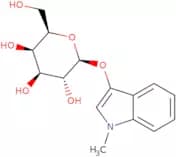
CAS :N-Methylindoxyl-beta-D-galactopyranoside monohydrate (MG) is a chromogenic probe that interacts with galactose residues found on glycoproteins, which are found on cell surfaces, leading to activation of cells. MG also binds specifically to the surface of lung cells and can inhibit the development of certain types of infections..Formule :C15H21NO7Degré de pureté :Min. 98 Area-%Couleur et forme :PowderMasse moléculaire :327.33 g/molAldol® 458 beta-D-galactopyranoside, Biosynth Patent: EP 2427431 and US 8940909
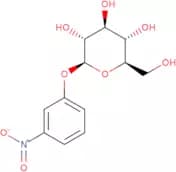
CAS :Aldol® 458 beta-D-galactopyranoside is a chromogenic and fluorogenic enzyme substrate used for detection of beta-galactosidase activity. The colorless enzyme substrate is cleaved by lactose utilizing bacteria grown in liquid or solid media, yielding yellow coloration and green fluorescence. Aldol® 458 beta-D-galactopyranoside can also be used in beta-galactosidase gene reporter assays or immunoassay applications (ELISA). Aldol® 458 beta-D-galactopyranoside can be used under aerobic and anaerobic conditions.Formule :C22H23NO8Degré de pureté :Min. 95 Area-%Couleur et forme :PowderMasse moléculaire :429.42 g/mol3-Nitrophenyl β-D-glucopyranoside
CAS :3-Nitrophenyl beta-D-glucopyranoside is a chromogenic enzyme substrate commonly used to assay for beta-glucosidase activity. Upon hydrolysis by the enzyme, it produces a yellow product that can be easily detected by spectrophotometry. This substrate is often used in the field of carbohydrate chemistry and biochemistry to study enzyme kinetics and inhibition in both in vitro and in vivo systems.Formule :C12H15NO8Degré de pureté :Min. 95%Couleur et forme :White Yellow PowderMasse moléculaire :301.25 g/mol5-Bromo-4-chloro-3-indolyl-D-thymidine-3'-phosphate cyclohexylammonium salt
CAS :5-Bromo-4-chloro-3-indolyl-D-thymidine-3'-phosphate cyclohexylammonium salt is a chromogenic substrate used to detect the specific enzymatic activity of alkaline phosphatase. After cleavage, 5-bromo-4-chloro-indoxyl is released, resulting in a blue to blue-green color change in bacterial colonies or media. 5-Bromo-4-chloro-3-indolyl-D-thymidine-3'-phosphate cyclohexylammonium salt is used in immunohistochemistry (IHC) and Western blot detection, immunoassays used to detect proteins.Formule :C18H17BrClN3O8P·C6H14NDegré de pureté :Min. 95%Couleur et forme :White PowderMasse moléculaire :649.86 g/molCalcium 2-naphthylphosphate
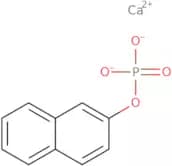
CAS :Calcium 2-naphthylphosphate, which is the calcim salt of 2-naphthylphosphate, is a chromogenic substrate to measure alkaline phosphatase activity. After enzymatic cleavage, the product yielded (2-naphthol) generates a red-colored complex upon reaction with a diazonium salt like Fast Blue RR or Fast Garnet GBC.
Degré de pureté :(%) Min. 95%Couleur et forme :PowderMasse moléculaire :282.24 g/mol2-Nitrophenyl b-L-fucopyranoside
CAS :2-Nitrophenyl beta-L-fucopyranoside is a chromogenic substrate used to detect the enzymatic activity of beta-L-fucosidase. After cleavage, the nitrophenyl moiety is released exhibiting a light yellowish color. 2-Nitrophenyl beta-L-fucopyranoside is used in bacterial fucose metabolism studies to identify and quantify the enzymatic activity in, for example, Bacteroides spp..Degré de pureté :Min. 98 Area-%Couleur et forme :PowderMasse moléculaire :285.25 g/mol4-Nitrophenyl laurate
CAS :4-Nitrophenyl laurate is a chromogenic substrate for lipase. Upon hydrolysis, para-nitrophenol is released yielding a yellowish colour. 4-Nitrophenyl laurate is used in different applications such as the Lipase activity screening, clinical diagnosticsFormule :C18H27NO4Degré de pureté :Min. 95%Couleur et forme :White PowderMasse moléculaire :321.41 g/mol2-Nitrophenyl butyrate
CAS :2-Nitrophenyl butyrate is a chromogenic enzyme substrate that is commonly used in enzymatic assays to detect lipases and esterases. When hydrolyzed by these enzymes, the substrate yields a yellow product that can be detected spectrophotometrically at 405 nm. The advantage of using 2-nitrophenyl butyrate is its high sensitivity and specificity for detecting lipolytic and esterolytic activities. This substrate is widely used in various applications, including enzyme kinetics studies, inhibitor screening, and the determination of esterase activity in biological samples such as serum, plasma, and cell lysates.
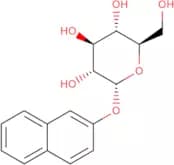
Formule :C10H11NO4Degré de pureté :Min. 95%Couleur et forme :Clear LiquidMasse moléculaire :209.2 g/mol2-Naphthyl a-D-glucopyranoside
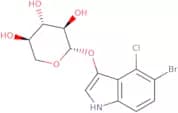
CAS :2-Naphthyl-lpha-D-glucopyranoside is a substrate for α-glucosidase. 2-Naphthol is released upon hydrolyzation. By simultaneous coupling with a suitable staining reagent, such as hexazonium p-rosaniline, the corresponding reddish-brown azo-dye is formed. Naphthols can also be detected by fluorescence analysis.Formule :C16H18O6Degré de pureté :Min. 98 Area-%Couleur et forme :PowderMasse moléculaire :306.31 g/mol5-Bromo-4-chloro-3-indolyl β-D-xylopyranoside
CAS :5-Bromo-4-chloro-3-indolyl b-D-xylopyranoside is an enzyme substrate. This chromogenic substrate is used for beta-D-xylosidase enzyme. In culture media, 5-Bromo-4-chloro-3-indolyl b-D-xylopyranoside is utilised for identification of bacteria such as Klebsiella and Enterobacter.
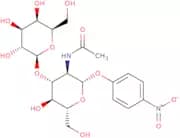
Formule :C13H13BrClNO5Degré de pureté :Min. 95%Couleur et forme :PowderMasse moléculaire :378.6 g/mol4-Nitrophenyl 2-acetamido-2-deoxy-3-O-(b-D-galactopyranosyl)-b-D-glucopyranoside
CAS :Chromogenic substrate for fucosyltransferasesFormule :C20H28N2O13Degré de pureté :Min. 98 Area-%Couleur et forme :White PowderMasse moléculaire :504.44 g/mol2-Nitrophenyl α-D-glucopyranoside
CAS :2-Nitrophenyl a-D-glucopyranoside is a chromogenic substrate commonly used to assay the activity of glucosidases. Upon cleavage of the glycosidic bond by glucosidases, the released 2-nitrophenyl group yields a yellow color detectable by spectrophotometry. This substrate has high sensitivity and is widely used in a variety of applications, including drug discovery and enzyme kinetics studies.
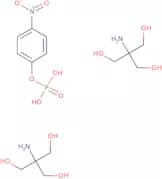
Formule :C12H15NO8Degré de pureté :Min. 95%Couleur et forme :White to off-white solid.Masse moléculaire :301.25 g/mol4-Nitrophenyl phosphate bis(tris) salt
CAS :Substrate for alkaline phosphataseFormule :C6H6NO6P•(C4H11NO3)2Degré de pureté :(%) Min. 99%Couleur et forme :PowderMasse moléculaire :461.36 g/molAldol® 470 butyrate, Biosynth Patent: EP 2427431 and US 8940909
CAS :Produit contrôléAldol® 470 butyrate, a chromogenic substrate manufactured by Cymit Quimica and used for enzymatic assays that produces a yellow-orange color upon enzymatic cleavage.Formule :C27H25NO5Degré de pureté :Min. 95%Couleur et forme :PowderMasse moléculaire :443.5 g/mol5-Bromo-4-chloro-3-indoxyl oleate
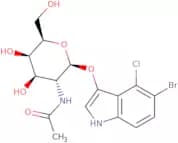
CAS :5-Bromo-4-chloro-3-indoxyl oleate is a chromogenic substrate used to detect the specific enzymatic activity of lipase. After cleavage, 5-bromo-4-chloro-indoxyl is released, resulting in a blue to blue-green color change in bacterial colonies or media. 5-Bromo-4-chloro-3-indoxyl oleate is used in lipid metabolism disorder screening.Formule :C26H37BrClNO2Degré de pureté :Min. 95%Couleur et forme :PowderMasse moléculaire :510.93 g/mol5-Bromo-4-chloro-3-indoxyl-N-acetyl-beta-D-galactosaminide
CAS :5-Bromo-4-Chloro-3-Indoxyl-N-Acetyl-Beta-D-Galactosaminide is a chromogenic substrate for detecting beta-galactosidase and GalNAc-transferase enzymes. Upon hydrolysis by the enzyme, it produces a blue-green colored compound that can be detected visually or measured spectrophotometrically. This substrate is useful in characterizing the activity of Beta-Galactosidase and GalNAc-transferase enzymes involved in glycobiology research and diagnostic applications.Formule :C16H18BrClN2O6Degré de pureté :Min. 98 Area-%Couleur et forme :Crystalline PowderMasse moléculaire :449.68 g/mol