Substrats chromogènes
Les substrats chromogènes sont des composés qui produisent un changement de couleur visible lorsqu'ils sont métabolisés par des enzymes spécifiques. Ces substrats sont largement utilisés dans les tests diagnostiques, la recherche biochimique et les dosages immuno-enzymatiques (ELISA) pour détecter et quantifier l'activité enzymatique. Le changement de couleur permet une identification visuelle facile et rapide des réactions enzymatiques, faisant des substrats chromogènes des outils essentiels en analyse de laboratoire. Chez CymitQuimica, nous proposons une large sélection de substrats chromogènes de haute qualité pour soutenir vos applications de recherche et de diagnostic.
712 produits trouvés pour "Substrats chromogènes"
Trier par
Degré de pureté (%)
0
100
|
0
|
50
|
90
|
95
|
100
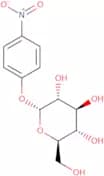
4-Nitrophenyl a-D-glucopyranoside
CAS :<p>Chromogenic substrate for alpha-glucosidase</p>Formule :C12H15NO8Degré de pureté :Min. 98 Area-%Couleur et forme :White PowderMasse moléculaire :301.25 g/mol5-Amino-3-indoxyl-β-D-galactopyranoside
<p>5-Amino-3-indoxyl-b-D-galactopyranoside is a chromogenic substrate for the enzyme galactosidase. 5-Amino-3-indoxyl-b-D-galactopyranoside is used in diagnostic tests to identify the presence of lactose intolerance. It can also be used to detect traces of blood in food, water, and other substances. This product has a high purity that makes it suitable for conjugation applications.</p>Formule :C14H18N2O6Degré de pureté :Min. 95%Masse moléculaire :310.31 g/mol4-Nitrophenyl-β-D-glucopyranoside
CAS :<p>4-Nitrophenyl-beta-D-glucopyranoside is a fluorescent probe that can be used in the study of the biochemical properties of enzymes. This compound binds to the enzyme's active site, which allows for transfer reactions to occur. 4-Nitrophenyl-beta-D-glucopyranoside is an artificial substrate that is biochemically inert and has a similar physical structure to natural substrates. It can be used as a model system to study enzymatic reactions and has been shown to have pharmacokinetic properties and a pH optimum. The detection sensitivity of this compound is high, making it ideal for use in biochemical studies.</p>Formule :C12H15NO8Degré de pureté :Min. 99.0 Area-%Masse moléculaire :301.25 g/molRef: 3D-N-4401
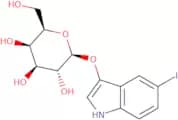
Produit arrêté5-Iodo-3-indolyl b-D-galactopyranoside
CAS :<p>5-Iodo-3-indolyl b-D-galactopyranoside is a chromogenic substrate used for beta-galactosidase. It is incorporated into media or detection kits for rapid and direct identification of microorganisms.</p>Formule :C14H16INO6Degré de pureté :Min. 98 Area-%Couleur et forme :PowderMasse moléculaire :421.18 g/mol5-Bromo-4-chloro-3-indoxyl-beta-D-glucuronic acid, sodium salt trihydrate
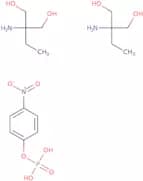
CAS :<p>Chromogenic substrate for beta-glucuronidase (GUS) yielding blue precipitate upon cleavage. Used for identification of beta-glucuronidase. X-beta-D-glucuronide has been reported as chromogenic substrate in a number of chromogenic E. coli/ coliform culture media. About 95% of common E. coli possess beta-D-glucuronidase activity. Such chromogenic culture media are used for detection and enumeration of E. coli in food samples such as meat, dairy products and shellfish and have clinical applications in the assessment of urinary infections. It has gained international acceptance as highly accurate test for the presence of E. coli in drinking water samples. It is also used for the detection of the expression of GUS (E. coli beta-glucuronidase) gene fusion marker constructs in plants. The sodium salt has advantages over the cyclohexylammonium salt as being non-electrostatic and possessing a naturally-occurring cation.</p>Formule :C14H18BrClNNaO10Degré de pureté :Min. 99.0 Area-%Masse moléculaire :498.65 g/mol4-Nitrophenyl phosphate mono(2-amino-2-ethyl-1,3-propanediol) salt monohydrate
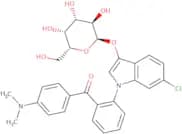
CAS :<p>Chromogenic substrate for alkaline phosphatase</p>Formule :C26H32N3NaO6S2Degré de pureté :Min. 95%Couleur et forme :PowderMasse moléculaire :457.41 g/molAldol® 518 α-D-galactopyranoside, Biosynth Patent: EP 2427431 and US 8940909
CAS :<p>Aldol® 518 alpha-D-galactopyranoside is a chromogenic and fluorogenic enzyme substrate used for detection of alpha-galactosidase activity. The enzyme substrate is cleaved by alpha-galactosidase positive bacteria and yeasts in liquid or solid media, yielding red color and red fluorescence signal. Aldol® 518 alpha-D-galactopyranoside can also be used to detect alpha-galactosidase (encoded by the Mel1 gene) in yeast gene reporter assays or for identification of alpha-gal positive transformants on agar plates. Aldol® 518 alpha-D-galactopyranoside can be used under aerobic and anaerobic conditions.</p>Formule :C29H29ClN2O7Degré de pureté :Min. 95%Couleur et forme :PowderMasse moléculaire :553.01 g/molAldol® 455 beta-D-glucopyranoside - Biosynth Patent: EP 2427431 and US 8940909
<p>Aldol® 455 is a substrate for the enzyme beta-galactosidase. It is used in food testing, staining, and environmental testing. Aldol® 455 has been shown to be a good substrate for fluorogenic and chromogenic substrates. It can be conjugated with an antibody or other ligand for use in immunoassays. Aldol® 455 is of high purity and high quality, making it suitable for use in diagnostics and as an enzyme substrate. This product can also be used as a culture media additive.</p>Degré de pureté :Min. 95%Aldol® 467 N-acetyl-beta-D-glucosaminide, Biosynth Patent: EP 2427431 and US 8940909
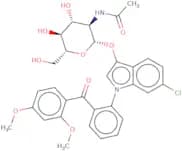
CAS :<p>Aldol® 467 N-acetyl-beta-D-glucosaminide is a chromogenic and fluorogenic enzyme substrate used for detection of beta-N-acetyl-glucosaminidase activity. The colorless enzyme substrate is cleaved in the presence of beta-N-acetyl-glucosaminidase yielding development of a yellow product. In addition, green fluorescence is generated when a suitable matrix or Aldol® 355 fluorescence enhancer is present. Aldol® 467 N-acetyl-beta-D-glucosaminide amide can be used in enzymatic assays or in live bacterial cultures. Aldol® 467 N-acetyl-beta-D-glucosaminide is suitable for use in liquid and solid media, under aerobic as well as anaerobic conditions.</p>Formule :C31H31ClN2O9Degré de pureté :Min. 95%Couleur et forme :PowderMasse moléculaire :611.04 g/mol5-Bromo-4-chloro-3-indoxyl-a-D-xylopyranoside
<p>5-Bromo-4-chloro-3-indoxyl-a-D-xylopyranoside is a fluorogenic substrate that can be used in food testing and environmental testing. This product is a conjugate of the xylosidase enzyme (EC 3.2.1.37) with 5-bromo-4-chloroindoxyl, which has been shown to have a high affinity for the enzyme's active site and enzymatic activity. The purity of this product is > 95% and the CAS number is 68618-41-5.</p>Degré de pureté :Min. 95%N-Benzoyl-Val-Gly-Arg p-nitroanilide hydrochloride
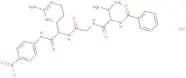
CAS :<p>N-Benzoyl-Val-Gly-Arg p-nitroanilide hydrochloride is a fluorogenic substrate that can be used for the detection of β-glucuronidase. It has been shown to have high purity and quality, which makes it an excellent choice for use in food testing and staining.</p>Formule :C26H34N8O6•HClDegré de pureté :Min. 95%Masse moléculaire :591.06 g/mol3-Amino-9-ethylcarbazole
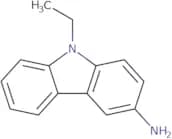
CAS :<p>3-Amino-9-ethylcarbazole is a peroxidase substrate suitable for use in immunoblotting and immunohistochemical staining procedures. This substrate produces an insoluble end product that is red in color and can be observed visually.</p>Formule :C14H14N2Degré de pureté :Min. 95%Couleur et forme :Beige PowderMasse moléculaire :210.27 g/mol