

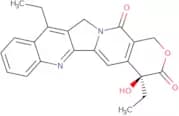

Informations sur le produit
Nom:7-Ethyl camptothecin
Synonymes :
- (4S)-4,11-Diethyl-4-hydroxy-1H-pyrano[3',4':6,7]indolizino[1,2-b]quinoline-3,14(4H,12H)-dione7-Ethyl-20(S)-camptothecinSN 22
Marque:Biosynth
Description :Camptothecin is a natural product that belongs to the ester family of compounds. It has been isolated from the bark of Camptotheca acuminata, a tree native to China. Camptothecin inhibits cancer cell growth by binding to DNA and interrupting DNA replication and transcription. The drug also binds to RNA polymerase II and blocks RNA synthesis. Camptothecins have a low therapeutic index, meaning that the effective dose may be too high for some patients. This drug is not suitable for use in postharvest treatments because it is unstable under these conditions.
The anticancer activity of camptothecin was first observed in 1974 when researchers noted that this drug had an inhibitory effect on tumor xenografts in mice. The mechanism by which camptothecin exerts its effects on cells has not been fully elucidated but it is thought that this drug interacts with choline molecules on the surface of cancer cells, inhibiting their repair mechanisms and leading to
The anticancer activity of camptothecin was first observed in 1974 when researchers noted that this drug had an inhibitory effect on tumor xenografts in mice. The mechanism by which camptothecin exerts its effects on cells has not been fully elucidated but it is thought that this drug interacts with choline molecules on the surface of cancer cells, inhibiting their repair mechanisms and leading to
Avis:Nos produits sont destinés uniquement à un usage en laboratoire. Pour tout autre usage, veuillez nous contacter.
Propriétés chimiques
Masse moléculaire :376.41 g/mol
Formule :C22H20N2O4
Degré de pureté :Min. 95%
InChI :InChI=1S/C22H20N2O4/c1-3-12-13-7-5-6-8-17(13)23-19-14(12)10-24-18(19)9-16-15(20(24)25)11-28-21(26)22(16,27)4-2/h5-9,27H,3-4,10-11H2,1-2H3/t22-/m0/s1
Code InChI :InChIKey=MYQKIWCVEPUPIL-QFIPXVFZSA-N
SMILES :CCc1c2c(nc3ccccc13)-c1cc3c(c(=O)n1C2)COC(=O)[C@]3(O)CC