AC-25859 - buffer-solution-ph-7-phosphate-buffer | 7558-79-4
Désolé, aucun produit avec la référence AC-25859 n'a été trouvé, cependant nous vous invitons à consulter les produits similaires suivants:
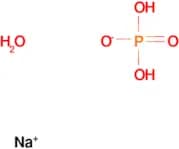
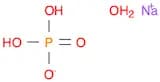
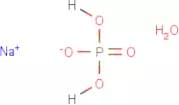
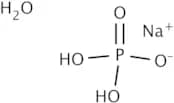
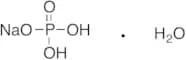
Sodium phosphate monobasic monohydrate
CAS :Degré de pureté :99.0%Couleur et forme :Solid, Crystalline PowderMasse moléculaire :137.99099731445312Sodium dihydrogen phosphate monohydrate, Puratronic™, 99.998% (metals basis)
CAS :sodium phosphoric acid hydrateFormule :H5NaO5PDegré de pureté :99.998%Masse moléculaire :139.00Sodium dihydrogen phosphate monohydrate, ACS, 98.0-102.0%
CAS :sodium phosphoric acid hydrateFormule :H5NaO5PDegré de pureté :98.0-102.0%Couleur et forme :White, Powder or crystals or crystalline powderMasse moléculaire :139.00Phosphoric acid, monosodium salt, monohydrate (8CI,9CI)
CAS :Formule :H4NaO5PDegré de pureté :98%Couleur et forme :SolidMasse moléculaire :137.9923Sodium dihydrogen phosphate monohydrate (99.9%-Na)
CAS :Sodium dihydrogen phosphate monohydrate (99.9%-Na)
Formule :NaH2PO4·H2ODegré de pureté :(99.9%-Na)Couleur et forme :white pwdr.Masse moléculaire :120.05 (137.99)Sodium di-Hydrogen Phosphate 1-hydrate (Reag. USP, Ph. Eur.) for analysis, ACS
CAS :Sodium di-Hydrogen Phosphate 1-hydrate (Reag. USP, Ph. Eur.) for analysis, ACS
Masse moléculaire :137.99g/molSodium Dihydrogen Phosphate Monohydrate
CAS :Sodium Dihydrogen Phosphate MonohydrateDegré de pureté :≥95%Couleur et forme :White SolidMasse moléculaire :137.99g/molSodium phosphate monobasic monohydrate
CAS :Formule :H2NaO4P·H2ODegré de pureté :(Titration) 98.0 - 103.0 % (NaH2PO4, anhydrous basis)Couleur et forme :Colourless or white crystalsMasse moléculaire :137.99Sodium phosphate monobasic monohydrate, 99%, GlenBiol™, suitable for molecular biology
CAS :Formule :H2NaO4P·H2ODegré de pureté :(Titration) 99.0 - 101.0 %Couleur et forme :White to off-white powder or crystalsMasse moléculaire :137.99Sodium Phosphate Monobasic Monohydrate
CAS :Applications Sodium Phosphate Monobasic Monohydrate is often used in foods and in water treatment. it can be used as a buffer to adjust pH. In medicine, it is sometimes used as a stimulant laxative before certain operations and medical procedures.
References Krajewska, B., et al.: Biocat. Biotrans., 23, 225 (2005); Aliabadi, H., et al.: Am. J. Health-System Pharm., 65, 441 (2008); Henderson, J., et al. Gastrointestinal endoscopy 42, 238 (1995)Formule :Na·H2O·H2O4PCouleur et forme :NeatMasse moléculaire :137.99Sodium phosphate monobasic monohydrate
CAS :Sodium phosphate monobasic monohydrate is a nonsteroidal anti-inflammatory drug that belongs to the class of sodium salts. It is used to treat bowel disease and has been shown to reduce the production of prostaglandins in the stomach, which are mediators of inflammation. Sodium phosphate monobasic monohydrate can also be used for its anti-inflammatory effects on other parts of the body, such as joints or muscles. This drug is often used for rheumatoid arthritis, osteoarthritis, or ankylosing spondylitis. The molecular weight of this compound is 288.3 g/mol and it has a melting point of 519°C. Sodium phosphate monobasic monohydrate can be administered orally or intravenously and should not be given with food or antacids due to its high solubility in water. Sodium phosphate monobasic monohydrate also has potential cytotoxicity and significant cytotoxicity against human cells in vitroFormule :H2NaO4P·H2ODegré de pureté :Min. 98 Area-%Couleur et forme :PowderMasse moléculaire :137.99 g/molSodium Phosphate Monobasic Monohydrate extrapure AR, 99%
CAS :Formule :NaH2PO4·H2ODegré de pureté :min. 99%Couleur et forme :White, Crystalline powder, Clear, ColourlessMasse moléculaire :137.99Sodium Phosphate Monobasic Monohydrate for HPLC, 99%
CAS :Formule :NaH2PO4·H2ODegré de pureté :min. 99%Couleur et forme :White, Crystalline powder, Clear, ColourlessMasse moléculaire :137.99N-Carbamoyl-L-cysteine
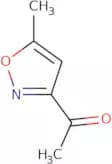
N-Carbamoyl-L-cysteine is a synthetic amino acid that can be used to immobilize proteins onto solid surfaces. This immobilization technique is often used in the study of enzyme activities and reaction mechanisms. N-Carbamoyl-L-cysteine binds to the enzyme's active site, thereby preventing it from reacting with its substrate. The binding studies have been shown using a number of immobilized enzymes, including trypsin, chymotrypsin, and papain. The immobilization process has been shown using a reaction solution containing 0.1 M phosphate buffer (pH 7) and 10 mM of N-carbamoyl-L-cysteine. Immobilization has also been performed on an immobilized enzyme mutant strain to test its stability and activity following the binding process. N-Carbamoyl-L-cysteine's chemical structure includes two reactive groups: the carbamic acid groupFormule :C4H8N2O3SDegré de pureté :Min. 95%Couleur et forme :White To Off-White SolidMasse moléculaire :164.18 g/mol1-(5-Methylisoxazol-3-yl)ethanone
1-(5-Methylisoxazol-3-yl)ethanone is a synthetic compound that has been shown to react with metal ions. It was found to be reactive in hydrochloric acid and spontaneous in alkaline solutions. The compound was catalysed by the presence of acids and analytical methods were developed for its detection in acidic, neutral, and basic solutions. Densities of 1-(5-methylisoxazol-3-yl)ethanone are 1.07 g/mL at 25°C and 1.076 g/mL at 100°C. Buffers used for its analysis include: phosphate buffer pH 7, sodium acetate buffer pH 5, sodium citrate buffer pH 4, potassium phosphate buffer pH 6, ammonium chloride buffer pH 9, ammonium acetate buffer pH 8, potassium chloride buffer pH 10, ammonium sulfate buffer pH 11.Formule :C6H7NO2Degré de pureté :Min. 95%Masse moléculaire :125.13 g/mol3,4-Dimethoxy-2-methylpyridine
3,4-Dimethoxy-2-methylpyridine (DMMP) is an experimental drug that has been shown to have pharmaceutical properties. This compound was synthesized by reacting methylamine with 3,4-dimethoxyphenylacetonitrile in the presence of methanol and sodium hydroxide. DMMP has a buffer capacity of 1.6 meq/g at pH 4.5 and a pKa of 9.6. The reduction process for DMMP can be done electrochemically or chemically using palladium on activated carbon or acetic acid as a catalyst. DMMP has been shown to exhibit cyclic voltammetric behavior with a half-wave potential of 0.78 V and an oxidation frequency of 1.1 Hz at +0.8 V vs Ag/AgCl reference electrode in 2 M tetrahydrofuran solution containing 0.1 M phosphate buffer (pH 7). Optimization studies have shownFormule :C8H11NO2Degré de pureté :Min. 95%Masse moléculaire :153.18 g/mol