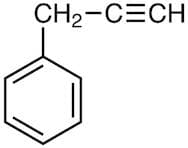
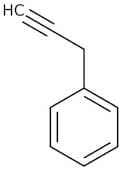
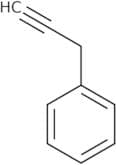
CAS 10147-11-2
:3-fenil-1-propino
- Benzene, (2-propynyl)-
- (2-Propynyl)benzene
- Prop-2-Yn-1-Ylbenzene
- 3-Phenyl-1-propyne, stabilized, 97% 5GR
- 3-Phenyl-1-propyne contains ca.250 ppm BHT as inhibitor, 97%
- 3-Phenyl-1-propyne (stabilized with BHT)
- 3-Phenyl-1-propyne,97%,stabilized
- 3-PHENYL-1-PROPYNE
- Benzylacetylene
- 3-Phenyl-1-propyne ,96% [stabilized]
- 3-PHENYL-1-PROPYNE 97%
- Propargylbenzene
- 3-Phenyl-1-propyne, 97%, stab.
- prop-2-ynylbenzene
- 3-Phenyl-1-propyne, stabilized, 97%
- 3-Phenyl-1-propyne, stabilized, 97% 1GR
- Vedi altri sinonimi
3-Phenyl-1-propyne (stabilized with BHT)
CAS:Formula:C9H8Purezza:>95.0%(GC)Colore e forma:Colorless to Light orange to Yellow clear liquidPeso molecolare:116.163-Phenyl-1-propyne, 97%, stab.
CAS:3-Phenyl-1-propyne is used as a starting material in the synthesis of 4-phenyl-2-butyn-1-ol. It is also used in the preparation of beta-hydroxytriazoles and indoles. This Thermo Scientific Chemicals brand product was originally part of the Alfa Aesar product portfolio. Some documentation and label iFormula:C9H8Purezza:97%Colore e forma:Colorless to yellow, LiquidPeso molecolare:116.163-Phenyl-1-propyne (stabilised with BHT)
CAS:Formula:C9H8Purezza:95.0%Colore e forma:Liquid, Clear colourless to yellow liquidPeso molecolare:116.1633-Phenylpropyne
CAS:Prodotto controllatoApplications 3-Phenylpropyne is a useful synthetic intermediate. It is an intermediate used to synthesize carlina oxide. It can also be used to prepare triazole substituted pyrazolopyrimidinamide derivatives via click chemistry as potential inhibitors of the Plasmodium falciparum PfPK7 protein kinase.
Not a dangerous good if item is equal to or less than 1g/ml and there is less than 100g/ml in the package
References Klein, M., et al.: Org. Biomol. Chem., 7, 3421 (2009)Formula:C9H8Colore e forma:NeatPeso molecolare:116.163-Phenyl-1-propyne
CAS:3-Phenyl-1-propyne is a molecule that belongs to the class of indolizinones. It has been shown to have antiviral activity and inhibit the protease activity of serine proteases such as trypsin, chymotrypsin, and elastase. 3-Phenyl-1-propyne also inhibits viral replication in Hepatitis B virus (HBV) and Hepatitis C virus (HCV) in vitro. In addition, it has been found to stabilize functional groups such as amino acid residues on the surface of proteins. This property may be useful for developing novel protein molecules with improved stability or function. 3-Phenyl-1-propyne can be synthesized by reacting phenols with propyne in an elimination reaction. The isolated yield for this reaction is 70%. The product is a mixture of two stereoisomers that are separated by hydrogen bonding interactions. 3-Phenyl-
Formula:C9H8Purezza:Min. 95%Colore e forma:Clear LiquidPeso molecolare:116.16 g/mol