CAS 104-10-9
:2-(4-Aminofenil)etanolo
Descrizione:
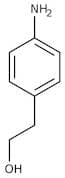
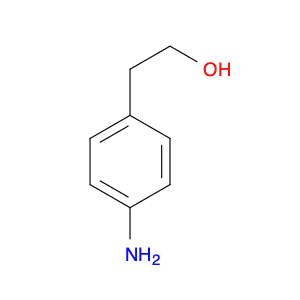
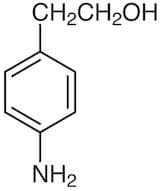
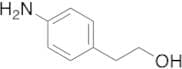
2-(4-Aminofenil)etanolo, noto anche come para-amminofenilethanolo, è un composto organico caratterizzato dalla presenza di un gruppo amminico (-NH2) e di un gruppo idrossile (-OH) attaccati a un anello fenilico. Questo composto presenta una catena etilica di due carboni che collega il gruppo fenilico sostituito da ammino al gruppo idrossile. Tipicamente è un solido bianco a bianco sporco a temperatura ambiente ed è solubile in acqua e solventi organici grazie ai suoi gruppi funzionali polari. La presenza del gruppo amminico conferisce proprietà basiche, permettendogli di partecipare a varie reazioni chimiche, tra cui acilazione e alchilazione. 2-(4-Aminofenil)etanolo è di interesse nella chimica medicinale e può fungere da precursore nella sintesi di farmaci, in particolare nello sviluppo di analgesici e agenti antinfiammatori. Inoltre, può essere utilizzato nella produzione di coloranti e come reagente nella sintesi organica. Devono essere osservate precauzioni di sicurezza quando si maneggia questo composto, poiché può comportare rischi per la salute in caso di esposizione.
Formula:C8H11NO
InChI:InChI=1S/C8H11NO/c9-8-3-1-7(2-4-8)5-6-10/h1-4,10H,5-6,9H2
InChI key:InChIKey=QXHDYMUPPXAMPQ-UHFFFAOYSA-N
SMILES:C(CO)C1=CC=C(N)C=C1
Sinonimi:- 2-(4-Amino-phenyl)ethanol
- 2-(4-Aminophenyl) ethanol
- 2-(4-Aminophenyl)-1-ethanol
- 2-(4-Aminophenyl)ethyl alcohol
- 2-(p-Aminophenyl)ethanol
- 4-(2-Hydroxyethyl)aniline
- 4-(2-Hydroxyethyl)phenylamine
- 4-Amino Phenethyl Alcohol
- 4-Aminobenzeneethanol
- 4-Aminophenethyl alcohol
- Benzeneethanol, 4-amino-
- NSC 409780
- P-Amino Phenethyl Alcohol
- P-Aminophenethyl Alcohol
- Phenethyl alcohol, p-amino-
- Vedi altri sinonimi
Ordinare per
Purezza (%)
0
100
|
0
|
50
|
90
|
95
|
100
10 prodotti.
2-(4-Aminophenyl)ethanol, 97%
CAS:2-(4-Aminophenyl)ethanol is used as nonsymmetric monomer in the preparation of ordered [head-to-head (H-H) or tail-to-tail (T-T)] poly(amide-ester), in the synthesis of 4-aminostyrene and in functionalization of graphene nanoplatelets. This Thermo Scientific Chemicals brand product was originallyFormula:C8H11NOPurezza:97%Colore e forma:Pale cream to cream to yellow to brown, Crystals or powder or crystalline powder or lumps or granulesPeso molecolare:137.184-Aminophenethyl alcohol
CAS:4-Aminophenethyl alcoholFormula:C8H11NOPurezza:≥95%Colore e forma: brown crystalline powderPeso molecolare:137.17903g/mol2-(4-Aminophenyl)ethanol
CAS:Formula:C8H11NOPurezza:>98.0%(GC)(T)Colore e forma:White to Light yellow to Light orange powder to crystalPeso molecolare:137.184-Aminophenethyl alcohol
CAS:Formula:C8H11NOPurezza:95%Colore e forma:Solid, Chunks or Crystalline PowderPeso molecolare:137.1824-Aminophenethyl Alcohol
CAS:Prodotto controllatoApplications 4-Aminophenethyl Alcohol, is a building block that can be used in the synthesis of various compounds, such as in synthesis of 4-aminostyrene, and in functionalization of graphene nanoplatelets.
References Li L, et al.Polymer Journal 33(4), 364-370; Hagiwara T, et al. Macromolecules 24(26), 6856-6858, (1991);Formula:C8H11NOColore e forma:NeatPeso molecolare:137.18Ref: ST-EA-CP-G91005
10mgPrezzo su richiesta25mgPrezzo su richiesta50mgPrezzo su richiesta100mgPrezzo su richiesta4-Aminophenethyl alcohol
CAS:4-Aminophenethyl alcohol is a monosubstituted, basic compound that is used in the laboratory as a cell culture medium supplement to promote growth of fibroblasts. This compound has been shown to stimulate human intestinal cells and human peripheral blood mononuclear cells. 4-Aminophenethyl alcohol acts as a hydroxyl group donor, which may be due to its ability to form hydrogen ions when reacted with sodium hydroxide solution. The reaction of this compound with diazonium salt produces an intermediate, which can be hydrolyzed by the addition of sodium hydroxide solution. The resultant chloride ion reacts with the aminophenethyldihydroxylamine (APDA) moiety to produce APDCl. This product has been shown to increase the population growth rate of fibroblasts in culture by causing DNA synthesis and protein synthesis. Linear regression analysis revealed that there was no statistically significant difference between the control and experimental groups for either DNAFormula:C8H11NOPurezza:Min. 95%Peso molecolare:137.18 g/mol