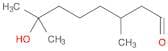
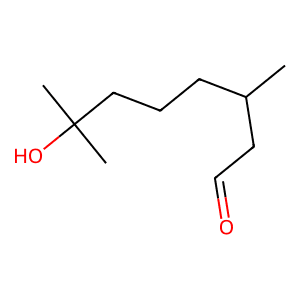
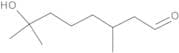
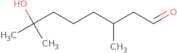
CAS 107-75-5
:Idrossicitronellale
Descrizione:
Idrossicitronellale, con il numero CAS 107-75-5, è un composto organico classificato come un monoterpenoide e un aldeide. È un liquido incolore a giallo pallido con un odore floreale e agrumato, rendendolo un ingrediente popolare in profumi e cosmetici. Idrossicitronellale è solubile in alcol e oli, ma ha una solubilità limitata in acqua. La sua formula molecolare è C10H18O e presenta un gruppo idrossile (-OH) e un gruppo aldeidico (-CHO), contribuendo alla sua reattività e proprietà aromatiche. Questo composto è spesso utilizzato come esaltatore di fragranze ed è anche noto per le sue potenziali proprietà allergeniche, il che ha portato a un controllo normativo nelle formulazioni cosmetiche. Inoltre, Idrossicitronellale può essere sintetizzato a partire da citronellal, un componente naturale derivato da oli essenziali. Le sue applicazioni si estendono oltre la profumeria per includere l'uso in agenti aromatizzanti e come potenziale intermedio nella sintesi organica. I dati di sicurezza indicano che deve essere maneggiato con cura, poiché può causare irritazione della pelle in individui sensibili.
Formula:C10H20O2
InChI:InChI=1S/C10H20O2/c1-9(6-8-11)5-4-7-10(2,3)12/h8-9,12H,4-7H2,1-3H3
InChI key:InChIKey=WPFVBOQKRVRMJB-UHFFFAOYSA-N
SMILES:C(C(C)(C)O)CCC(CC=O)C
Sinonimi:- (±)-Hydroxycitronellal
- 3,7-Dimethyl-7-Hydroxyoctanal
- 3,7-Dimethyl-7-hydroxyoctan-1-al
- 7-Hydroxy-3,7-dimethyloctanal
- Citronellal hydrate
- Citronellal, hydroxy-
- Cyclalia
- Cyclosia
- Cyclosia base
- Fixol
- Laurine
- Lilyl aldehyde
- Muguet synthetic
- Muguettine principle
- NSC 406740
- Octanal, 7-hydroxy-3,7-dimethyl-
- Vedi altri sinonimi
Ordinare per
Purezza (%)
0
100
|
0
|
50
|
90
|
95
|
100
7 prodotti.
7-Hydroxy-3,7-dimethyloctanal
CAS:Formula:C10H20O2Purezza:95%Colore e forma:LiquidPeso molecolare:172.26467-Hydroxycitronellal
CAS:7-HydroxycitronellalFormula:C10H20O2Purezza:95%Colore e forma: clear. colourless liquidPeso molecolare:172.26g/mol7-Hydroxy-3,7-dimethyloctanal
CAS:7-Hydroxy-3,7-dimethyloctanal has extremely weak agonist activity against TRPM8 (EC50 = 1960 µM) and can be used in related research in the field of life sciences.
Formula:C10H20O2Colore e forma:SolidPeso molecolare:172.267-Hydroxycitronellal
CAS:Prodotto controllatoStability Air Sensitive
Applications 7-Hydroxycitronellal shows fungicide activity the strains of Candida tropicalis.
References Filho, O., et al.: Bioscience Journal, 33, 204 (2017)Formula:C10H20O2Colore e forma:NeatPeso molecolare:172.267-Hydroxy-3,7-dimethyloctanal
CAS:Formula:C10H20O2Purezza:95%Colore e forma:Liquid, No data available.Peso molecolare:172.268Citronellal hydrate
CAS:Citronellal hydrate is a chemical substance that is found in many essential oils, such as citronella, lemon grass, and citronella. It has been shown to have significant effects on the human metabolism and urine samples. Citronellal hydrate can be used as a preservative due to its ability to inhibit bacterial growth, including bacteria that are resistant to benzalkonium chloride. Citronellal hydrate also has been shown to have an effect on cell maturation, which may be predictive for the development of cancer cells. Citronellal hydrate is present in many natural products that are used in cosmetics and personal care products. It is a good analytical method for identifying the presence of other chemicals in a sample because it has been shown to react with molecules such as alcohols, amines, ketones, esters, and ethers. Citronellal hydrate reacts with these molecules by altering their mass through an electron-transfer process called triple-Formula:C10H20O2Purezza:Min. 95%Peso molecolare:172.26 g/mol