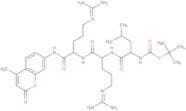
CAS 109358-46-5
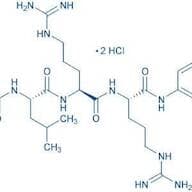
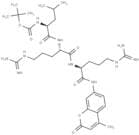
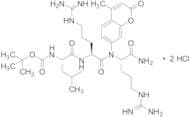
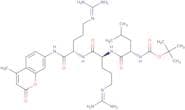
:Boc-Leu-Arg-Arg-AMC . 2 HCl
Descrizione:
Boc-Leu-Arg-Arg-AMC·2 HCl, noto anche come substrato peptidico, è un composto sintetico comunemente utilizzato nella ricerca biochimica, in particolare negli studi che coinvolgono proteasi e attività enzimatiche. Il gruppo "Boc" (tert-butilossicarbonile) funge da gruppo protettivo per l'aminoacido leucina (Leu), mentre "Arg" denota i residui di arginina, noti per le loro proprietà basiche e il coinvolgimento in vari processi biologici. La parte "AMC" (7-amino-4-metilcumarina) agisce come un reporter fluorescente, consentendo la rilevazione della scissione enzimatica. La presenza di due sali di cloruro (HCl) indica che il composto è in forma salina, il che può migliorare la sua solubilità in soluzioni acquose. Questo composto è tipicamente utilizzato in saggi per monitorare l'attività proteolitica, poiché la scissione del legame peptidico rilascia l'AMC fluorescente, consentendo un'analisi quantitativa. La sua stabilità, solubilità e proprietà fluorescenti lo rendono uno strumento prezioso nella biologia molecolare e nella biochimica per studiare la cinetica enzimatica e la specificità del substrato.
Ordinare per
Purezza (%)
0
100
|
0
|
50
|
90
|
95
|
100
Trovati 6 prodotti.
Boc-Leu-Arg-Arg-AMC · 2 HCl
CAS:Boc-LLR-AMC is a good substrate for the Kex2 endoprotease (kexin, previously known as proteinase yscF), a membrane-bound, calcium-dependent serine protease from yeast α-cells. Boc-LRR-AMC is also used for determining the trypsin-like activity of the proteasome.Formula:C33H52N10O7·2HClPurezza:> 99%Colore e forma:White PowderPeso molecolare:773.76Boc-LRR-AMC
CAS:Boc-LRR-AMC is a fluorogenic 26S/20S proteasome substrate that releases fluorescent AMC upon cleavage, aiding activity quantification.Formula:C33H52N10O7Colore e forma:SolidPeso molecolare:700.83Boc-Leu-Arg-Arg-AMC
CAS:Formula:C33H52N10O7·C2H4O2Purezza:≥ 98.0%Colore e forma:White lyophilised powderPeso molecolare:760.9Boc-Leu-Arg-Arg-AMC·2 HCl
CAS:Prodotto controllatoFormula:C33H52N10O7Colore e forma:NeatPeso molecolare:700.829Boc-Leu-Arg-Arg-AMC dihydrochloride
CAS:Boc-Leu-Arg-Arg-AMC·2 HCl is a soybean trypsin inhibitor that has been used in the study of basic protein synthesis and cellular physiology. This inhibitor binds to the active site of soybean trypsin, preventing it from cleaving peptide bonds. The kinetic of this reaction was studied using Boc-Leu-Arg-Arg-AMC·2 HCl as a substrate and its inhibition by various concentrations of inhibitors. The inhibitory effect on the enzyme activity was measured by following the release of AMC fluorogenic substrate in vitro. Boc-Leu-Arg-Arg-AMC·2 HCl was found to be an effective inhibitor of melanoma antigen formation in vivo when injected into mice with melanoma xenografts. It also decreased tumor growth and increased survival rates in leukemic mice treated with platinum chemotherapy drugs or other pharmacological agents.Formula:C33H52N10O7·2HClPurezza:Min. 95%Peso molecolare:773.75 g/molBoc-Leu-Arg-Arg-AMC
CAS:Boc-Leu-Arg-Arg-AMC is a synthetic, nonpeptide antagonist of the CGRP receptor. It has been shown to inhibit the binding of peptides to the CGRP receptor and is used as a research tool for studying the pharmacology and protein interactions of this receptor. Boc-Leu-Arg-Arg-AMC has been shown to stimulate ion channel activity in vitro. This compound also has an affinity for antibodies that are specific for CGRP receptors, which can be used as a ligand in immunoassays.Formula:C33H52N10O7Purezza:Min. 95%Peso molecolare:700.83 g/mol