CAS 110042-95-0
:Acemannan
Descrizione:
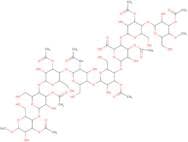
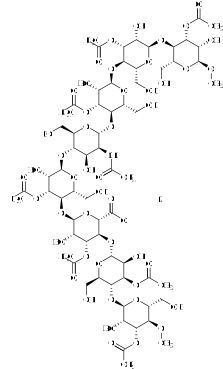
Acemannan è un polisaccaride derivato dal gel della foglia interna della pianta di aloe vera, noto per le sue varie proprietà biologiche. È composto principalmente da mannosio e ha una struttura complessa che include uno scheletro di unità di mannosio collegate da legami β-(1→4), con vari gruppi acetilici e catene laterali. Acemannan presenta proprietà immunomodulanti, anti-infiammatorie e di guarigione delle ferite, rendendolo un ingrediente popolare nelle formulazioni cosmetiche e farmaceutiche. La sua capacità di migliorare l'idratazione della pelle e promuovere la riparazione dei tessuti è attribuita alla sua capacità di stimolare l'attività dei fibroblasti e la sintesi del collagene. Inoltre, Acemannan è stato studiato per i suoi potenziali effetti antivirali e antibatterici, contribuendo al suo utilizzo nella medicina alternativa. La sostanza è generalmente riconosciuta come sicura per l'applicazione topica, sebbene la sua efficacia possa variare in base alla formulazione e alla concentrazione. In generale, Acemannan è apprezzato per il suo potenziale terapeutico ed è ampiamente utilizzato in prodotti per la salute e il benessere.
Formula:C64H97NO49
InChI:InChI=1/C66H101NO49/c1-18(75)67-33-34(83)42(26(11-68)102-59(33)110-44-29(14-71)106-63(38(87)51(44)97-21(4)78)113-46-30(15-72)107-64(39(88)53(46)99-23(6)80)111-45-28(13-70)103-60(94-10)35(84)50(45)96-20(3)77)109-61-37(86)52(98-22(5)79)48(32(17-74)105-61)114-66-41(90)55(101-25(8)82)56(57(116-66)58(91)92)115-65-40(89)54(100-24(7)81)47(31(16-73)108-65)112-62-36(85)49(95-19(2)76)43(93-9)27(12-69)104-62/h26-57,59-66,68-74,83-90H,11-17H2,1-10H3,(H,67,75)(H,91,92)/p-1/t26-,27-,28-,29-,30-,31-,32-,33+,34-,35+,36+,37+,38+,39+,40+,41+,42-,43-,44-,45-,46-,47-,48-,49-,50-,51-,52-,53-,54-,55-,56+,57+,59-,60+,61-,62-,63-,64-,65-,66+/m1/s1
Sinonimi:- (2S,3S,4R,5S,6S)-6-{[(2R,3R,4R,5S,6R)-6-{[(2R,3S,4R,5S,6R)-5-(acetylamino)-6-{[(2R,3R,4R,5S,6R)-4-(acetyloxy)-6-{[(2R,3R,4R,5S,6R)-4-(acetyloxy)-6-{[(2R,3R,4R,5S,6S)-4-(acetyloxy)-5-hydroxy-2-(hydroxymethyl)-6-methoxytetrahydro-2H-pyran-3-yl]oxy}-5-hydroxy-2-(hydroxymethyl)tetrahydro-2H-pyran-3-yl]oxy}-5-hydroxy-2-(hydroxymethyl)tetrahydro-2H-pyran-3-yl]oxy}-4-hydroxy-2-(hydroxymethyl)tetrahydro-2H-pyran-3-yl]oxy}-4-(acetyloxy)-5-hydroxy-2-(hydroxymethyl)tetrahydro-2H-pyran-3-yl]oxy}-4-(acetyloxy)-3-{[(2R,3S,4R,5R,6R)-4-(acetyloxy)-5-{[(2R,3S,4R,5R,6R)-4-(acetyloxy)-3-hydroxy-6-(hydroxymethyl)-5-methoxytetrahydro-2H-pyran-2-yl]oxy}-3-hydroxy-6-(hydroxymethyl)tetrahydro-2H-pyran-2-yl]oxy}-5-hydroxytetrahydro-2H-pyran-2-carboxylate (non-preferred name)
- Acemananan
- Acemananan [INN-Spanish]
- Acemannan [USAN:INN]
- Acemannan hydrogel
- Acemannan is a highly acetylated, polydispersed, linear mannan obtained from the mucilage of Aloe barbadensis, Miller (aloe vera)
- Acemannan is a highly acetylated, polydispersed, linear mannan obtained from the mucilage of Aloe barbadensis, Miller (aloe vera). Molecular weight is 1-2 million daltons
- Acemannanan
- Acemannanum
- Acemannanum [INN-Latin]
- Aloe Vera Mucilage
- Carraklenz Wound & Skin Cleanser
- Carrisyn
- Snow & Sun Sports Gel
- alpha-D-Galacto-beta-D-mannan, (1-4),(1-6)-, acetate
- α-<span class="text-smallcaps">D</smallcap>-Galacto-β-<smallcap>D</span>-mannan, (1→4),(1→6)-, acetate
- α-D-Galacto-β-D-mannan, (1→4),(1→6)-, acetate
- Acemannan
- Ace-m
- Acemannan Q: What is the storage condition of
- Polymannoacetate
- Aids-000120
- Acemannan (Technical Grade)
- Acemannan Q: What is the CAS Number of
- Aids000120
- Vedi altri sinonimi
Ordinare per
Purezza (%)
0
100
|
0
|
50
|
90
|
95
|
100
3 prodotti.
Acemannan
CAS:Acemannan is a natural compound found in the Aloe vera plant and has been used in traditional Chinese medicine for its various health benefits. It has been shown to have anticancer properties by inhibiting cancer cell growth and inducing apoptosis. Acemannan works by targeting various kinases and proteins involved in tumor development, making it an effective inhibitor of cancer progression. This compound has also been found to have angiotensin-converting enzyme (ACE) inhibitory activity, which can help regulate blood pressure. Acemannan analogs have been developed and tested for their potential as anticancer agents, showing promising results in human urine cancer cell lines. Overall, acemannan is a powerful natural compound with many potential health benefits.Formula:C66H101NO49Purezza:Min. 95%Peso molecolare:1,692.5 g/mol