CAS 111-58-0
:Oleoylethanolamide
Descrizione:
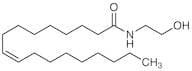
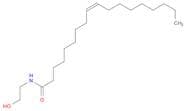
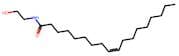
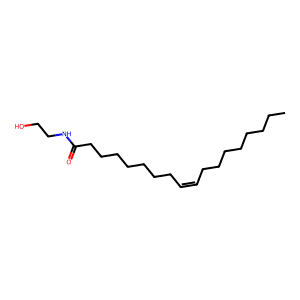
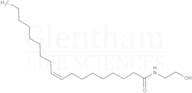
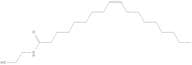
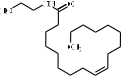
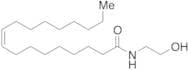
Oleoylethanolamide (OEA) è un etanolamide di acido grasso derivato dall'acido oleico, un comune acido grasso monoinsaturo. È caratterizzato dal suo ruolo come molecola segnalatrice in vari processi biologici, in particolare nella regolazione dell'appetito e dell'omeostasi energetica. Si sa che OEA attiva il recettore alfa attivato da proliferatori di perossisomi (PPAR-α), che gioca un ruolo cruciale nel metabolismo dei lipidi e nell'infiammazione. Questo composto si trova tipicamente nell'intestino tenue ed è prodotto in risposta ai grassi alimentari. OEA è stata studiata per i suoi potenziali effetti terapeutici, inclusa la gestione del peso e le proprietà neuroprotettive. In termini di proprietà fisiche, OEA è un liquido viscoso a temperatura ambiente ed è solubile in solventi organici, ma ha una solubilità limitata in acqua. La sua struttura molecolare presenta un legame ammidico, che contribuisce alla sua attività biologica. In generale, Oleoylethanolamide è significativo sia in biochimica che in farmacologia, con ricerche in corso che esplorano le sue varie implicazioni per la salute.
Formula:C20H39NO2
InChI:InChI=1S/C20H39NO2/c1-2-3-4-5-6-7-8-9-10-11-12-13-14-15-16-17-20(23)21-18-19-22/h9-10,22H,2-8,11-19H2,1H3,(H,21,23)/b10-9-
InChI key:InChIKey=BOWVQLFMWHZBEF-KTKRTIGZSA-N
SMILES:C(CCCCC/C=C\CCCCCCCC)CC(NCCO)=O
Sinonimi:- (9Z)-N-(2-Hydroxyethyl)-9-octadecenamide
- (9Z)-N-(2-hydroxyethyl)octadec-9-enamide
- 9-Octadecenamide, N-(2-hydroxyethyl)-
- 9-Octadecenamide, N-(2-hydroxyethyl)-, (9Z)-
- 9-Octadecenamide, N-(2-hydroxyethyl)-, (Z)-
- Am 3101
- Monoethanolamine oleic acid amide
- N-(2-Hydroxyethyl)-9-Z-octadecenamide
- N-(2-Hydroxyethyl)-9-octadecenamide
- N-(2-Hydroxyethyl)oleamide
- N-Oleoyl-2-aminoethanol
- N-Oleoylethanolamide
- N-Oleoylethanolamine
- Oleamide MEA
- Oleamide, N-(2-hydroxyethyl)-
- Oleic acid ethanolamide
- Oleic acid monoethanolamide
- Oleoyl monoethanolamide
- Oleoylethanolamide
- Vedi altri sinonimi
Ordinare per
Purezza (%)
0
100
|
0
|
50
|
90
|
95
|
100
12 prodotti.
N-Oleoylethanolamine
CAS:Formula:C20H39NO2Purezza:>98.0%(GC)Colore e forma:White to Almost white powder to crystalPeso molecolare:325.54(9Z)-N-(2-hydroxyethyl)octadec-9-enamide
CAS:Formula:C20H39NO2Purezza:85%Colore e forma:SolidPeso molecolare:325.5292Oleoylethanolamide
CAS:Oleoylethanolamide (N-Oleoylethanolamide) is a high affinity endogenous agonist of PPAR-α.Formula:C20H39NO2Purezza:99.98%Colore e forma:SolidPeso molecolare:325.53Ref: TM-T12296
2mg34,00€5mg50,00€1mL*10mM (DMSO)55,00€10mg75,00€25mg138,00€50mg236,00€100mg356,00€200mg522,00€N-Oleoylethanolamine
CAS:Formula:C20H39NO2Purezza:(HPLC) ≥ 98.0%Colore e forma:White to off-white powderPeso molecolare:325.53Ref: 4Z-P-191013
5mgPrezzo su richiesta10mgPrezzo su richiesta25mgPrezzo su richiesta50mgPrezzo su richiesta100mgPrezzo su richiestaN-Oleoylethanolamide
CAS:Prodotto controllatoApplications N-Oleoylethanolamide is an agonist of peroxisome proliferator-activated receptor-α (PPAR-α). N-Oleoylethanolamide generates an intestinal signal that stimulates central dopamine activity establishing a link between caloric-homeostatic and hedonic-homeostatic controllers. Oleoylethanolamide has been implicated as the molecular mechanism associated with gastric bypass success. N-Oleoylethanolamide is a selective GPR55 agonist.
References Sasso, O., et. al.: Pain, 154, 350 (2013); Begg, D.P., Woods, S.C.: Cell Met., 18, 459 (2013); Chem. and Eng. News p.7, Jan. 8 (2017)Formula:C20H39NO2Colore e forma:Off-WhitePeso molecolare:325.53N-(2-Hydroxyethyl)oleamide
CAS:Formula:C20H39NO2Purezza:95.0%Colore e forma:SolidPeso molecolare:325.537N-Oleoylethanolamide
CAS:N-Oleoylethanolamide (NOPE) is a fatty acid amide that is synthesized from oleic acid and ethanolamide. NOPE is a low potency compound that has been shown to cause mitochondrial membrane depolarization in mesenteric cells. It also activates the peroxisome proliferator-activated receptor alpha, which causes mitochondrial membrane potential to be maintained. NOPE has been shown to inhibit prostate cancer and bone cancer cell growth in vitro and reduce the size of prostate tumors in vivo. NOPE also inhibits the activity of two different enzymes that are involved in cellular processes such as apoptosis: protein kinase C and phosphodiesterase 4. The effects of NOPE on these enzymes may be due to its ability to bind with fatty acids or other lipids, thereby inhibiting their synthesis or function.Formula:C20H39NO2Purezza:Min. 95%Colore e forma:PowderPeso molecolare:325.53 g/mol