CAS 11121-48-5
:Rosa Bengala
Descrizione:
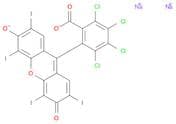
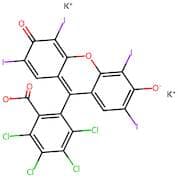
Rosa Bengala è un colorante sintetico appartenente alla classe dei coloranti xanteni, caratterizzato dal suo vibrante colore rosa-rosso. È comunemente usato in varie applicazioni, tra cui come colorante biologico in microscopia, fotosensibilizzatore in terapia fotodinamica e come tracciante negli studi ambientali. La struttura chimica di Rosa Bengala presenta un derivato dibromato della fluoresceina, che contribuisce alla sua forte assorbanza nello spettro visibile. È solubile in acqua e solventi organici, rendendolo versatile per diverse condizioni sperimentali. Rosa Bengala mostra proprietà fototossiche, che possono essere sfruttate in applicazioni mediche per colpire e distruggere le cellule tumorali all'attivazione della luce. Inoltre, è stato studiato per le sue proprietà antiossidanti e il potenziale utilizzo nelle industrie alimentari e cosmetiche. Tuttavia, le considerazioni di sicurezza sono importanti, poiché può causare irritazione della pelle e reazioni allergiche in alcuni individui. In generale, Rosa Bengala è un composto prezioso sia nella ricerca scientifica che nelle applicazioni pratiche, con una gamma di caratteristiche che lo rendono adatto a usi diversi.
Formula:Unspecified
InChI:InChI=1/C20H4Cl4I4O5/c21-10-8(9(20(31)32)11(22)13(24)12(10)23)7-3-1-5(25)16(29)14(27)18(3)33-19-4(7)2-6(26)17(30)15(19)28/h1-2,29H,(H,31,32)
Sinonimi:- Bengal Rose
- HFinCl<sub>4</sub>I<sub>4</sub>
- Rb 1017
- Rose Bengale
- SODIUM TETRAIODODICHLOROFLUORESCEIN
- C.I. Acid Red 94
- redno.105
- Rose Bengal
- TETRACHLOROTETRAIODOFLUORESCEIN SODIUM SALT
- RB
- rose
- C.I.AcidRed94(45440)
- TETRAIODOTETRACHLOROFLUORESCEIN DISODIUM SALT
- 2,3,4,5-tetrachloro-6-(6-hydroxy-2,4,5,7-tetraiodo-3-oxo-3H-xanthen-9-yl)benzoic acid
- Vedi altri sinonimi
Ordinare per
Purezza (%)
0
100
|
0
|
50
|
90
|
95
|
100
5 prodotti.
Rose Bengal
CAS:Rose Bengal is a photosensitizer effective against microbial cells. In the presence of light and oxygen, it inhibits the growth of yeast cells and other microorganisms, sometimes leading to their death. Rose Bengal can also limit bacterial growth, restrict the colony size of filamentous fungi, and suppress the growth of "spreading fungi" such as Rhizopus and Trichoderma.Colore e forma:Solid(3-Oxo-6-Oxido-2,4,5,7-Tetraiodo-3H-Xanthen-9-Yl)-3,4,5,6-Tetrachlorobenzoate Sodium Salt
CAS:(3-Oxo-6-Oxido-2,4,5,7-Tetraiodo-3H-Xanthen-9-Yl)-3,4,5,6-Tetrachlorobenzoate Sodium SaltPurezza:95%Sodium 2,3,4,5-tetrachloro-6-(2,4,5,7-tetraiodo-6-oxido-3-oxo-3H-xanthen-9-yl)benzoate
CAS:Purezza:98%Peso molecolare:1017.63PV-10
CAS:PV-10 is a peptide that activates ion channels. It is an agonist for the nicotinic acetylcholine receptor (nAChR) and a low-affinity antagonist for the N-methyl-D-aspartate receptor (NMDAR). PV-10 binds to specific sites on the nAChR, which causes the channel to open and allow ions to flow into the cell. This leads to depolarization of the membrane, which triggers an action potential in neurons. PV-10 is also able to bind to other proteins such as NR1 subunits of NMDARs and alpha 7 subunits of nAChRs. These interactions inhibit the function of these receptors and prevent them from opening their channels. This prevents calcium influx into cells, blocking neurotransmitter release and preventing the activation of downstream pathways that lead to neuronal death. PV-10 has been shown to be selective for certain types of ion channels over othersFormula:C20H4Cl4I4O5Purezza:Min. 95%Peso molecolare:973.7 g/mol