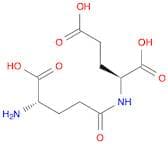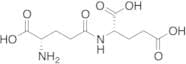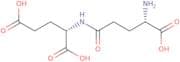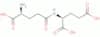
CAS 1116-22-9
:Acido L-γ-glutamil-L-glutammico
Descrizione:
Acido L-γ-glutamil-L-glutammico, noto anche come dipeptide, è un composto formato da due residui di acido glutammico legati da un legame peptidico. È caratterizzato dalla sua struttura, che include un gruppo funzionale acido carbossilico e un gruppo amminico, tipico degli amminoacidi. Questa sostanza è solubile in acqua, riflettendo la natura polare dei suoi gruppi funzionali, e presenta proprietà associate agli amminoacidi, come la capacità di partecipare a varie reazioni biochimiche. Acido L-γ-glutamil-L-glutammico è spesso studiato nel contesto del suo ruolo nelle vie metaboliche e delle sue potenziali applicazioni in nutrizione e farmaceutica. Può anche mostrare attività biologica, influenzando la neurotrasmissione e la segnalazione cellulare a causa del suo coinvolgimento nella sintesi dei neurotrasmettitori. La stabilità e la reattività del composto possono essere influenzate da fattori come pH e temperatura, rendendo importante considerare queste condizioni in contesti sperimentali. In generale, Acido L-γ-glutamil-L-glutammico è una molecola significativa in biochimica con varie implicazioni nella salute e nella malattia.
Formula:C10H16N2O7
InChI:InChI=1S/C10H16N2O7/c11-5(9(16)17)1-3-7(13)12-6(10(18)19)2-4-8(14)15/h5-6H,1-4,11H2,(H,12,13)(H,14,15)(H,16,17)(H,18,19)/t5-,6-/m0/s1
InChI key:InChIKey=OWQDWQKWSLFFFR-WDSKDSINSA-N
SMILES:[C@H](NC(CC[C@@H](C(O)=O)N)=O)(CCC(O)=O)C(O)=O
Sinonimi:- (2S)-2-{[(4S)-4-ammonio-4-carboxylatobutanoyl]amino}pentanedioate
- <span class="text-smallcaps">L</smallcap>-Glutamic acid, <smallcap>L</span>-γ-glutamyl-
- <span class="text-smallcaps">L</smallcap>-Glutamic acid, N-<smallcap>L</span>-γ-glutamyl-
- <span class="text-smallcaps">L</smallcap>-γ-Glutamyl-<smallcap>L</span>-glutamic acid
- Gamma-Glutamylglutamic Acid
- Glutamic acid, N-<span class="text-smallcaps">L</smallcap>-γ-glutamyl-, <smallcap>L</span>-
- Glutamic acid, N-<span class="text-smallcaps">L</span>-γ-glutamyl-
- H-Gamma-Glu-Glu-Oh
- L-gamma-glutamyl-L-glutamic acid
- N-gamma-L-Glutamyl-L-glutamic acid
- gamma-Glutamylglutamate
- γ-<span class="text-smallcaps">L</smallcap>-Glutamyl-<smallcap>L</span>-glutamic acid
- γ-Glutamylglutamic acid
- L-Glutamic acid, N-L-γ-glutamyl-
- L-Glutamic acid, L-γ-glutamyl-
- Glutamic acid, N-L-γ-glutamyl-
- Glutamic acid, N-L-γ-glutamyl-, L-
- Vedi altri sinonimi
Ordinare per
Purezza (%)
0
100
|
0
|
50
|
90
|
95
|
100
6 prodotti.
H-Glu(Glu-OH)-OH
CAS:Bachem ID: 4000639.
Formula:C10H16N2O7Colore e forma:White PowderPeso molecolare:276.25Ref: 4Z-PG-356
5mgPrezzo su richiesta10mgPrezzo su richiesta25mgPrezzo su richiesta50mgPrezzo su richiesta100mgPrezzo su richiestaγ-L-Glutamyl L-Glutamic Acid
CAS:Prodotto controllatoApplications H-GAMMA-GLU-GLU-OH (cas# 1116-22-9) is a useful research chemical.
Formula:C10H16N2O7Colore e forma:NeatPeso molecolare:276.24H-Glu(Glu-OH)-OH
CAS:H-Glu(Glu-OH)-OH is a synthetic amino acid that is currently being investigated as a diagnostic agent for the detection of intracellular protein degradation by matrix metalloproteinase-9 (MMP-9). H-Glu(Glu-OH)-OH is taken up by cells in a concentration and time dependent manner, with an uptake rate of approximately 1.6 x 10^6 molecules per cell per hour. The uptake mechanism is not yet known, but has been hypothesized to be due to receptor binding. H-Glu(Glu-OH)-OH binds to cerebellar granule cells and alters mitochondrial metabolism, which may be related to its effects on the ubiquitin proteasome pathway. This compound also has diagnostic potential for atherosclerosis and glutamate transport disorders.Formula:C10H16N2O7Purezza:Min. 95%Peso molecolare:276.24 g/mol