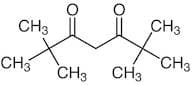
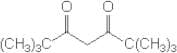
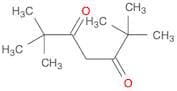
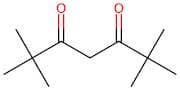
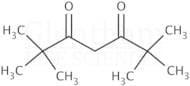
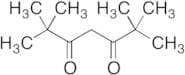
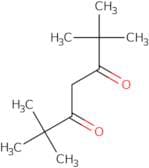
CAS 1118-71-4
:2,2,6,6-Tetrametil-3,5-eptanedione
Descrizione:
2,2,6,6-Tetrametil-3,5-eptanedione, con il numero CAS 1118-71-4, è un composto organico caratterizzato dalla sua struttura di diketone, che presenta due gruppi carbonilici (C=O). Questo composto è un liquido incolore o giallo pallido a temperatura ambiente ed è noto per il suo distintivo odore dolce e fruttato. È solubile in solventi organici come etanolo ed etere, ma ha una solubilità limitata in acqua a causa dei suoi gruppi alchilici idrofobici. La presenza di più gruppi metilici contribuisce al suo ingombro sterico, influenzando la sua reattività e stabilità. 2,2,6,6-Tetrametil-3,5-eptanedione è spesso utilizzato come reagente nella sintesi organica e come ligando nella chimica di coordinazione grazie alla sua capacità di chelare ioni metallici. Inoltre, ha applicazioni nella produzione di vari intermedi chimici e può fungere da agente aromatizzante nell'industria alimentare. Devono essere osservate precauzioni di sicurezza quando si maneggia questo composto, poiché potrebbe comportare rischi per la salute se inalato o ingerito.
Formula:C11H20O2
InChI:InChI=1/C11H20O2/c1-10(2,3)8(12)7-9(13)11(4,5)6/h7,12H,1-6H3/b8-7-
InChI key:InChIKey=YRAJNWYBUCUFBD-UHFFFAOYSA-N
SMILES:C(C(C(C)(C)C)=O)C(C(C)(C)C)=O
Sinonimi:- (4Z)-5-hydroxy-2,2,6,6-tetramethylhept-4-en-3-one
- 1,3-(tert-Butyl)-1,3-propanedione
- 1,3-Di-tert-butyl-1,3-propanedione
- 2,2,6,6-Tetramethyl-3,5-Heptanedione Dipivaloylmethane
- 2,2,6,6-Tetramethylheptan-3,5-dion
- 2,2,6,6-Tetramethylheptane-3,5-Dione
- 2,2,6,6-Tetrametilheptano-3,5-Diona
- 3,5-Heptanedione, 2,2,6,6-tetramethyl-
- Dipivaloylmethane
- Dpm-H
- Hepta-3,5-Dione, 2,2,6,6-Tetramethyl-
- Nsc 174296
- Tmhd
- Tmhd-H
- 2,2,6,6-Tetramethyl-3,5-heptanedione
- Dipivaloylmethane~Dpm-H~Tmhd-H
- (CH3)3CCOCH2COC(CH3)3
- 2,2,6,6-Tetramethylheptane-3,5-dione,98%TMHD
- 2,2,6,6-Tetramethyl heptanedione
- 2,2,6,6-tetramethyl-5-heptanedione
- 2,2,6,6-TETRAMETHYLHEPTANE-3,5-DIONE TMHD
- 2,2,6,6-TETRAMETHYL-3,5-HEPTANEDIONE, 95 %
- 2,2,6,6-Tetramethyl-3,5-heptadione
- 2,2,6,6-Tetramethyl-3,5-heptanedione, 98+%
- Vedi altri sinonimi
Ordinare per
Purezza (%)
0
100
|
0
|
50
|
90
|
95
|
100
9 prodotti.
Dipivaloylmethane
CAS:Formula:C11H20O2Purezza:>97.0%(GC)Colore e forma:Colorless to Light yellow clear liquidPeso molecolare:184.282,2,6,6-Tetramethyl-3,5-heptanedione, 98%
CAS:2,2,6,6-Tetramethyl-3,5-heptanedione is used in the synthesis of -aryl--diketones1 and dicyanamidobenzene-bridge diruthenium complex. This Thermo Scientific Chemicals brand product was originally part of the Alfa Aesar product portfolio. Some documentation and label information may refer to the legaFormula:C11H20O2Purezza:98%Colore e forma:Clear colorless to yellow, LiquidPeso molecolare:184.282,2,6,6-Tetramethylheptane-3,5-dione, 98% TMHD
CAS:2,2,6,6-Tetramethylheptane-3,5-dione, 98% TMHD
Formula:(CH3)3CC(O)CH2C(O)C(CH3)3Purezza:98%Colore e forma:colorless to pale yellow liq. or low melting solidPeso molecolare:184.282,2,6,6-Tetramethylheptane-3,5-dione
CAS:Formula:C11H20O2Purezza:97%Colore e forma:LiquidPeso molecolare:184.27532,2,6,6-Tetramethylheptane-3,5-dione
CAS:2,2,6,6-Tetramethylheptane-3,5-dioneFormula:C11H20O2Purezza:98%Colore e forma: colorless to light yellow low melting solidPeso molecolare:184.27529g/mol2,2,6,6-Tetramethyl-3,5-heptanedione
CAS:Formula:C11H20O2Purezza:≥ 98.0%Colore e forma:Colourless to light-yellow liquid or crystalline solidPeso molecolare:184.282,2,6,6-Tetramethyl-3,5-heptanedione
CAS:Purezza:97.0%Colore e forma:Liquid, ClearPeso molecolare:184.27900695800782,2,6,6-Tetramethyl-3,5-heptanedione
CAS:Prodotto controllatoApplications 2,2,6,6-Tetramethyl-3,5-heptanedione is a beta diketone with antibacterial activity.
References Acheampong, Y. B., et al.: Indian J. Pharm. Sci., 46, 207 (1984)Formula:C11H20O2Colore e forma:NeatPeso molecolare:184.282,2,6,6-Tetramethyl-3,5-heptanedione
CAS:2,2,6,6-Tetramethyl-3,5-heptanedione (TMTD) is a picolinic acid analog that binds to receptor molecules. It has been shown to be a potent inhibitor of methanol dehydrogenase with an IC50 of 5 μM. TMTD also has the ability to form stable complexes with zirconium oxide and other metals. These complexes are formed by intramolecular hydrogen bonds and can be used in organometallic synthesis. Structural analysis of these complexes have revealed that the metal is coordinated by two nitrogen atoms and one hydroxyl group from the ligand.Formula:C11H20O2Purezza:Min. 95%Peso molecolare:184.28 g/mol