CAS 111917-59-0
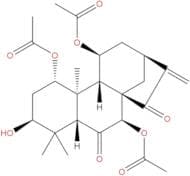
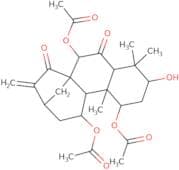
:Kaur-16-ene-6,15-dione,1,7,11-tris(acetilossi)-3-idrossi-, (1a,3b,7b,11b)- (9CI)
Descrizione:
Kaur-16-ene-6,15-dione, 1,7,11-tris(acetossido)-3-idrossi-, (1a,3b,7b,11b)-, comunemente noto con il suo numero CAS 111917-59-0, è un composto chimico appartenente alla classe dei terpenoidi, specificamente un tipo di kaurene. Questo composto presenta una struttura complessa caratterizzata da molteplici gruppi funzionali, inclusi gruppi dione e idrossile, così come sostituenti acetossido. La presenza di questi gruppi funzionali suggerisce una potenziale attività biologica, che viene spesso esplorata negli studi farmacologici. I derivati del Kaur-16-ene sono noti per i loro ruoli nella fisiologia vegetale e possono mostrare vari effetti, come proprietà anti-infiammatorie o anti-cancro. La stereochimica indicata dalla notazione (1a,3b,7b,11b) suggerisce specifici arrangiamenti spaziali degli atomi, che possono influenzare significativamente la reattività del composto e la sua interazione con obiettivi biologici. In generale, questo composto è di interesse sia nella chimica dei prodotti naturali che nella chimica medicinale a causa della sua complessità strutturale e delle potenziali applicazioni terapeutiche.
Formula:C26H34O9
Sinonimi:- AdenanthinA
Ordinare per
Purezza (%)
0
100
|
0
|
50
|
90
|
95
|
100
5 prodotti.
(1α,3β,7β,11β)-1,7,11-Tris(acetyloxy)-3-hydroxykaur-16-ene-6,15-dione
CAS:Formula:C26H34O9Purezza:98.5%Colore e forma:SolidPeso molecolare:490.5428Adenanthin
CAS:Adenanthin, a natural inhibitor of thiol-dependent antioxidant enzymes, impairs the effector functions of human natural killer cells.Formula:C26H34O9Purezza:98%Colore e forma:SolidPeso molecolare:490.55Adenanthin
CAS:Adenanthin is a natural diterpenoid compound, which is derived primarily from plants within the genus Isodon. This compound is obtained through the extraction and purification processes involving the aerial parts of these medicinally significant plants. Adenanthin exhibits its biological effects primarily through the modulation of oxidative stress pathways and the induction of apoptosis in certain cell lines. It specifically targets key redox-sensitive cysteine residues, thereby selectively inhibiting peroxiredoxin I and II. These actions result in the accumulation of reactive oxygen species (ROS), ultimately leading to the selective induction of apoptosis in cancerous cells, while sparing most non-cancerous cells.Formula:C26H34O9Purezza:Min. 95%Peso molecolare:490.6 g/mol