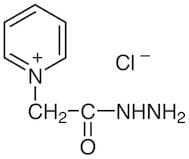
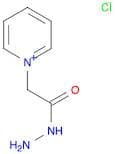
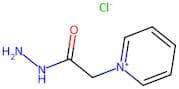
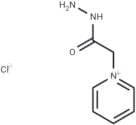
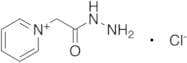
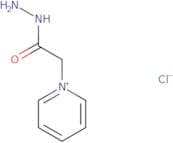
CAS 1126-58-5
:Girard's
Descrizione:
Il reagente Girard's T, noto anche come 2,4-dinitrofenilidrazina (DNPH), è un composto chimico comunemente utilizzato in chimica organica per l'identificazione e la caratterizzazione dei composti carbonilici, come aldeidi e chetoni. È caratterizzato dalla sua capacità di formare derivati di idrazone stabili in seguito a reazione con gruppi carbonilici, che possono essere facilmente isolati e analizzati. Il reagente è tipicamente un solido cristallino di colore giallo-arancio, e i suoi derivati spesso mostrano punti di fusione distinti, facilitando l'identificazione del composto carbonilico originale. Il reagente Girard's T è anche notevole per la sua sensibilità e specificità, rendendolo uno strumento prezioso sia in applicazioni di laboratorio che industriali, inclusa l'analisi di prodotti farmaceutici e campioni ambientali. Inoltre, è importante maneggiare questo reagente con cura a causa della sua potenziale tossicità e della necessità di misure di sicurezza appropriate durante l'uso. In generale, il reagente Girard's T gioca un ruolo significativo nella sintesi organica e nella chimica analitica.
Formula:C7H10N3O·Cl
InChI:InChI=1S/C7H9N3O.ClH/c8-9-7(11)6-10-4-2-1-3-5-10;/h1-5H,6,8H2;1H
InChI key:InChIKey=NDXLVXDHVHWYFR-UHFFFAOYSA-N
SMILES:C(C(NN)=O)[N+]=1C=CC=CC1.[Cl-]
Sinonimi:- 1-(2-Hydrazino-2-oxoethyl)pyridinium chloride
- 1-(2-Hydrazinyl-2-Oxoethyl)Pyridinium Chloride
- 1-(2-Hydrazinyl-2-oxoethyl)pyridin-1-iumchloride
- 1-(Carboxymethyl)pyridinium chloride, hydrazide
- 1-[(Hydrazinecarbonyl)methyl]pyridin-1-ium chloride
- 1126-58-5
- Girard's P reagent
- Girard-P reagent
- Pyridinioacetohydrazide chloride
- Pyridinium, 1- (2-hydrazino-2-oxoethyl)-, chloride
- Pyridinium, 1-(2-Hydrazinyl-2-Oxoethyl)-, Chloride (1:1)
- Pyridinium, 1-(carboxymethyl)-, chloride, hydrazide
- Vedi altri sinonimi
Ordinare per
Purezza (%)
0
100
|
0
|
50
|
90
|
95
|
100
9 prodotti.
Girard's Reagent P
CAS:Formula:C7H10ClN3OPurezza:>95.0%(T)Colore e forma:White to Light yellow to Light orange powder to crystalPeso molecolare:187.631-(2-Hydrazinyl-2-oxoethyl)pyridin-1-ium chloride
CAS:Formula:C7H10ClN3OPurezza:97%Colore e forma:SolidPeso molecolare:187.62681-(2-Hydrazinyl-2-oxoethyl)pyridin-1-ium chloride
CAS:1-(2-Hydrazinyl-2-oxoethyl)pyridin-1-ium chloridePurezza:97%Peso molecolare:187.63g/molGirard's reagent P
CAS:Formula:C7H10ClN3OPurezza:≥ 95.0%Colore e forma:White to light yellow or light orange crystalline powderPeso molecolare:187.63Girard's Reagent P
CAS:Girard's Reagent P, a cationic hydrazine compound, serves as a derivatization agent for the quantification of glycans, oxysterols, and 5-methylcytosineFormula:C7H10N3O·ClColore e forma:SolidPeso molecolare:187.63Girard's Reagent P
CAS:Prodotto controllatoApplications Girard’s reagent used in the identification and quantification of protein carbonylation as well as in the modification of nucleosides and nucleotides. Used in the preparation of potent photoactive agents.
References Mirzaei, H., et al.: J. Chrom. A, 1134, 122 (2007); Kanofsky, J.R., et al.: Photochem. Photobiol., 73, 349 (2001);Formula:C7H10N3O•ClColore e forma:NeatPeso molecolare:152.183545Girard's reagent P
CAS:Girard's reagent P is a mixture of phenylhydrazine and p-chloro-phenylhydrazine. It is used as a chemical test for the detection of carbonyl groups in organic compounds. This test has been shown to be sensitive to carotenoids, which are found in human serum or urine samples. Girard's reagent P can be used to identify cancer tissues by detecting the presence of hydroxyl groups that are found in the amino acids methionine and cysteine. The hydroxyl group reacts with the phenylhydrazine component of Girard's reagent P, giving off a purple color. Additionally, Girard's reagent P can be used in conjunction with other chemicals to identify specific types of cancer cells such as cerebrotendinous xanthomatosis and neuroblastoma, which have chemical structures that contain hydroxyl groups.Formula:C7H10ClN3OPurezza:Min. 95%Colore e forma:White PowderPeso molecolare:187.63 g/mol1-(2-Hydrazinyl-2-oxoethyl)pyridin-1-ium chloride
CAS:Formula:C7H10ClN3OPurezza:97%Colore e forma:SolidPeso molecolare:187.63