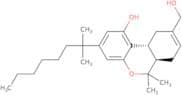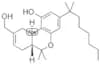
CAS 112830-95-2
:HU-210
Descrizione:
HU-210 è un cannabinoide sintetico che è strutturalmente correlato al THC, il componente attivo della cannabis. È noto per la sua alta potenza e affinità per i recettori cannabinoidi, in particolare CB1 e CB2, che fanno parte del sistema endocannabinoide nel corpo umano. Questo composto è caratterizzato dalla sua capacità di produrre effetti simili a quelli dei cannabinoidi naturali, inclusi analgesia, stimolazione dell'appetito e alterazioni dell'umore e della percezione. A causa della sua potenza, HU-210 è stato studiato per le sue potenziali applicazioni terapeutiche, ma solleva anche preoccupazioni riguardo alla sicurezza e al potenziale di abuso. Come sostanza chimica da ricerca, non è approvato per uso medico ed è spesso associato a sfide legali e normative. La sua stabilità e solubilità nei solventi organici lo rendono adatto per studi di laboratorio, ma la mancanza di studi umani completi limita la comprensione dei suoi effetti a lungo termine e del suo profilo di sicurezza. In generale, HU-210 esemplifica le complessità dei cannabinoidi sintetici e le loro implicazioni sia nella ricerca che nella salute pubblica.
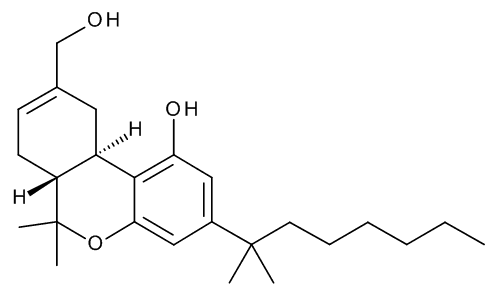
Formula:C25H38O3
InChI:InChI=1S/C25H38O3/c1-6-7-8-9-12-24(2,3)18-14-21(27)23-19-13-17(16-26)10-11-20(19)25(4,5)28-22(23)15-18/h10,14-15,19-20,26-27H,6-9,11-13,16H2,1-5H3/t19-,20-/m1/s1
InChI key:InChIKey=SSQJFGMEZBFMNV-WOJBJXKFSA-N
SMILES:OC1=C2[C@]3([C@](C(C)(C)OC2=CC(C(CCCCCC)(C)C)=C1)(CC=C(CO)C3)[H])[H]
Sinonimi:- (6AR,10aR)-3-(1,1-Dimethylheptyl)-6a,7,10,10a-tetrahydro-1-hydroxy-6,6-dimethyl-6H-dibenzo[b,d]pyran-9-methanol
- (6aR)-trans-3-(1,1-Dimethylheptyl)-6a,7,10,10a-tetrahydro-1-hydroxy-6,6-dimethyl-(6H)-dibenzo[b.d]pyran-9-methanol
- (6aR,10aR)-9-(hydroxymethyl)-6,6-dimethyl-3-(2-methyloctan-2-yl)-6a,7,10,10a-tetrahydro-6H-benzo[c]chromen-1-ol
- (6aS,10aS)-3-(1,1-dimethylheptyl)-9-(hydroxymethyl)-6,6-dimethyl-6a,7,8,10a-tetrahydrobenzo[c]isochromen-1-ol
- 6H-Dibenzo[b,d]pyran-9-methanol, 3-(1,1-dimethylheptyl)-6a,7,10,10a-tetrahydro-1-hydroxy-6,6-dimethyl-, (6aR,10aR)-
- 6H-Dibenzo[b,d]pyran-9-methanol, 3-(1,1-dimethylheptyl)-6a,7,10,10a-tetrahydro-1-hydroxy-6,6-dimethyl-, (6aR-trans)-
- HU-210 DEA Schedule I
- HU 210
- (-)-HU-210
- HU-210/112830-95-2
- HU-210 (exempt preparation)
- (-)-11-OH-Δ8-THC-1,1-dimethylheptyl
- HU-210 (solution)
- HU 210 (100μg/mL in Methanol)
- (6aR)-6aβ,7,10,10aα-Tetrahydro-6,6-dimethyl-1-hydroxy-3-(1,1-dimethylheptyl)-6H-dibenzo[b,d]pyran-9-methanol
- HU-210 (Spice Cannabinoid)
- (6aR)-6aβ,7,10,10aα-Tetrahydro-1-hydroxy-6,6-dimethyl-3-(1,1-dimethylheptyl)-6H-dibenzo[b,d]pyran-9-methanol
- 11-OH-Δ8-THC-1,1-dimethylheptyl
- Vedi altri sinonimi
Ordinare per
Purezza (%)
0
100
|
0
|
50
|
90
|
95
|
100
6 prodotti.
HU 210 (100 μg/ml in Methanol)
CAS:Prodotto controllatoFormula:C25H38O3Colore e forma:Single SolutionPeso molecolare:386.57HU 210
CAS:Prodotto controllatoStability Hygroscopic
Applications A synthetic agonist analog of ∆9-Tetrahydro Cannabinol (T293200), which is the primary psychoactive component of marijuana. HU-210 is a potent central cannabinoid (CB1) and peripheral cannabinoid (CB2) receptor agonist. It binds to neuroblastoma cell membrane CB1 receptors with about the same affinity as CP-55940. Synthetic cannabinoidsControlled Substance.
References Slipetz, D.M. et al.: Mol. Pharmacol., 48, 352 (1995); Bertalovitz, A.C. et al.: Drug Dev. Res., 71, 404 (2010); Howlett, A.C. et al.: Curr. Pharm. Des., 1, 343 (1995);Formula:C25H38O3Colore e forma:Light YellowPeso molecolare:386.57HU 210
CAS:Prodotto controllatoHU-210 is a synthetic cannabinoid receptor agonist with a strong affinity for the CB1 and CB2 receptor (Ki = 0.061 and 0.52 nM, respectively)1. In vitro, it has been shown to promote proliferation of embryonic neural stem cells in the hippocampus through the activation of Gi/o proteins and ERK signaling2. In vivo, it has been associated with counteracting amyloid beta-dependent inflammation in Alzheimer’s disease as well as preventing neuronal loss and cognitive decay. In vivo effects are thought to be mediated by CB1 and CB2 receptors mediated activation of microglia-secreted TNFα and other inflammatory markers3.Formula:C25H38O3Purezza:Min. 95%Peso molecolare:386.57 g/mol