CAS 112924-45-5
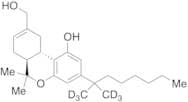
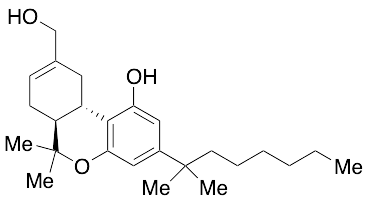
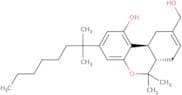
:1,1-Dimetilheptil-11-idrossitetraidrocannabinolo
Descrizione:
1,1-Dimetilheptil-11-idrossitetraidrocannabinolo, comunemente noto come cannabinoide sintetico, è un composto che imita gli effetti dei cannabinoidi naturali presenti nella pianta di cannabis. Questa sostanza è caratterizzata dalla sua complessa struttura molecolare, che include uno scheletro di tetraidrocannabinolo (THC) modificato con una catena laterale di dimetilheptile e un gruppo idrossile in posizione 11. La sua formula chimica contribuisce alla sua lipofilia, permettendole di interagire efficacemente con i recettori cannabinoidi nel corpo, in particolare i recettori CB1 e CB2, che sono coinvolti in vari processi fisiologici come la sensazione di dolore, la regolazione dell'umore e il controllo dell'appetito. Il composto è tipicamente studiato per i suoi potenziali effetti terapeutici, comprese le proprietà analgesiche e anti-infiammatorie, ma può anche presentare effetti psicoattivi simili a quelli del THC. A causa della sua natura sintetica, può presentare profili farmacocinetici e farmacodinamici diversi rispetto ai cannabinoidi naturali, sollevando preoccupazioni riguardo alla sicurezza, alla legalità e al potenziale di abuso.
Formula:C25H38O3
InChI:InChI=1/C25H38O3/c1-6-7-8-9-12-24(2,3)18-14-21(27)23-19-13-17(16-26)10-11-20(19)25(4,5)28-22(23)15-18/h10,14-15,19-20,26-27H,6-9,11-13,16H2,1-5H3/t19-,20-/m0/s1
InChI key:InChIKey=SSQJFGMEZBFMNV-PMACEKPBSA-N
SMILES:OC1=C2[C@@]3([C@@](C(C)(C)OC2=CC(C(CCCCCC)(C)C)=C1)(CC=C(CO)C3)[H])[H]
Sinonimi:- (+)-Hu-210
- (6aS,10aS)-3-(1,1-Dimethylheptyl)-6a,7,10,10a-tetrahydro-1-hydroxy-6,6-dimethyl-6H-dibenzo[b,d]pyran-9-methanol
- (6aS,10aS)-9-(hydroxymethyl)-6,6-dimethyl-3-(2-methyloctan-2-yl)-6a,7,10,10a-tetrahydro-6H-benzo[c]chromen-1-ol
- 6H-Dibenzo[b,d]pyran-9-methanol, 3-(1,1-dimethylheptyl)-6a,7,10,10a-tetrahydro-1-hydroxy-6,6-dimethyl-, (6aS,10aS)-
- 6H-Dibenzo[b,d]pyran-9-methanol, 3-(1,1-dimethylheptyl)-6a,7,10,10a-tetrahydro-1-hydroxy-6,6-dimethyl-, (6aS-trans)-
- Dexanabinol
- Hu 211
- Prs 211007-000
- Sinnabidiol
- 1,1-Dimethylheptyl-11-hydroxytetrahydrocannabinol
- [6aS,(+)]-6a,7,10,10aβ-Tetrahydro-1-hydroxy-6,6-dimethyl-3-(1,1-dimethylheptyl)-6H-dibenzo[b,d]pyran-9-methanol
- (6aS,10aS)-3-(1,1-Dimethylheptyl)-6a,77,10,10a-tetrahydro-1-hydroxy-6,6-dimethyl-6H-dibenzo[b,d]pyran-9-methanol
- (6AR)-TRANS-3-(1,1-DIMETHYLHEPTYL)-6A,7,10,10A-TETRAHYDRO-1-HYDROXY-6,6-DIMETHYL-6H-DIBENZO[B,D]PYRAN-9-METHANOL
- (6AR,10AR)-3-(1,1'-DIMETHYLHEPTYL)-6A,7,10,10A-TETRAHYDRO-1-HYDROXY-6,6-DIMETHYL-6H-DIBENZO[B,D]PYRAN-9-METHANOL
- (6aS,10aS)-9-(hydroxymethyl)-6,6-dimethyl-3-(2-methyloctan-2-yl)-6a,7,10,10a-tetrahydrobenzo[c]chromen-1-ol
- (6aS,10aS)-3-(1,1-dimethylheptyl)-6,6-dimethyl-9-methylol-6a,7,10,10a-tetrahydrobenzo[c]chromen-1-ol
- (6aS)-6aα,7,10,10aβ-Tetrahydro-6,6-dimethyl-1-hydroxy-3-(1,1-dimethylheptyl)-6H-dibenzo[b,d]pyran-9-methanol
- Vedi altri sinonimi
Ordinare per
Purezza (%)
0
100
|
0
|
50
|
90
|
95
|
100
3 prodotti.
HU 211
CAS:Prodotto controllatoApplications HU-211 is a synthetic cannabinoid derivative that inhibits TNFα and interleukin-6 (1,2,3). HU-211 exhibits neuroprotective, antioxidant, and anti-inflammatory properties. It might be a useful agent for the treatment of stroke patients, by protecting neuronal lysosomes from nitric oxide (NO)-mediated toxicity.
References (1) Shohami, E., et al.: J. Neuroimmunol., 72, 169 (1997)(2) Ramazan, D., et al.: Neuochemical Res., 33, 1683 (2008) (3) Leker, R., et al.: J. Neurol. Sci., 162, 114 (1999)Formula:C25H38O3Colore e forma:NeatPeso molecolare:386.57HU 211
CAS:Prodotto controllatoHU 211 is a novel synthetic cannabinoid that has been shown to have a number of pharmacological activities. It has been shown to induce neuronal death by causing mitochondrial membrane potential depolarization, which leads to the release of cytochrome c and other apoptotic factors from the mitochondria. HU 211 has also been shown to inhibit tumor growth in animal models when administered alone or in combination with cytotoxic agents like paclitaxel. The synergistic effect between HU 211 and paclitaxel is due to their ability to decrease the expression of anti-apoptotic molecules. HU 211 also inhibits transcriptional regulation, leading to inhibition of protein synthesis and cell proliferation. HU 211's antitumor activity has been demonstrated in animal models for breast, colon, lung, liver, and prostate cancers as well as bowel disease (including colitis), Parkinson's disease, and dopamine-related disorders.Formula:C25H38O3Purezza:Min. 95%Peso molecolare:386.57 g/mol