CAS 113-59-7
:Clorprotixene
Descrizione:
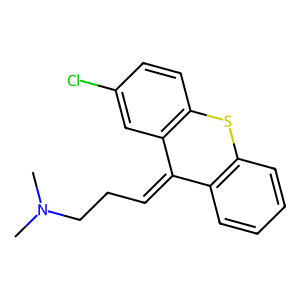
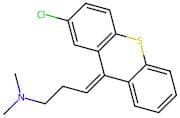
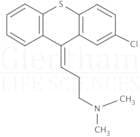
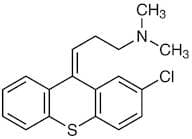
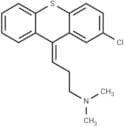
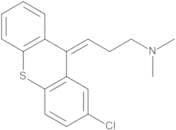
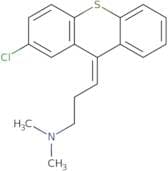
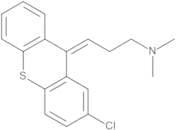
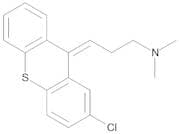
Clorprotixene è un farmaco antipsicotico utilizzato principalmente nel trattamento della schizofrenia e di altri disturbi psicotici. Appartiene alla classe dei composti tioxanteni e presenta proprietà sia antipsicotiche che sedative. La struttura chimica di Clorprotixene include un nucleo di tioxantene, caratterizzato da un sistema di anelli fusi contenente atomi di zolfo e azoto. Questo composto agisce principalmente come antagonista della dopamina, influenzando l'attività dei neurotrasmettitori nel cervello, in particolare i recettori della dopamina, che sono cruciali per i suoi effetti terapeutici. Clorprotixene viene tipicamente somministrato per via orale e può essere disponibile anche come formulazione iniettabile. La sua farmacocinetica implica il metabolismo nel fegato, con una emivita relativamente lunga, consentendo una somministrazione una volta al giorno in molti casi. Gli effetti collaterali comuni possono includere sedazione, aumento di peso e sintomi extrapiramidali, che sono tipici di molti farmaci antipsicotici. A causa dei suoi effetti sedativi, si consiglia cautela nell'uso di macchinari o nella guida mentre si assume questo farmaco. In generale, Clorprotixene è un'opzione importante nella gestione farmacologica di gravi condizioni di salute mentale.
Formula:C18H18ClNS
InChI:InChI=1S/C18H18ClNS/c1-20(2)11-5-7-14-15-6-3-4-8-17(15)21-18-10-9-13(19)12-16(14)18/h3-4,6-10,12H,5,11H2,1-2H3/b14-7-
InChI key:InChIKey=WSPOMRSOLSGNFJ-AUWJEWJLSA-N
SMILES:C(\CCN(C)C)=C/1\C=2C(SC=3C1=CC=CC3)=CC=C(Cl)C2
Sinonimi:- (3E)-3-(2-chloro-9H-thioxanthen-9-ylidene)-N,N-dimethylpropan-1-aminium chloride
- (3Z)-3-(2-Chloro-9H-thioxanthen-9-ylidene)-N,N-dimethyl-1-propanamine
- (3Z)-3-(2-chloro-9H-thioxanthen-9-ylidene)-N,N-dimethylpropan-1-amine
- (Z)-3-(2-Chloro-9H-thioxanthen-9-ylidene)-N,N-dimethyl-1-propanamine
- 1-Propanamine, 3-(2-chloro-9H-thioxanthen-9-ylidene)-N,N-dimethyl-, (3Z)-
- 1-Propanamine, 3-(2-chloro-9H-thioxanthen-9-ylidene)-N,N-dimethyl-, (Z)-
- 2-Chloro-3-(Dibenzo(B,E)Thiin-10-Ylidene)Propyldimethylamine
- 9H-Thioxanthene, 1-propanamine deriv.
- CPT
- CPX
- Chlorprothixen
- Chlorprotixen
- Chlorprotixene
- Chlothixen
- Chorprothixene
- Clorprotixeno
- Cloxan
- Iaractan
- Mk 184
- N 714
- Paxyl
- Rentovet
- Ro 4-0403
- Ro 4-04033
- Tactaran
- Taractan
- Tarasan
- Tardan
- Thioxanthene-Δ9,γ-propylamine, 2-chloro-N,N-dimethyl-, (Z)-
- Thioxanthene-Δ<sup>9,γ</sup>-propylamine, 2-chloro-N,N-dimethyl-, (Z)-
- Traquilan
- Trictal
- Truxal
- Truxaletten
- Truxil
- Vetacalm
- cis-Chlorprothixene
- Vedi altri sinonimi
Ordinare per
Purezza (%)
0
100
|
0
|
50
|
90
|
95
|
100
12 prodotti.
{3-[(9Z)-2-chloro-9H-thioxanthen-9-ylidene]propyl}dimethylamine
CAS:Formula:C18H18ClNSPurezza:98%Colore e forma:SolidPeso molecolare:315.8602Chlorprothixene 100 µg/mL in Acetonitrile
CAS:Formula:C18H18ClNSColore e forma:Single SolutionPeso molecolare:315.86Chlorprothixene
CAS:Formula:C18H18ClNSPurezza:>98.0%(T)Colore e forma:White to Orange to Green powder to crystalPeso molecolare:315.86Chlorprothixene
CAS:Chlorprothixene (Truxal) is a typical antipsychotic drug of the thioxanthene class, which was the first of the series to be synthesized.Formula:C18H18ClNSPurezza:98.77% - 99.756%Colore e forma:Pale Yellow Crystals SolidPeso molecolare:315.86Ref: 4Z-C-335001
5mgPrezzo su richiesta10mgPrezzo su richiesta25mgPrezzo su richiesta50mgPrezzo su richiesta100mgPrezzo su richiestaChlorprothixene
CAS:Applications Chlorprothixene
Not a dangerous good if item is equal to or less than 1g/ml and there is less than 100g/ml in the packageFormula:C18H18ClNSColore e forma:White To Light YellowPeso molecolare:315.86Chlorprothixene
CAS:Prodotto controllatoChlorprothixene is a derivative of fluorescein and has been used in the treatment of bone cancer. The reaction mechanism of chlorprothixene is not well understood, but it is believed to be due to its ability to bind with 5-HT2 receptors. Chlorprothixene also has anti-inflammatory properties, which may be due to the inhibition of nitrogen atoms in immune cells. This drug has low potency and can cause drug interactions with other drugs that are metabolized by enzymes in the liver such as cytochrome P450 enzymes. It also has a trifluoroacetic acid substituent, which can cause significant pharmacokinetic changes when given intravenously.Formula:C18H18ClNSPurezza:Min. 95%Colore e forma:PowderPeso molecolare:315.86 g/mol

![{3-[(9Z)-2-chloro-9H-thioxanthen-9-ylidene]propyl}dimethylamine](/_next/image/?url=https%3A%2Fstatic.cymitquimica.com%2Fproducts%2FIN%2Fthumb%2FDA00785B.jpg&w=3840&q=75)