CAS 1137-99-1
:acido 4-((2-idrossietossi)carbonil)benzoico
Descrizione:
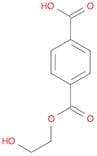
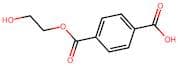
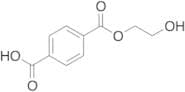
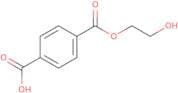
acido 4-((2-idrossietossi)carbonil)benzoico, noto anche con il suo numero CAS 1137-99-1, è un composto organico caratterizzato dalla sua struttura di acido benzoico modificata con un gruppo idrossietossicarbonilico nella posizione para. Questo composto appare tipicamente come un solido bianco a bianco sporco ed è solubile in solventi polari grazie alla presenza di gruppi funzionali sia di acido carbossilico che di etere. La sua struttura molecolare suggerisce che ha potenziali applicazioni in ambito farmaceutico e come mattoncino nella sintesi organica. Il gruppo idrossietossico può conferire proprietà aggiuntive come una maggiore idrofilicità, che può influenzare la sua reattività e interazione con i sistemi biologici. L'acidità del composto è attribuita al gruppo acido carbossilico, che può partecipare a legami idrogeno e influenzare la sua solubilità e stabilità in vari ambienti. In generale, acido 4-((2-idrossietossi)carbonil)benzoico è un composto versatile con potenziale utilità in varie applicazioni chimiche e industriali.
Formula:C10H9O5
InChI:InChI=1S/C10H10O5/c11-5-6-15-10(14)8-3-1-7(2-4-8)9(12)13/h1-4,11H,5-6H2,(H,12,13)
InChI key:InChIKey=BCBHDSLDGBIFIX-UHFFFAOYSA-N
SMILES:C(OCCO)(=O)C1=CC=C(C(O)=O)C=C1
Sinonimi:- 1,4-Benzenedicarboxylic acid, 1-(2-hydroxyethyl) ester
- 1,4-Benzenedicarboxylic acid, mono(2-hydroxyethyl) ester
- 1-(2-Hydroxyethyl) 1,4-benzenedicarboxylate
- 2-Hydroxyethyl hydrogen terephthalate
- 2-Hydroxyethyl terephthalate
- Ethylene glycol terephthalate (1:1)
- Ethylene glycol, hydrogen terephthalate (1:1)
- Ethylene glycol, mono(hydrogen terephthalate)
- Ethylene glycol-terephthalic acid monoester
- Hydrogen 2-hydroxyethyl terephthalate
- Mono(2-hydroxyethyl) terephthalate
- Mono(β-hydroxyethyl) terephthalate
- Terephthalic acid ethylene glycol monoester
- Terephthalic acid, 2-hydroxyethyl ester
- Terephthalic acid, mono(2-hydroxyethyl) ester
- Vedi altri sinonimi
Ordinare per
Purezza (%)
0
100
|
0
|
50
|
90
|
95
|
100
5 prodotti.
4-((2-Hydroxyethoxy)carbonyl)benzoic acid
CAS:Formula:C10H10O5Purezza:95%Colore e forma:SolidPeso molecolare:210.1834Ref: IN-DA003875
1g253,00€5gPrezzo su richiesta10gPrezzo su richiesta25gPrezzo su richiesta100mg121,00€250mg177,00€4-((2-Hydroxyethoxy)Carbonyl)Benzoic Acid
CAS:4-((2-Hydroxyethoxy)Carbonyl)Benzoic AcidPurezza:95%Peso molecolare:210.18g/mol1-(2-Hydroxyethyl) Ester, 1,4-Benzenedicarboxylic Acid
CAS:Applications 1-(2-Hydroxyethyl) Ester, 1,4-Benzenedicarboxylic Acid could be used to condition bacteria to enable it to target polymer polyethylene terephthalate (PET).
References Kumar, V., et al.: J. Environ. Chem. Eng., 8, 103977 (2020);Formula:C10H10O5Colore e forma:NeatPeso molecolare:210.1834-(2-Hydroxyethoxycarbonyl)benzoate
CAS:4-(2-Hydroxyethoxycarbonyl)benzoate (4HB) is a monomer of poly(4HB). It is used as a biodegradable polymer for the synthesis of hydrogels. 4HB is synthesized from the corresponding dicarboxylic acid, which contains two or more carboxyl groups. The synthesis of 4HB involves esterification with 2-hydroxyethanol and subsequent alkali hydrolysis to remove water. The product is purified by precipitation with ethanol, filtration, and vacuum drying. 4HB has been used as a substrate in biological treatment processes such as anaerobic digestion and aerobic composting. 4HB can be used as a functional group that can react at various temperatures, making it suitable for thermophilic organisms like Thermus aquaticus. The phylogenetic tree of the enzyme β-galactosidase reveals that the enzyme evolved from a common ancestor shared with LacB (β-Formula:C10H10O5Purezza:Area-% Min. 95 Area-%Colore e forma:White Off-White PowderPeso molecolare:210.18 g/mol4-((2-Hydroxyethoxy)carbonyl)benzoic acid
CAS:Purezza:95%Colore e forma:SolidPeso molecolare:210.1849976