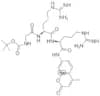
CAS 113866-14-1
:BOC-GRR-AMC
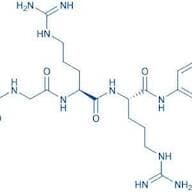
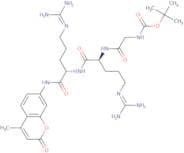
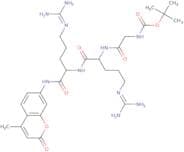
- T-Butyloxycarbonylglycyl-L-Arginyl-L-Arginine 4-Methylcoumaryl-7-Amide
- Boc-Gly-Arg-Arg-Mca
- Boc-Gly-Arg-Arg-Amc
- tert-butyl N-[2-[[(2S)-5-(diaminomethylideneamino)-1-[[(2S)-5-(diaminomethylideneamino)-1-[(4-methyl-2-oxochromen-7-yl)amino]-1-oxopentan-2-yl]amino]-1-oxopentan-2-yl]amino]-2-oxoethyl]carbamate
- BOC-GRR-AMC
- L-Argininamide, N-[(1,1-dimethylethoxy)carbonyl]glycyl-L-arginyl-N-(4-methyl-2-oxo-2H-1-benzopyran-7-yl)-
- TERT-BUTYLOXYCARBONYL-GLYCYL-L-ARGINYL-L-ARGININE 4-METHYLCOUMARYL-7-AMIDE
Boc-Gly-Arg-Arg-AMC
CAS:A substrate for flavivirus proteases such as West Nile virus protease, yellow fever virus NS3 protease, and dengue virus NS2B-NS3 protease.Boc-GRR-AMC is cleaved by type II Metacaspases Atmc4 and Atmc9 of Arabidopsis thaliana. Stock solutions of Boc-GRR-AMC are best prepared in DMSO.Formula:C29H44N10O7Purezza:98.7%Colore e forma:White PowderPeso molecolare:644.73Boc-Gly-Arg-Arg-AMC acetate salt
CAS:Boc-Gly-Arg-Arg-AMC acetate salt is a protease inhibitor that inhibits the activity of serine proteases. This protein is a potent and selective inhibitor of the NS3 protease from hepatitis C virus, which is responsible for the cleavage of polyproteins into mature proteins. Boc-Gly-Arg-Arg-AMC acetate salt has been shown to be effective in transfection experiments and polymerase chain reaction, as well as in inhibiting the activity of soybean trypsin and mammalian tissue proteases.
Formula:C29H44N10O7•(C2H4O2)xPurezza:Min. 98 Area-%Colore e forma:PowderPeso molecolare:644.72 g/molBoc-Gly-Arg-Arg-AMC
CAS:Boc-Gly-Arg-Arg-AMC is a research tool that has a high purity and is used in cell biology, antibody production, ion channels, and protein interactions. It is an inhibitor of ion channels, which can be used for pharmacology to study the function of ion channels. Boc-Gly-Arg-Arg-AMC has also been shown to inhibit binding between the ligand and receptor.
Formula:C29H44N10O7Purezza:Min. 95%Peso molecolare:644.72 g/molBoc-Gly-Arg-Arg-AMC trifluoroacetate
CAS:Boc-Gly-Arg-Arg-AMC trifluoroacetate is a potent inhibitor of kinases, which are enzymes that play a crucial role in various cellular processes. It has been shown to effectively inhibit the activity of both Chinese and human kinases. This inhibitor has also demonstrated its efficacy as an anticancer agent by inducing apoptosis in cancer cells. Boc-Gly-Arg-Arg-AMC trifluoroacetate is a medicinal protein analog that can be used for the development of novel inhibitors with improved potency and selectivity. Its potential therapeutic applications make it a promising candidate for cancer treatment. Additionally, this compound can be detected in urine, making it an excellent biomarker for kinase activity in vivo.Formula:C29H44N10O7•(C2HF3O2)xPurezza:Min. 95%Colore e forma:Powder