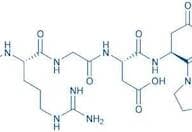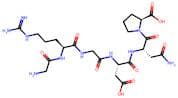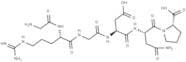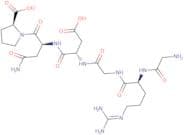
CAS 114681-65-1
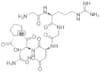
:glicina-arginina-glicina-acido aspartico-asparagina-prolina
Descrizione:
La sostanza chimica nota come glicina-arginina-glicina-acido aspartico-asparagina-prolina, con il numero CAS 114681-65-1, è un peptide composto da sei amminoacidi: glicina (Gly), arginina (Arg), acido aspartico (Asp), asparagina (Asn) e prolina (Pro). Questa sequenza peptidica è notevole per la sua potenziale attività biologica, in particolare nei processi di adesione cellulare e segnalazione, poiché contiene motivi che possono interagire con i recettori della superficie cellulare. La presenza di arginina e acido aspartico suggerisce che potrebbe svolgere un ruolo nel legame con le integrine, che sono cruciali per l'adesione cellulare alla matrice extracellulare. Inoltre, la struttura di questo peptide può influenzare la sua solubilità, stabilità e funzione biologica complessiva. Peptidi come glicina-arginina-glicina-acido aspartico-asparagina-prolina sono spesso studiati nel contesto dello sviluppo di farmaci, ingegneria dei tessuti e medicina rigenerativa grazie alla loro capacità di imitare processi biologici naturali. Comprendere le caratteristiche e le funzioni di tali peptidi è essenziale per la loro applicazione in contesti terapeutici.
Formula:C23H38N10O10
Sinonimi:- H-Gly-Arg-Gly-Asp-Asn-Pro-OH
- Grgdnp
- RGD peptide
- RGD peptide(GRGDNP)
Ordinare per
Purezza (%)
0
100
|
0
|
50
|
90
|
95
|
100
7 prodotti.
H-Gly-Arg-Gly-Asp-Asn-Pro-OH
CAS:Potent inhibitor of cell attachment to fibronectin. GRGDNP promotes cell adhesion preferentially via the α₅β₁ integrin.Formula:C23H38N10O10Purezza:97.7%Colore e forma:WhitePeso molecolare:614.62Ref: 54-OR1023741
1mgPrezzo su richiesta5mgPrezzo su richiesta10mgPrezzo su richiesta25mgPrezzo su richiesta50mg421,00€100mg699,00€H-Gly-Arg-Gly-Asp-Asn-Pro-OH
CAS:RGD peptide (GRGDNP) (RGD peptide GRGDNP(2TFA)) is a integrin-ligand interactions inhibitor.Formula:C23H38N10O10Purezza:>99.99%Colore e forma:SolidPeso molecolare:614.61H-Gly-Arg-Gly-Asp-Asn-Pro-OH
CAS:H-Gly-Arg-Gly-Asp-Asn-Pro-OH is a peptide that is used in the detection of damaged tissue. This peptide has been shown to have significant cytotoxicity, with an EC50 at around 100 nM. H-Gly-Arg-Gly-Asp-Asn-Pro-OH has also been shown to be reactive with integrin receptors, which are found on the surface of pluripotent cells and are involved in cell adhesion. The fluorescence intensity of this peptide increases when it binds to the integrin receptor, indicating that it may be useful for measuring changes in cellular calcium levels.
Formula:C23H38N10O10Purezza:Min. 95%Peso molecolare:614.62 g/molH-Gly-Arg-Gly-Asp-Asn-Pro-OH
CAS:H-Gly-Arg-Gly-Asp-Asn-Pro-OH is a cyclic peptide that is derived from the amino acid sequence of human collagen. It has been shown to have significant cytotoxicity and act as a chemoattractant for cells. H-Gly-Arg-Gly-Asp-Asn-Pro-OH has also been found to stimulate the growth of fibroblasts and increase the production of collagen, which is an important structural protein in connective tissue. HGRAAAP has been shown to have antiinflammatory properties and can be used to treat autoimmune diseases and infectious diseases, such as papillary muscle dysfunction, which is caused by inflammation. HGRAAAP may also be used to inhibit water permeability into cells, which would be helpful for the treatment of certain cancers that are caused by unregulated cell growth.Formula:C23H38N10O10Purezza:Min. 95%Peso molecolare:614.61 g/molH-Gly-Arg-Gly-Asp-Asn-Pro-OH
CAS:Custom research peptide; min purity 95%. For different specs please use the Peptide Quote Tool
Formula:C23H38N10O10Peso molecolare:614.6 g/mol