CAS 1159-68-8
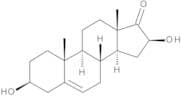
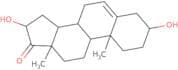
:(3beta,16beta)-3,16-diidrossiandrost-5-en-17-one
Descrizione:
La sostanza chimica nota come (3beta,16beta)-3,16-diidrossiandrost-5-en-17-one, con il numero CAS 1159-68-8, è un composto steroideo che appartiene alla classe degli androgeni. Presenta due gruppi funzionali idrossile (-OH) situati nelle posizioni 3 e 16 dello scheletro steroideo, il che contribuisce alla sua attività biologica. La presenza di un doppio legame tra le posizioni 5 e 6 della struttura steroidea è caratteristica dei derivati dell'androsteno. Questo composto è spesso studiato per i suoi potenziali effetti sull'attività ormonale e il suo ruolo in vari percorsi biochimici. Può mostrare proprietà legate all'attività anabolica, influenzando la crescita e lo sviluppo muscolare. Inoltre, le sue modifiche strutturali possono influenzare la sua solubilità, stabilità e interazione con i recettori biologici. In quanto steroide, è anche rilevante nel contesto della farmacologia e dell'endocrinologia, dove può essere studiato per applicazioni terapeutiche o come precursore nella sintesi di altri composti steroidei.
Formula:C19H28O3
InChI:InChI=1/C19H28O3/c1-18-7-5-12(20)9-11(18)3-4-13-14(18)6-8-19(2)15(13)10-16(21)17(19)22/h3,12-16,20-21H,4-10H2,1-2H3/t12-,13+,14-,15-,16-,18-,19-/m0/s1
Sinonimi:- 3beta,16beta-Dihydroxyandrost-5-en-17-one
- Androst-5-En-17-One, 3,16-Dihydroxy-, (3Beta,16Beta)-
Ordinare per
Purezza (%)
0
100
|
0
|
50
|
90
|
95
|
100
2 prodotti.
16β-Hydroxydehydroepiandrosterone
CAS:Prodotto controllatoFormula:C19H28O3Colore e forma:NeatPeso molecolare:304.4016β-Hydroxy dhea
CAS:Prodotto controllatoDhea is a steroid hormone that is formed in the adrenal glands and brain. Dhea has been shown to have receptor binding activity in human cells, which may be due to its ability to bind to glucocorticoid receptors. Dhea also binds to mineralocorticoid receptors and has been shown to increase blood pressure. Dhea can be conjugated with glucuronic acid or sulfate, which will affect its distribution in the body. The conjugates are hydrolyzed by esterases or glucuronidases and release dhea into the circulation. The major route of elimination of dhea is through the kidneys where it undergoes glomerular filtration and tubular secretion. In infants, dhea is transferred from maternal milk to the infant's blood stream via diffusion across the mammary gland barrier. Mass spectrometry-based assays have been developed for determining plasma concentrations of dhea, estradiol, and progesterone in humans.Formula:C19H28O3Purezza:Min. 95%Peso molecolare:304.4 g/mol