CAS 117-08-8
:Anidride tetracloroftalica
Descrizione:
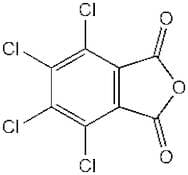
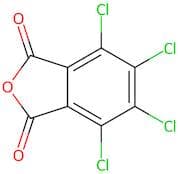
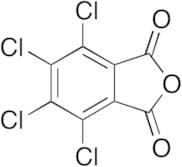
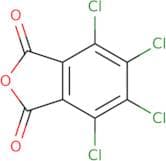
Anidride tetracloroftalica (CAS 117-08-8) è un composto chimico caratterizzato dal suo gruppo funzionale anidride derivato dall'acido ftalico, con quattro atomi di cloro sostituiti nell'anello aromatico. Si presenta come un solido cristallino di colore bianco a giallo chiaro ed è noto per il suo alto punto di fusione e bassa solubilità in acqua, rendendolo più solubile nei solventi organici. Questo composto è utilizzato principalmente nella produzione di poliimmidi e altri polimeri, fungendo da intermediario chiave in varie sintesi chimiche. La sua reattività è notevole, poiché può subire idrolisi per formare acido tetrachlorofhtalico e può anche partecipare a reazioni con nucleofili a causa della natura elettrofila del gruppo anidride. Anidride tetracloroftalica è considerato pericoloso, con potenziali effetti sulla salute in caso di esposizione, richiedendo misure di sicurezza appropriate durante la manipolazione. Le sue applicazioni si estendono alla produzione di rivestimenti, adesivi e come intermediario chimico nella sintesi di altri composti, evidenziando la sua importanza nella chimica industriale.
Formula:C8Cl4O3
InChI:InChI=1S/C8Cl4O3/c9-3-1-2(8(14)15-7(1)13)4(10)6(12)5(3)11
InChI key:InChIKey=AUHHYELHRWCWEZ-UHFFFAOYSA-N
SMILES:ClC1=C2C(=C(Cl)C(Cl)=C1Cl)C(=O)OC2=O
Sinonimi:- (2,3,6-Trichlorophenyl)Acetic Acid
- 1,3-Dioxy-4,5,6,7-tetrachloroisobenzofuran
- 1,3-Isobenzofurandione, 4,5,6,7-Tetrachloro
- 3,4,5,6-Tetrachlorophthalic anhydride
- 4,5,6,7-Tetrachloro-1,3-isobenzofurandione
- 4,5,6,7-Tetrachloro-2-Benzofuran-1,3-Dione
- 4,5,6,7-Tetrachloroisobenzofuran-1,3-dione
- 4,5,6,7-Tetrachlorp-l,3-dioxoph-thalan
- NSC 1484
- Niagathal
- Phthalic anhydride, tetrachloro-
- Tetra Chloro Phthalic Anhydride
- Tetrachloro Phthalic Anhydride
- Tetrachlorophthalic acid anhydride
- Vedi altri sinonimi
Ordinare per
Purezza (%)
0
100
|
0
|
50
|
90
|
95
|
100
4 prodotti.
Tetrachlorophthalic anhydride, 98%
CAS:Protection of amines as their tetrachlorophthalimide derivatives, by reaction with the anhydride in the presence of triethylamine, has been found to be useful in oligosaccharide chemistry. The group is stable to a wide range of reagents but can be selectively cleaved with ethylenediamine at lower teFormula:C8Cl4O3Purezza:98%Colore e forma:White, Powder or crystalline powderPeso molecolare:285.89Tetrachlorophthalic anhydride
CAS:Tetrachlorophthalic anhydrideFormula:C8Cl4O3Purezza:97%Colore e forma: white powderPeso molecolare:285.90g/molTetrachlorophthalic Anhydride
CAS:Prodotto controllatoApplications Tetrachlorophthalic Anhydride is used in the synthesis of nucleoside analogues with a specific structure as apoptosis inducing active compounds. Also used in the synthesis of carbonic anhydrase inhbitors. Chlorinated Reactive Flame Retardant Intermediate
References Hirschhaeuser, C. et al.: Chem. A. Eur. J., 19, 13017 (2013); Sethi, K. et al.: Bioorg. Med. Chem., 21, 5168 (2013);Formula:C8Cl4O3Colore e forma:NeatPeso molecolare:285.9Tetrachlorophthalic anhydride
CAS:Prodotto controllatoTetrachlorophthalic anhydride (TCPA) is a reactive chemical that has been shown to have anti-inflammatory activity. TCPA has been found to inhibit the release of histamine from mast cells in humans, and it inhibits the production of pro-inflammatory cytokines such as tumor necrosis factor alpha (TNF-α). TCPA has also been shown to have a toxic effect on human lymphocyte transformation, which may be due to its ability to induce apoptosis. The toxicity of TCPA was studied in rats and mice, where it was found that TCPA did not cause any significant changes in clinical pathology or hydroxyl group levels.Formula:C8Cl4O3Purezza:Min. 97.5 Area-%Colore e forma:White/Off-White SolidPeso molecolare:285.89 g/mol