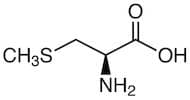
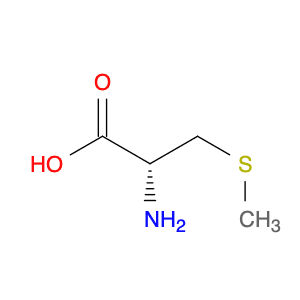
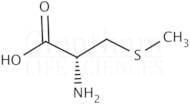
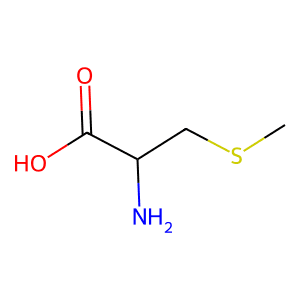
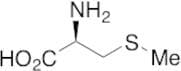
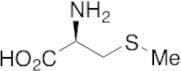
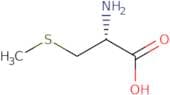
CAS 1187-84-4
:(-)-S-Metil-L-cisteina
- (-)-S-Methyl-<span class="text-smallcaps">L</span>-cysteine
- (2R)-2-(Methylamino)-3-sulfanylpropanoic acid
- (2R)-2-(Methylamino)-3-sulfanylpropans?ure
- (2R)-2-Amino-3-(methylsulfanyl)propanoic acid
- (2R)-2-Azaniumyl-3-methylsulfanylpropanoate
- (2S)-2-(methylammonio)-3-sulfanylpropanoate
- (R)-N-Methylcysteine
- 3-(Methylthio)alanine
- <span class="text-smallcaps">L</span>-Cysteine, S-methyl-
- <span class="text-smallcaps">L</span>-S-Methylcysteine
- Acide (2R)-2-(méthylamino)-3-sulfanylpropano?que
- Alanine, 3-(methylthio)-, <span class="text-smallcaps">L</span>-
- Cysteine, N-methyl, L-
- L-cysteine, N-methyl-
- L-methylcysteine
- N-Methyl-L-cystein
- N-Methyl-L-cysteine
- NSC 15387
- S-Methyl-(R)-cysteine
- S-Methyl-L-Cysteine
- S-Methylcysteine
- L-Cysteine, S-methyl-
- Alanine, 3-(methylthio)-, L-
- L-S-Methylcysteine
- S-Methyl-L-cysteine, 99+%
- S-Methyl-L-Cys-OH
- S-METHYL-L-CYSTEINE/ H-CYS(ME)-OH
- H-L-CYS(ME)-OH
- S-Methyl-L-Cysteine(SMC)
- (2R)-2-Amino-3-methylsulfanylpropanoic acid
- Methylcysteine
- SMC
- S-METHYL-CYSTEINE
- L-CH3SCH2CH(NH2)COOH
- (R)-2-AMINO-3-(METHYLMERCAPTO)PROPIONIC ACID
- H-CYS(ME)-OH
- Vedi altri sinonimi
S-Methyl-L-cysteine
CAS:Formula:C4H9NO2SPurezza:>98.0%(T)Colore e forma:White to Almost white powder to crystalPeso molecolare:135.18S-Methyl-L-cysteine
CAS:Formula:C4H9NO2SPurezza:≥ 97.0%Colore e forma:White, off-white or light-yellow powderPeso molecolare:135.18S-Methyl-L-cysteine
CAS:S-Methyl-L-cysteine is a natural substrate for MSRA, providing neuroprotection, antioxidation, and anti-obesity effects.Formula:C4H9NO2SPurezza:97.061% - 99.87%Colore e forma:SolidPeso molecolare:135.18S-Methyl-L-cysteine
CAS:Prodotto controllatoApplications S-Methyl-L-cysteine is a substrate in the catalytic antioxidant system mediated by methionine sulfoxide reductase A (MSRA). It has been studied as a theurapeutic for neurodegenerative diseases including Parkinson′s.
References Wassef, R., et al.: J. Neurosci., 21, 12808 (2007)Formula:C4H9NO2SColore e forma:NeatPeso molecolare:135.19h-cys(me)-oh
CAS:Formula:C4H9NO2SPurezza:98%Colore e forma:White to almost white powderPeso molecolare:135.18S-Methyl-L-cysteine
CAS:Prodotto controllatoFormula:C4H9NO2SColore e forma:NeatPeso molecolare:135.19H-Cys(Me)-OH
CAS:H-Cys(Me)-OH is an organosulfur compound that contains a sulfhydryl group. It is used as a model system for the study of the p2 group of compounds in nitrogen chemistry and enzyme activity. H-Cys(Me)-OH has been shown to have anti-inflammatory properties, which may be due to its ability to inhibit prostaglandin synthesis. The compound also exhibits carcinogenic potential, as it induces mitochondrial membrane depolarization and kidney bean necrosis in rats when administered at high doses.
Formula:C4H9NO2SPurezza:Min. 95 Area-%Peso molecolare:135.19 g/molRef: ST-EA-CP-C275004
10mgPrezzo su richiesta25mgPrezzo su richiesta50mgPrezzo su richiesta100mgPrezzo su richiesta