CAS 1191-95-3
:Ciclobutanone
Descrizione:
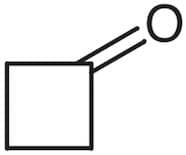
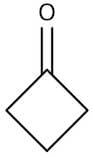
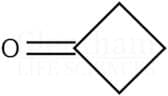
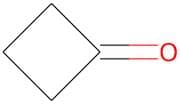
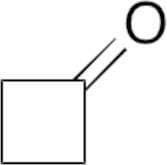
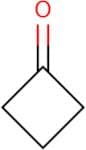
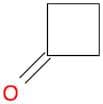
Ciclobutanone è una chetone ciclica caratterizzata da un anello di carbonio a quattro membri con un gruppo carbonilico (C=O) attaccato a uno degli atomi di carbonio. La sua formula molecolare è C4H6O e presenta una struttura unica che influenza le sue proprietà chimiche. Ciclobutanone è un liquido incolore a temperatura ambiente, con un odore distintivo. È relativamente instabile rispetto a chetoni ciclici più grandi a causa della tensione dell'anello associata alla sua piccola dimensione dell'anello. Questa tensione può portare a reattività, rendendo Ciclobutanone suscettibile a varie reazioni chimiche, inclusa l'aggiunta nucleofila e l'ossidazione. Il composto è solubile in solventi organici ma ha una solubilità limitata in acqua. Ciclobutanone è utilizzato nella sintesi organica e come intermediario nella produzione di farmaci e altri composti chimici. La sua reattività e le caratteristiche strutturali lo rendono un argomento interessante di studio nel campo della chimica organica, in particolare nel contesto della tensione dell'anello e delle sue implicazioni per il comportamento chimico.
Formula:C4H6O
InChI:InChI=1S/C4H6O/c5-4-2-1-3-4/h1-3H2
InChI key:InChIKey=SHQSVMDWKBRBGB-UHFFFAOYSA-N
SMILES:O=C1CCC1
Sinonimi:- Ai3-37787
- Ciclobutanona
- Cyclobutanon
- Nsc 87632
- Cyclobutanone
Ordinare per
Purezza (%)
0
100
|
0
|
50
|
90
|
95
|
100
10 prodotti.
Cyclobutanone (stabilized with Na2CO3)
CAS:Formula:C4H6OPurezza:>97.0%(GC)Colore e forma:Colorless to Yellow to Orange clear liquidPeso molecolare:70.09Cyclobutanone, 98%, stab. with ca 0.1% BHT
CAS:Cyclobutanone is used in preparation of cyclobutane derivatives. It is used as a starting material for aminocyclobutanecarboxylic acid through sulfonyloxiranes. It is also used to prepare dihydro-furan-2-one in presence of polystyrene-bound phenylselenic acid as catalyst. Further, it is involved inFormula:C4H6OPurezza:0.1%Colore e forma:Clear or slightly turbid, colorless to pale yellow, LiquidPeso molecolare:70.09Cyclobutanone
CAS:Formula:C4H6OPurezza:(GC) ≥ 99.0%Colore e forma:Clear, colourless to light yellow liquidPeso molecolare:70.09Cyclobutanone (stabilized with 0.1% BHT)
CAS:Formula:C4H6OPurezza:98.0%Colore e forma:Liquid, ClearPeso molecolare:70.091Ref: 4Z-B-150028
5mgPrezzo su richiesta10mgPrezzo su richiesta25mgPrezzo su richiesta50mgPrezzo su richiesta100mgPrezzo su richiestaCyclobutanone
CAS:CyclobutanoneFormula:C4H6OPurezza:98%Colore e forma: yellowish liquidPeso molecolare:70.08983g/molCyclobutanone
CAS:Prodotto controllatoStability Volatile
Applications Cyclobutanone is a member of cycloketone compounds that have potential genotoxic and cytotoxic effects and are most commonly found in irradiated food.
Not a dangerous good if item is equal to or less than 1g/ml and there is less than 100g/ml in the package
References Anandon, A., et al.: EFSA Journal, 9, 1930 (2011); Delincee, H., et al.: Radiat. Phys. Chem., 63, 431 (2002); Obana, H. ,et al.: J. Health Sci., 52, 375 (2006)Formula:C4H6OColore e forma:NeatPeso molecolare:70.09Cyclobutanone - stabilise 0.01 % BHT
CAS:Cyclobutanone is a chemical compound that is used as a model system for studying the oxidation of organic compounds. Cyclobutanone can be synthesized by the reaction of trifluoroacetic acid with cyclohexanone, which in turn can be produced from the hydrogenation of acetone or by dehydration of propionaldehyde. This chemical has been shown to inhibit the growth of infectious bacteria such as Mycobacterium tuberculosis and Streptococcus pneumoniae. It is also effective against other bacterial strains, such as Escherichia coli, Salmonella typhi, and Pseudomonas aeruginosa. Cyclobutanone inhibits the metabolism of glucose in cells by blocking the enzyme hexokinase and preventing glycolysis from occurring, leading to an accumulation of lactic acid in blood and urine. This effect on glucose metabolism may contribute to some autoimmune diseases, such as type 1 diabetes mellitus and celiac disease. The structure of cyclFormula:C4H6OPurezza:Min. 95%Colore e forma:Colorless Clear LiquidPeso molecolare:70.09 g/mol