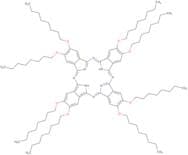
CAS 119457-81-7
:2,3,9,10,16,17,23,24-octakis(octilossi)-29H,31H-fosfeno
Descrizione:
La sostanza chimica nota come "2,3,9,10,16,17,23,24-octakis(octilossi)-29H,31H-fosfeno" è un composto organico complesso caratterizzato dai suoi molteplici sostituenti octiloossigenati. Questa struttura suggerisce un alto grado di idrofobicità a causa delle lunghe catene alchiliche, che possono influenzare la sua solubilità e interazione con altre sostanze. La presenza di più legami eterei (gruppi octiloossigenati) di solito migliora la stabilità del composto e può conferire proprietà fisiche uniche, come punti di fusione e ebollizione più bassi rispetto a composti simili con meno catene alchiliche. Inoltre, le grandi dimensioni molecolari del composto e la sua struttura ramificata possono portare a comportamenti interessanti in varie applicazioni, comprese potenziali applicazioni nella scienza dei materiali, nanotecnologia o come tensioattivi. Le sue proprietà specifiche, come stabilità termica, reattività e potenziali applicazioni, dipenderebbero dall'architettura molecolare complessiva e dalla disposizione dei gruppi octiloossigenati. Ulteriori caratterizzazioni attraverso tecniche come NMR, spettroscopia IR o spettrometria di massa fornirebbero ulteriori approfondimenti sulle sue proprietà e comportamento.
- 2,3,9,10,16,17,23,24-Octakis(octyloxy)-29H,31H-phthalocyanine
Ordinare per
Purezza (%)
0
100
|
0
|
50
|
90
|
95
|
100
2 prodotti.
29H,31H-Phthalocyanine, 2,3,9,10,16,17,23,24-octakis(octyloxy)-
CAS:Formula:C96H146N8O8Peso molecolare:1540.23522,3,9,10,16,17,23,24-Octakis(octyloxy)-29H,31H-phthalocyanine
CAS:<p>2,3,9,10,16,17,23,24-Octakis(octyloxy)-29H,31H-phthalocyanine (OCTPt) is a silicon-based molecule that has been shown to be an effective inhibitor of metal ion catalyzed oxidation. The molecule is not spontaneous and requires nanomolar concentrations in order to inhibit the reaction. The molecule is able to inhibit the oxidation of metal surfaces at efficiencies up to 99%. OCTPt binds to the metal surface and prevents oxygen from binding. This leads to a decrease in the rate of oxidation by about two orders of magnitude. A Langmuir adsorption isotherm was used to study the thermodynamic properties of OCTPt on gold surfaces. OCTPt was shown to have a strong synergistic effect with other inhibitors such as 2-mercaptobenzothiazole (MBTZ). The molecules can be seen using microscopy techniques such as scanning electron microscopy</p>Formula:C96H146N8O8Purezza:Min. 95%Peso molecolare:1,540.24 g/mol