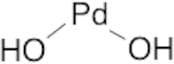
CAS 12135-22-7
:Idrossido di palladio
Descrizione:
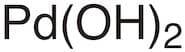
Idrossido di palladio, con il numero CAS 12135-22-7, è un composto inorganico composto da palladio, ossigeno e idrogeno. Appare tipicamente come un solido di colore marrone scuro o nero ed è noto per le sue proprietà catalitiche, in particolare nelle reazioni di idrogenazione e come catalizzatore nella sintesi organica. Idrossido di palladio è spesso utilizzato nella produzione di catalizzatori di palladio e in applicazioni elettrochimiche, come celle a combustibile e batterie. È relativamente stabile a condizioni ambientali, ma può decomporsi quando riscaldato, rilasciando acqua e formando metallo di palladio. Il composto è solubile in acidi forti e può essere convertito in sali di palladio attraverso varie reazioni chimiche. A causa della sua reattività e della capacità di assorbire idrogeno, Idrossido di palladio gioca un ruolo significativo in vari processi industriali, inclusa la purificazione dell'idrogeno e la sintesi di sostanze chimiche fini. Devono essere adottate precauzioni di sicurezza quando si maneggia questo composto, poiché può comportare rischi per la salute se inalato o ingerito.
Formula:H2O2Pd
InChI:InChI=1/2H2O.Pd/h2*1H2;/q;;+2/p-2
InChI key:InChIKey=NXJCBFBQEVOTOW-UHFFFAOYSA-L
SMILES:[Pd](O)O
Sinonimi:- Escat 1951
- Palladium Dihydrate
- Palladium dihydroxide
- Palladium hydroxide (Pd(OH)2)
- Palladium hydroxide (Pd(OH)<sub>2</sub>)
- Palladium(2+) Dihydroxide
- Palladium(II) Hydroxide
- Pearlman's catalyst
- Pearlmans Catalyst
- ESCAT 1421
- ESCAT 1431
- ESCAT TM 1621
- ESCAT TM 1951
- ESCAT 1471
- ESCAT 1621
- ESCAT TM 1421
- ESCAT TM 1431
- PALLADIUM-ACTIVATED CARBON
- ESCAT 1921
- ESCAT 1931
- ESCAT(TM) 1911B
- PALLADIUM CARBON
- ESCAT(TM) 1921
- ESCAT(TM) 1971
- ESCAT(TM) 1961
- ESCAT(TM) 1471
- ESCAT(TM) 1941
- Vedi altri sinonimi
Ordinare per
Purezza (%)
0
100
|
0
|
50
|
90
|
95
|
100
Trovati 9 prodotti.
Palladium Hydroxide (contains Pd, PdO) on Carbon (wetted with ca. 50% Water)
CAS:Formula:Pd(OH)2Colore e forma:Black powder to crystalPeso molecolare:140.43Palladium hydroxide, Pd 20% on carbon, nominally 50% water, Pearlman's Catalyst
CAS:Hydrogenolysis of benzyl-nitrogen bondsPalladium hydroxide, Pd 20% on carbon, nominally 50% water is used as a catalyst for hydrogenolysis of benzyl groups and epoxides. It is used to reduce nitro compounds to amines. It acts as a dehydrogenation reagent as well as a useful reagent for debenzylationFormula:H2O2PdPeso molecolare:140.43Palladium hydroxide, Pd 5% on carbon powder, Type A403002-5, nominally 50% water
CAS:This Thermo Scientific Chemicals brand product was originally part of the Alfa Aesar product portfolio. Some documentation and label information may refer to the legacy brand. The original Alfa Aesar product / item code or SKU reference has not changed as a part of the brand transition to Thermo SciFormula:H2O2PdPeso molecolare:140.43Palladium hydroxide, 99%
CAS:Acts as a catalyst for arylation reactions. It is employed in hydrogenolysis of benzyl-nitrogen bonds. This Thermo Scientific Chemicals brand product was originally part of the Alfa Aesar product portfolio. Some documentation and label information may refer to the legacy brand. The original Alfa AesFormula:H2O2PdPurezza:99%Peso molecolare:140.43Palladium(II) hydroxide on carbon, 20% Pd, wet support, powder
CAS:Palladium(II) hydroxide on carbon, 20% Pd, wet support, powderFormula:·Pd·2OHPurezza:95%Colore e forma:Black Solid-PowderPeso molecolare:140.43468Ref: 54-IN2807
1gPrezzo su richiesta5gPrezzo su richiesta10gPrezzo su richiesta25gPrezzo su richiesta100gPrezzo su richiestaPalladium hydroxide on carbon 5%
CAS:Formula:H2O2PdPurezza:95.0%Colore e forma:SolidPeso molecolare:140.43Ref: 10-F033057
1gPrezzo su richiesta5gPrezzo su richiesta10gPrezzo su richiesta25gPrezzo su richiestaRef: 10-F996250
1gPrezzo su richiesta5gPrezzo su richiesta10gPrezzo su richiesta50gPrezzo su richiestaPalladium hydroxide on carbon, 20 wt.% 50% water
CAS:Formula:H4O3PdPurezza:95.0%Colore e forma:Solid, Black powderPeso molecolare:158.45Ref: 10-F075132
1gPrezzo su richiesta5gPrezzo su richiesta10gPrezzo su richiesta25gPrezzo su richiesta50gPrezzo su richiesta100gPrezzo su richiestaPalladium Hydroxide (20% on Carbon) (~50% water by weight)
CAS:Prodotto controllatoApplications Palladium Hydroxide is a catalyst for hydrogenation reactions as well as in the synthesis of glycopeptides used in obtaining antibodies from autoimmune diseases.
References Bonache, M. et al.: Adv. Exp. med. Bio., 611, 411 (2009); Dzhardimalieva, G. et al.: Russ. Chem. Bull., 58, 2070 (2009);Formula:H2O2PdColore e forma:NeatPeso molecolare:140.43