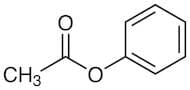
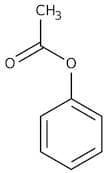
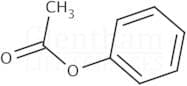
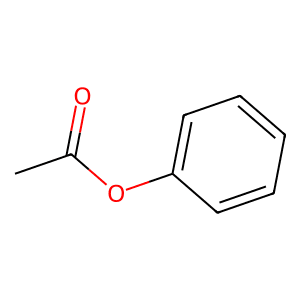
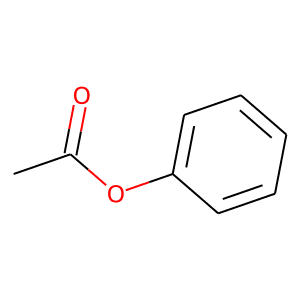
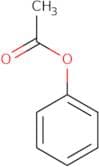
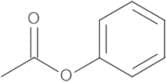
CAS 122-79-2
:Acetato di fenile
- (4-Acetoxy)polystyrene
- (Acetyloxy)benzene
- 2-Acetoxybenzene
- Acetate de phenyle
- Acetate, Phenyl
- Acetato De Fenilo
- Acetic acid phenyl ester
- Acetoxybenzene
- Essigsaeure-Phenylester
- Nsc 27795
- Phenol acetate
- Phenylacetat
- Phenyl acetate
- Phenyl ester of acetic acid
- ETHYL BIS ( 2, 4 DINITRO PHENYL
- fenylesterkyselinyoctove
- Phenylacetate 99%
- PHENYL ACETATE 99+%
- BenzoateAcetate
- Essigsurephenylester
- Fenylester kyseliny octove
- Pcetic acid phenyl ester
- Vedi altri sinonimi
Phenyl Acetate
CAS:Formula:C8H8O2Purezza:>98.0%(GC)Colore e forma:Colorless to Almost colorlessclear liquidPeso molecolare:136.15Phenyl acetate, 97%
CAS:Phenyl acetate levels in urine are marker for the diagnosis of some forms of unipolar major depressive disorders. It undergoes Fries rearrangement to form a mixture of o- and p-hydroxyacetophenones which are useful intermediates in manufacture of pharmaceuticals. It is a metabolite of PhenylbutyrateFormula:C8H8O2Purezza:97%Colore e forma:Clear colorless to pale yellow to pale brown, LiquidPeso molecolare:136.15Phenyl acetate
CAS:Phenyl acetate, a phenylalanine metabolite, may inhibit tumor growth and induce apoptosis.Formula:C8H8O2Purezza:99.70%Colore e forma:Colorless Mobile Liquid Laboratory Reagent And In The Production Of Some Organic ChemicalsPeso molecolare:136.15Phenyl acetate
CAS:Formula:CH3CO2C6H5Purezza:≥ 97.0%Colore e forma:Clear, colourless to faint yellow-brown liquidPeso molecolare:136.15Phenyl acetate
CAS:Phenyl acetate
Formula:C8H8O2Purezza:95%Colore e forma: clear. colourless liquidPeso molecolare:136.15g/molAcetic acid-phenyl ester
CAS:Prodotto controllatoFormula:C8H8O2Colore e forma:NeatPeso molecolare:136.15Ref: 4Z-P-372
5mgPrezzo su richiesta10mgPrezzo su richiesta25mgPrezzo su richiesta50mgPrezzo su richiesta100mgPrezzo su richiestaPhenyl acetate
CAS:Phenyl acetate is a phenol compound that has been shown to inhibit the growth of cancer cells in vitro and in vivo. Phenyl acetate was found to be more potent than benzoate at inhibiting the growth of malignant brain cells. It also inhibits prostaglandin synthesis by binding with basic proteins, which prevents the release of prostaglandin J2. This activity suggests that phenyl acetate may be useful in treating cancer, as well as inflammatory disorders such as arthritis and asthma. The structural analysis of phenyl acetate reveals that it has an intermolecular hydrogen bond between two phenyl groups, which is responsible for its antifungal activity.
Formula:C8H8O2Purezza:Min. 98%Colore e forma:Clear LiquidPeso molecolare:136.15 g/molPhenyl Acetate
CAS:Applications Phenyl Acetate is a metabolite of Phenylbutyrate (PB), useful in the treatment of neuroblastoma and lung cancer. An odorant found in strawberries, passion fruit and black tea.
References Ubeda, C. et al.; J. Agr. Food Chem. 60, 6095 (2012); Burzynski, S.R. & Nagy-Kubove, E.; J. Cancer Ther. 2, 518 (2011); Brat, P. et al.; J. Agr. Food Chem., 48, 6210 (2000); Mick, W. & Schreier, P.; J. Agr. Food Chem., 32, 924 (1984)Formula:C8H8O2Colore e forma:ColourlessPeso molecolare:136.15