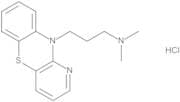
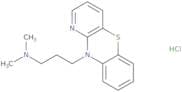
CAS 1225-65-6
:Cloridrato di protipendile
- ((4-Dimethylaminopropylpyrido (3,2b) benzothiazine)) hydrochloride
- 10-(3-Dimethylaminopropyl)-1-azaphenothiazine hydrochloride
- 10H-Pyrido(3,2-b)(1,4)benzothiazine, 10-(3-(dimethylamino)propyl)-, monohydrochloride
- 10H-Pyrido[3,2-b][1,4]benzothiazine-10-propanamine, N,N-dimethyl-, hydrochloride (1:1)
- 10H-Pyrido[3,2-b][1,4]benzothiazine-10-propanamine, N,N-dimethyl-, monohydrochloride
- Ay-56031
- Azacon
- D 206
- Dominal forte
- Dominal hydrochloride
- Iso-Thiopental
- N,N-Dimethyl-10H-pyrido(3,2-b)(1,4)benzothiazine-10-propanamine, monohydrochloride
- Prothipendyl HCl
- Prothipendyl hydrochloride
- Prothipendyl monohydrochloride
- Tolnate
- Unii-7610629Rvh
- Vedi altri sinonimi
Prothipendyl Hydrochloride
CAS:Applications A Phenothiazine (P318040) analog. Antipsychotic.
References Sartorelli, A.C., et al.: Experientia, 21, 457 ( 1965),Formula:C16H19N3S·ClHColore e forma:NeatPeso molecolare:321.87Prothipendyl hydrochloride
CAS:Prothipendyl hydrochloride serves as an orally active compound for researching mental symptoms in the elderly, such as anxiety [1].Formula:C16H20ClN3SColore e forma:SolidPeso molecolare:321.87Prothipendyl hydrochloride
CAS:Prodotto controllatoProthipendyl hydrochloride is a low-potency, non-selective 5-HT receptor antagonist. It is used in the treatment of depression and anxiety disorders. Prothipendyl hydrochloride has been shown to be effective in treating Parkinson's disease and other movement disorders by blocking the action of dopamine on 5-HT receptors. Prothipendyl hydrochloride also has been shown to have cardiac effects. It binds to cardiac tissue with high affinity, which may be due to its ability to bind nitrogen atoms. Prothipendyl hydrochloride is not active against human liver cells, which may be due to its specificity for cb2 receptors that are found only in the central nervous system.
Formula:C16H20ClN3SPurezza:Min. 95%Peso molecolare:321.87 g/molRef: 3D-FP27245
Prodotto fuori produzione