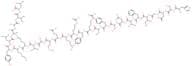
CAS 127317-03-7
:polipeptide attivante l'adenilato ciclasi pituitaria
Descrizione:
Il polipeptide attivante dell'adenilato ciclasi dell'ipofisi (PACAP) è un neuropeptide che svolge un ruolo cruciale in vari processi fisiologici, tra cui neuroprotezione, neurotrasmissione e secrezione ormonale. È caratterizzato dalla sua capacità di attivare l'adenilato ciclasi, portando a livelli aumentati di AMP ciclico (cAMP) nelle cellule bersaglio. Il PACAP è noto per le sue diverse funzioni biologiche, tra cui la modulazione dei ritmi circadiani, la regolazione delle risposte allo stress e il coinvolgimento nelle funzioni riproduttive. Il peptide mostra alta affinità per recettori specifici, vale a dire i recettori PACAP (PAC1, VPAC1 e VPAC2), che mediano i suoi effetti in diversi tessuti. Inoltre, il PACAP è implicato in varie condizioni patofisiologiche, comprese le malattie neurodegenerative e i disturbi metabolici. La sua struttura consiste in una sequenza di amminoacidi che contribuiscono alla sua stabilità e attività, ed è spesso studiato per le sue potenziali applicazioni terapeutiche in neurologia ed endocrinologia. In generale, il PACAP è una molecola significativa sia nella ricerca di base che clinica, evidenziando la sua importanza nella comprensione di sistemi biologici complessi.
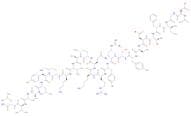
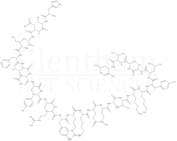
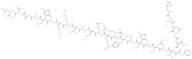
Formula:C142H224N40O39S
Sinonimi:- Pituitary Adenylate Cyclase Activating Polypeptide (1-27) amide (human, ovine, rat)
- H-His-Ser-Asp-Gly-Ile-Phe-Thr-Asp-Ser-Tyr-Ser-Arg-Tyr-Arg-Lys-Gln-Met-Ala-Val-Lys-Lys-Tyr-Leu-Ala-Ala-Val-Leu-NH2
- PACAP 27 Amide, Ovine
Ordinare per
Purezza (%)
0
100
|
0
|
50
|
90
|
95
|
100
9 prodotti.
PACAP (1-27), Human, Ovine, Rat
CAS:For cellular and molecular biology applications
Formula:C142H224N40O39SPeso molecolare:3147.64PACAP-27 (human, mouse, ovine, porcine, rat)
CAS:PACAP-38 and its N-terminal fragment PACAP-27 are neuropeptides originally isolated from ovine hypothalamus, but also found in humans and rats. Both PACAP-27, which shows considerable homology with vasoactive intestinal polypeptide (VIP), and PACAP-38 stimulate adenylate cyclase much more potently than VIP. Specific PACAP receptors have been identified in different tissues and cell lines.Kojro et al. observed that the PAC1 agonists PACAP-27 and PACAP-38 strongly increased the activity of α-secretase, thus promoting the non-amyloidogenic processing of amyloid precursor protein.Formula:C142H224N40O39SPurezza:≥ 97%Colore e forma:WhitePeso molecolare:3147.65H-HIS-SER-ASP-GLY-ILE-PHE-THR-ASP-SER-TYR-SER-ARG-TYR-ARG-LYS-GLN-MET-ALA-VAL-LYS-LYS-TYR-LEU-ALA-ALA-VAL-LEU-NH2
CAS:Formula:C142H224N40O39SPurezza:95%Peso molecolare:3147.6076Pituitary adenylate cyclase activating polypeptide-27 ovine
CAS:Formula:C142H224N40O39SPeso molecolare:3147.64PACAP (1-27), human, ovine, rat
CAS:PACAP (1-27) (the N-terminal fragment of PACAP-38) is a novel neuropeptides originally isolated from bovine hypothalamus, also found in humans and rats.Formula:C142H224N40O39SPurezza:98%Colore e forma:SolidPeso molecolare:3147.66PACAP-27 (human, mouse, ovine, porcine, rat)
CAS:PACAP 1-27 (Pituitary adenylate cyclase-activating polypeptide 27) is a potent stimulator of adenylyl cyclase and increases cAMP levels.
Formula:C142H224N40O39SPeso molecolare:3,147.65 g/molPACAP-27 (human, mouse, ovine, porcine, rat)
CAS:Custom research peptide; min purity 95%.
Formula:C142H224N40O39SPurezza:Min. 95%Peso molecolare:3,147.68 g/molPACAP27 (Human, 1-27 Amide)
CAS:PACAP27 is a peptide that is used as a research tool. PACAP27 binds to the receptor for pituitary adenylate cyclase-activating polypeptide (PACAP). The binding of PACAP27 to the receptor leads to activation of adenylyl cyclase, which increases intracellular levels of cAMP. This increase in cAMP may lead to cellular responses such as increased ion channel activity and increased protein synthesis.Formula:C142H224N40O39SPurezza:Min. 95%Peso molecolare:3,147.6 g/molPACAP-27 (human, mouse, ovine, porcine, rat) trifluoroacetate salt
CAS:Trifluoroacetate saltFormula:C142H224N40O39SPurezza:Min. 95%Peso molecolare:3,147.61 g/mol