CAS 1314-32-5
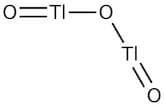
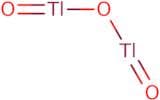
:Ossido di tallio (Tl2O3)
Descrizione:
Ossido di tallio (Tl2O3) è un composto inorganico caratterizzato dalla sua formazione a partire da tallio e ossigeno. Appare tipicamente come un solido giallastro o marrone ed è noto per il suo alto punto di fusione. L'ossido di tallio è un semiconduttore ed espone interessanti proprietà elettriche, rendendolo rilevante in varie applicazioni, tra cui elettronica e ottica. Il composto si trova principalmente in due stati di ossidazione, con Tl2O3 che rappresenta il tallio nello stato di ossidazione +3. È relativamente stabile nell'aria, ma può reagire con acidi per formare sali di tallio. L'ossido di tallio è anche notevole per la sua tossicità, il che richiede un'attenta manipolazione e smaltimento a causa dei potenziali rischi per la salute associati all'esposizione al tallio. In termini di solubilità, è scarsamente solubile in acqua, ma può dissolversi in acidi forti. Le sue proprietà uniche e le potenziali applicazioni nella scienza dei materiali e nell'elettronica continuano a essere oggetto di ricerca, sebbene le precauzioni di sicurezza siano fondamentali a causa della sua natura tossica.
Formula:O3Tl2
InChI:InChI=1/3O.2Tl/rO3Tl2/c1-4-3-5-2
Sinonimi:- Dithallium Trioxide
- Dithalliumtrioxid
- Thallic oxide
- Thallium oxide
- Thallium oxide (2:3)
- Thallium oxide (Tl<sub>2</sub>O<sub>3</sub>)
- Thallium sesquioxide
- Thallium trioxide
- Thallium(3+) oxide
- Thallium(III) oxide
- Trioxido De Ditalio
- Trioxyde de dithallium
- Thalliumoxide
- Thallium oxide (Tl2O3)
- Thallium (III) oxide (99.5%-Tl)
- Thalliumoxideblackpowder
- oxo-oxothallanyloxy-thallane
- Vedi altri sinonimi
Ordinare per
Purezza (%)
0
100
|
0
|
50
|
90
|
95
|
100
5 prodotti.
Thallium(III) oxide, 96%
CAS:Thallium(III) oxide is used in organic synthesis and as an analytical reagent This Thermo Scientific Chemicals brand product was originally part of the Alfa Aesar product portfolio. Some documentation and label information may refer to the legacy brand. The original Alfa Aesar product / item code oFormula:O3Tl2Purezza:96%Colore e forma:Brown, Crystals or powder or crystalline powderPeso molecolare:456.76Thallium(III) oxide (99.5%-Tl)
CAS:Thallium(III) oxide (99.5%-Tl)
Formula:Tl2O3Purezza:(99.5%-Tl)Colore e forma:black pwdr.Peso molecolare:456.74Thallium(III) oxide (99.99%-Tl) PURATREM
CAS:Thallium(III) oxide (99.99%-Tl) PURATREM
Formula:Tl2O3Purezza:(99.99%-Tl)Colore e forma:black pwdr.Peso molecolare:456.74Thallium (III) oxide
CAS:Thallium (III) oxide is a white powder that is insoluble in water and hydrochloric acid, soluble in nitric acid, and melts at 200 degrees Celsius. It has a density of 3.2 g/cm3 and thermal expansion coefficient of 5.5x10⁻⁶ K-1. Thallium (III) oxide has an irreversible oxidation reaction with hydrochloric acid to form thallous chloride and hydrogen gas. It also undergoes strong absorption of ultraviolet light at wavelengths below 300 nm, which makes it useful for the detection of hydrocarbons in petroleum products. Thallium (III) oxide can be used as a catalyst for acylation reactions and exhibits hydrogen bonding interactions with organic molecules.Formula:Tl2O3Purezza:Min. 95%Colore e forma:Brown Clear LiquidPeso molecolare:456.76 g/molThallium (III) oxide - 99.9%
CAS:Thallium oxide is a white solid that is used in the production of semiconductors, glass, and ceramics. The fluorescence spectrometry technique can be used to identify thallium compounds with high accuracy and sensitivity. Thallium oxide also has an acylation reaction with fatty acids. Thallium oxide can be easily oxidized by air to form a stable oxide, which has been shown to have a thermal expansion coefficient similar to zirconia. This chemical also has properties that are very similar to those of iron oxides, such as irreversible oxidation and hydrogen bonding interactions.
Formula:O3Tl2Purezza:Min. 95%Peso molecolare:456.76 g/molRef: 3D-FT138061
Prodotto fuori produzione