


CAS 131467-87-3
:2,1,3-Benzoxadiazolo, 4-idrazinil-7-nitro-, comp. con idrazina (1:1)
- 2,1,3-Benzoxadiazole, 4-hydrazino-7-nitro-, compd. with hydrazine (1:1)
- 2,1,3-Benzoxadiazole, 4-hydrazinyl-7-nitro-, compd. with hydrazine (1:1)
- 4-Hydrazino-7-Nitro-2,1,3-Benzoxadiazole - Hydrazine (1:1)
- 4-Hydrazino-7-Nitro-2,1,3-Benzoxadiazole Hydrazine
- Benzofurazan, 4-hydrazino-7-nitro-, compd. with hydrazine (1:1)
- Hydrazine, compd. with 4-hydrazino-7-nitro-2,1,3-benzoxadiazole (1:1)
- Hydrazine, compd. with 4-hydrazino-7-nitrobenzofurazan (1:1)
- Hydrazinonitrobenzoxadiazolehydrazine
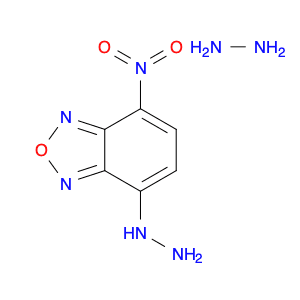
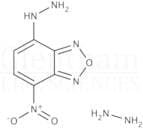
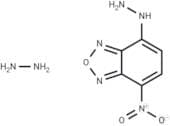
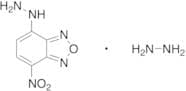
NBD-H (=4-Hydrazino-7-nitro-2,1,3-benzoxadiazole Hydrazine) [for HPLC Labeling]
CAS:Formula:C6H5N5O3·H4N2Purezza:>98.0%(HPLC)Colore e forma:Orange to Brown powder to crystalPeso molecolare:227.182,1,3-Benzoxadiazole, 4-hydrazinyl-7-nitro-, compd. with hydrazine (1:1)
CAS:Formula:C6H9N7O3Purezza:98%Colore e forma:SolidPeso molecolare:227.18084-Hydrazino-7-nitro-benzofurazan hydrazine adduct
CAS:Formula:C6H5N5O3·H4N2Purezza:≥ 98.0%Colore e forma:Beige to yellow-red solid or powderPeso molecolare:227.184-Hydrazino-7-nitro-benzofurazan hydrazine adduct
CAS:4-Hydrazino-7-nitrobenzofurazan hydrazine adduct serves as a fluorescent reagent for protein labeling.Formula:C6H9N7O3Colore e forma:SolidPeso molecolare:227.184-Hydrazino-7-nitro-benzofurazan hydrazine adduct
CAS:Prodotto controllatoApplications 4-Hydrazino-7-nitro-benzofurazan hydrazine adduct is a fluorescent reagent for protein labeling.
Formula:C6H5N5O3·H4N2Colore e forma:NeatPeso molecolare:227.19NBD-H (=4-Hydrazino-7-nitro-2,1,3-benzoxadiazole Hydrazine) [for HPLC Labeling]
CAS:Prodotto controllatoNBD-H is a carbonyl group labeling reagent that can be used for the detection of leukoderma. It reacts with amino, hydroxyl, and carboxylic acid groups in proteins to produce a variety of reaction products. NBD-H has been shown to cause renal toxicity in rats when administered intravenously. The reaction rate is temperature dependent and increases with increasing pH. Trifluoroacetic acid (TFA) is typically used as the solvent for the labeling reaction. TFA reacts with NBD-H to form the reactive intermediate trifluoroacetoamide, which reacts with protein amine groups to produce an NBD derivative that absorbs light at 400 nm or greater. This product can be used for reversed-phase high-performance liquid chromatography (HPLC).
Formula:C6H5N5O3·H4N2Purezza:Min. 95%Peso molecolare:227.18 g/mol
![NBD-H (=4-Hydrazino-7-nitro-2,1,3-benzoxadiazole Hydrazine) [for HPLC Labeling]](/_next/image/?url=https%3A%2Fstatic.cymitquimica.com%2Fproducts%2F3B%2Fthumb%2FA5557.jpg&w=3840&q=75)





![NBD-H (=4-Hydrazino-7-nitro-2,1,3-benzoxadiazole Hydrazine) [for HPLC Labeling]](/_next/image/?url=https%3A%2Fstatic.cymitquimica.com%2Fproducts%2F3D%2Fthumb%2FGFA46787.jpg&w=3840&q=75)
