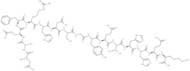
CAS 131580-10-4
:H-Asp-Ala-Glu-Phe-Arg-His-Asp-Ser-Gly-Tyr-Glu-Val-His-His-Gln-Lys-OH
Descrizione:
La sostanza chimica con il nome "H-Asp-Ala-Glu-Phe-Arg-His-Asp-Ser-Gly-Tyr-Glu-Val-His-His-Gln-Lys-OH" è un peptide composto da una sequenza di amminoacidi, specificamente acido aspartico (Asp), alanina (Ala), acido glutammico (Glu), fenilalanina (Phe), arginina (Arg), istidina (His), serina (Ser), glicina (Gly), tirosina (Tyr), valina (Val), glutamina (Gln) e lisina (Lys). Questo peptide è caratterizzato dai suoi diversi gruppi funzionali, che contribuiscono alla sua solubilità, reattività e attività biologica. La presenza di amminoacidi basici come Arg, His e Lys suggerisce potenziali interazioni con molecole cariche negativamente, mentre i residui aromatici (Phe, Tyr) possono partecipare a interazioni idrofobiche. La struttura del peptide può influenzare la sua conformazione e stabilità, impattando le sue funzioni biologiche, come l'attività enzimatica o il legame ai recettori. Il numero CAS 131580-10-4 identifica univocamente questo specifico peptide, facilitando il suo riconoscimento in banche dati chimiche e nella letteratura. In generale, questo peptide può avere applicazioni in biochimica, farmacologia e sviluppo terapeutico.
Formula:C84H119N27O28
Sinonimi:- Beta-Amyloid (1-16)
- Daefrhdsgyevhhqk
- Amyloid Beta-Protein (1-16)
Ordinare per
Purezza (%)
0
100
|
0
|
50
|
90
|
95
|
100
5 prodotti.
Amyloid β-Protein (1-16)
CAS:The Cu²⁺ complex of this soluble amyloid β-protein fragment showed significant oxidative activities toward the catechol-like substrate 1,2,3-trihydroxylbenzene (pyrogallol) and plasmid DNA cleavage. The N-terminal Aβ fragments Aβ1-14, Aβ1-15, and Aβ1-16 are elevated in cell media and in CSF in response to γ-secretase inhibitor treatment. The fragments can serve as biomarkers in clinical studies of the effect of such inhibitors.Formula:C84H119N27O28Purezza:> 98%Colore e forma:White PowderPeso molecolare:1955.03β-Amyloid (1-16)
CAS:β-Amyloid (1-16) is an amyloidogenic protein fragment with a sequence derived from β-amyloid.Formula:C84H119N27O28Purezza:98%Colore e forma:SolidPeso molecolare:1955.04Amyloid β-Protein (1-16)
CAS:Custom research peptide; min purity 95%. For different specs please use the Peptide Quote ToolFormula:C84H119N27O28Peso molecolare:1,955 g/molAmyloid β-Protein (Human, 1-16)
CAS:Amyloid beta-protein (Aβ) is a peptide that is associated with Alzheimer's disease. It is a research tool for understanding the biology of Aβ. The Aβ peptide has been shown to activate a number of receptors and ion channels, including the nicotinic acetylcholine receptor, which may be due to its ability to bind to these proteins with high affinity. Amyloid beta-protein has also been shown to bind antibodies, which may be due to its ability to act as an antigen. Amyloid beta-protein inhibits the function of ion channels and can be used in pharmacological studies as a tool for understanding how this protein interacts with other proteins.Formula:C84H119N27O28Purezza:Min. 95%Peso molecolare:1,955 g/molAmyloid beta-Protein (1-16) trifluoroacetate salt
CAS:Amyloid beta-Protein (1-16) trifluoroacetate salt is a modified form of amyloid beta protein. It is synthesized by the modification of amino acids with trifluoroacetic acid and can be used to study the pathogenesis of Alzheimer's disease. Amyloid beta-Protein (1-16) trifluoroacetate salt has been shown to bind to β-amyloid, which is thought to be the main component of plaques in Alzheimer's disease. This binding inhibits the formation of β-amyloid aggregates, which are associated with neurotoxicity and neuronal cell death.Formula:C84H119N27O28Purezza:Min. 95%Peso molecolare:1,955.01 g/mol