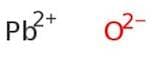
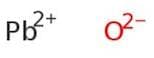
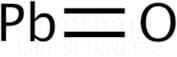
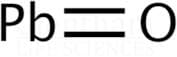
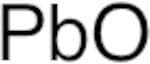
CAS 1317-36-8
:Ossido di piombo (PbO)
Descrizione:
Ossido di piombo (PbO), con il numero CAS 1317-36-8, è un composto inorganico che esiste principalmente in due forme: litargirio (α-PbO) e massicotto (β-PbO). Il litargirio è una polvere gialla-rossa, mentre il massicotto è tipicamente giallo e ha una struttura più cristallina. Il PbO è insolubile in acqua ma solubile negli acidi, rendendolo reattivo in vari ambienti chimici. Ha un alto punto di fusione ed espone proprietà semiconduttrici, il che lo rende utile in applicazioni elettroniche. L'ossido di piombo è utilizzato principalmente nella produzione di vetro, ceramiche e batterie al piombo-acido, così come in pigmenti e come stabilizzatore nelle materie plastiche. Tuttavia, a causa della tossicità del piombo, la manipolazione del PbO richiede rigorose precauzioni di sicurezza per prevenire l'esposizione, poiché può comportare rischi significativi per la salute, inclusa l'intossicazione da piombo. Le normative ambientali regolano anche il suo uso e smaltimento, sottolineando l'importanza di gestire responsabilmente le sostanze contenenti piombo.
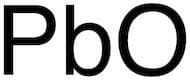
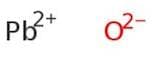
Formula:OPb
InChI:InChI=1S/O.Pb
InChI key:InChIKey=YEXPOXQUZXUXJW-UHFFFAOYSA-N
SMILES:O=[Pb]
Sinonimi:- Blei(II)-oxid
- Bleimonoxid
- Lead Mono Oxide
- Lead Oxide Regular
- Lead monooxide
- Lead monoxide
- Lead oxide
- Lead oxide (PbO)
- Lead oxide yellow
- Lead oxide yellow granular
- Lead protoxide
- Lead(2+) oxide
- Lead(II) oxide yellow
- Leadoxide
- Leadoxideyellowpowder
- Litharge
- Litharge Granular
- Litharge Irregular
- Litharge Regular
- Litharge S
- Litharge Yellow L 28
- Monoxido De Plomo
- Monoxyde de plomb
- Oxo-Lambda~2~-Plumbane
- Oxyde de plomb(II)
- PbO
- Pigment Yellow 46
- Plumbous Oxygen(-2) Anion
- Plumbous oxide
- Red Lead Oxide
- Rhenogran P60-80
- Yellow Lead Monoxide
- Yellow Lead Oxide Granular
- Yellow lead ocher
- lead (II) oxide, litharge, lead oxide
- C.I. Pigment Yellow 46
- Lead(II)oxide
- C.I. 77577
- Vedi altri sinonimi
Ordinare per
Purezza (%)
0
100
|
0
|
50
|
90
|
95
|
100
Trovati 13 prodotti.
Lead(II) Oxide
CAS:Formula:PbOPurezza:>98.0%(T)Colore e forma:Light yellow to Yellow to Orange powder to crystalPeso molecolare:223.20Lead(II) oxide, 99.9%
CAS:It is employed mostly in lead-based industrial glass and industrial ceramics, including computer components. Lead monoxide is used as an intermediate/precursor in the manufacture of several products, for example water proof cements, lubricants, lubricating oils, inorganic pigments, lead soaps, petrFormula:OPbPurezza:99.9%Colore e forma:Pale yellow to yellow or pale orange, Powder or crystalline powder or crystalsPeso molecolare:223.20Lead(II) oxide, Puratronic™, 99.999% (metals basis)
CAS:Used in producing iridescent colors on brass and bronze, coloring sulfur-containing substances and used as pigment for rubber. It is also used in oil refining, varnishes, paints, enamels and in assays for precious metal ores. This Thermo Scientific Chemicals brand product was originally part of theFormula:OPbPurezza:99.999%Peso molecolare:223.20Lead(II) oxide, 99.99% (metals basis)
CAS:Lead(II) oxide is employed mostly in lead-based industrial glass and industrial ceramics, including computer components. It is used as an intermediate/precursor in the manufacture of several products, for example water proof cements, lubricants, lubricating oils, inorganic pigments, lead soaps, petFormula:OPbPurezza:99.99%Peso molecolare:223.20Lead(II) oxide, low silver
CAS:Lead(II) oxide is used in storage batteries, ceramic cements and fluxes, pottery and glazes, in chromium pigments, in oil refining, in paints, and in the assay of precious metal ores. This Thermo Scientific Chemicals brand product was originally part of the Alfa Aesar product portfolio. Some documeFormula:OPbColore e forma:Powder, Yellow to yellow-orange to redPeso molecolare:223.20Lead(II) oxide, Puratronic™, 99.9995% (metals basis)
CAS:It is used in the manufacture of glass, ceramics and computer components. Addition of lead oxide increases the refractive index, electrical resistivity, Curie temperature, and the ability of the glass to absorb X-rays. It is also added to decrease the viscosity of glass. It is employed in the vulFormula:OPbPurezza:99.9995%Peso molecolare:223.20Lead(II) oxide (99.999+%-Pb) PURATREM
CAS:Lead(II) oxide (99.999+%-Pb) PURATREM
Formula:PbOPurezza:(99.999+%-Pb)Colore e forma:yellow pwdr.Peso molecolare:223.19Lead(II) oxide (Litharge), 99+%
CAS:Lead(II) oxide (Litharge), 99+%
Formula:PbOPurezza:99+%Colore e forma:yellow pwdr.Peso molecolare:223.19Lead(II) oxide, 99%
CAS:Formula:PbOPurezza:≥ 99.0%Colore e forma:Yellow or yellow-orange powderPeso molecolare:223.19Lead(II) Oxide
CAS:Applications Lead(II) Oxide is used as the starting material in the synthesis of Dibasic Lead Phthalate Hydrate (D417070); a compound that is used in vinyl wire insulation as a flame retardant.
Not a dangerous good if item is equal to or less than 1g/ml and there is less than 100g/ml in the package
References Grossman, R. et al.: J. Vinyl Addt. Tech., 9, 65 (2003); Grossman, R. et al.: Vinyl Addt. Tech., 6, 138 (2000)Formula:PbOColore e forma:NeatPeso molecolare:223.97157Lead (II) Oxide (Lead Monoxide, Litharge) ACS, 99%
CAS:Formula:PbOPurezza:min.99%Colore e forma:Yellow to orange, PowderPeso molecolare:223.20Lead (II) Oxide (Lead Monoxide, Litharge) pure, 99%
CAS:Formula:PbOPurezza:min.99%Colore e forma:Yellow to orange, PowderPeso molecolare:223.20Ref: SR-50314
Prodotto fuori produzione