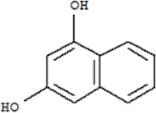
CAS 132-86-5
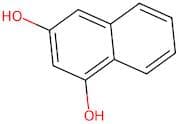
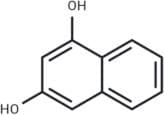
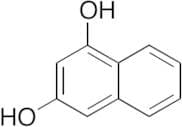
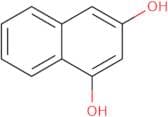
:1,3-Diidrossinaftalene
Descrizione:
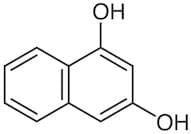
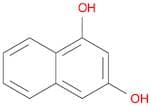
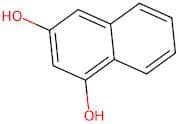
1,3-Diidrossinaftalene, noto anche come 1,3-naftalenodiolo, è un composto organico caratterizzato dalla presenza di due gruppi idrossile (-OH) attaccati a un anello di naftalene nelle posizioni 1 e 3. Questo composto appare come un solido cristallino bianco a giallo chiaro ed è solubile in alcol ed etere, ma meno solubile in acqua. Mostra proprietà tipiche dei composti fenolici, inclusa la capacità di formare legami idrogeno e partecipare a varie reazioni chimiche, come ossidazione e sostituzione. 1,3-Diidrossinaftalene è spesso utilizzato nella sintesi organica e come intermediario nella produzione di coloranti, prodotti farmaceutici e altri prodotti chimici. Inoltre, ha applicazioni nella ricerca, in particolare negli studi relativi alle sue proprietà antiossidanti e potenziali attività biologiche. I dati di sicurezza indicano che deve essere maneggiato con cura, poiché può causare irritazione al contatto con la pelle o gli occhi. Si raccomandano misure di sicurezza adeguate, incluso l'uso di dispositivi di protezione individuale, quando si lavora con questa sostanza.
Formula:C10H8O2
InChI:InChI=1S/C10H8O2/c11-8-5-7-3-1-2-4-9(7)10(12)6-8/h1-6,11-12H
InChI key:InChIKey=XOOMNEFVDUTJPP-UHFFFAOYSA-N
SMILES:OC=1C2=C(C=C(O)C1)C=CC=C2
Sinonimi:- 1,3-Naphthalenediol
- NSC 115890
- Naphthalene-1,3-Diol
- Naphtharesorcinol
- Naphthoresorcinol
- Naphtoresorcine
- 1,3-Dihydroxynaphthalene
Ordinare per
Purezza (%)
0
100
|
0
|
50
|
90
|
95
|
100
12 prodotti.
1,3-Dihydroxynaphthalene
CAS:Formula:C10H8O2Purezza:>98.0%(GC)(T)Colore e forma:White to Gray to Brown powder to crystalPeso molecolare:160.171,3-Dihydroxynaphthalene, 98%
CAS:It is used in the naphthoresorcinol test for uronic acids of Tollens and Rorive, a blue color can be extracted with ethanol after heating of uronic acids with naphthoresorcinol in hydrochloric acid. It is also employed as a reagent for various medical tests. It can also be used as a spot test reagenFormula:C10H8O2Purezza:98%Colore e forma:Cream to brown, PowderPeso molecolare:160.17Ref: IN-DA001019
250gPrezzo su richiesta250mg25,00€1g28,00€5g58,00€10g88,00€25g160,00€50g207,00€100g494,00€1,3-Dihydroxynaphthalene
CAS:1,3-Dihydroxynaphthalene
Formula:C10H8O2Purezza:98%Colore e forma: light orange to brown powderPeso molecolare:160.16932g/mol1,3-Dihydroxynaphthalene
CAS:Formula:C10H8O2Purezza:≥ 98.0%Colore e forma:Off-white to grey, orange or brown crystalline powderPeso molecolare:160.17Naphthoresorcinol, 10mM (in DMSO)
CAS:Naphthoresorcinol, 10mM (in DMSO)Purezza:≥98%Peso molecolare:160.17g/molNaphthoresorcinol
CAS:Naphthoresorcinol (1,3-Dihydroxynaphthalene) is a fluorescent dye (λex=330 nm, λem=380 nm).Formula:C10H8O2Purezza:99.56%Colore e forma:White To Tan CrystallinePeso molecolare:160.171,3-Naphthalenediol
CAS:Applications 1,3-Naphthalenediol is a derivative of naphthalene (N345600) and may have antibacterial activity against oral bacteria.Dyes and metabolites.
References Song, H-Y., et al.: J Korean Soc Appl Biol Chem, 55, 183-187 (2012)Formula:C10H8O2Colore e forma:NeatPeso molecolare:160.171,3-Dihydroxynaphthalene
CAS:1,3-Dihydroxynaphthalene is an organic compound that has been shown to inhibit HIV infection in vitro. The optimum concentration of 1,3-dihydroxynaphthalene for inhibition of HIV infection is 0.5% (w/v). This compound can be synthesized by the reaction of epoxy and a sulfonamide drug. In addition, 1,3-dihydroxynaphthalene has been shown to have anti-inflammatory properties and can be used as a potential treatment for metabolic disorders such as diabetes mellitus.Formula:C10H8O2Purezza:Min. 95%Colore e forma:PowderPeso molecolare:160.17 g/mol1,3-Dihydroxynaphthalene (Naphthoresorcinol) extrapure AR, 99%
CAS:Formula:C10H8O2Purezza:min. 99%Colore e forma:White to gray to brown, Powder to crystalPeso molecolare:160.17