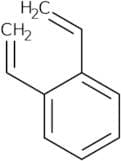
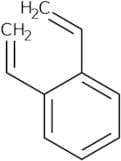
CAS 1321-74-0
:Divinilbenzene
Descrizione:
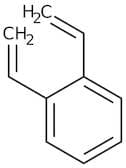
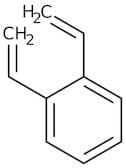
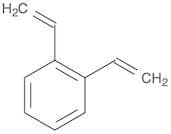
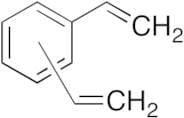
Divinilbenzene (DVB) è un composto organico caratterizzato dalla sua struttura, che contiene due gruppi vinilici attaccati a un anello di benzene. È un liquido incolore o giallo pallido con un odore aromatico distintivo. Il DVB è noto per la sua alta reattività grazie alla presenza dei gruppi vinilici, rendendolo un monomero prezioso nella produzione di polimeri e resine reticolati. È comunemente utilizzato nella sintesi di resine per scambio ionico, così come nella produzione di vari plastici e rivestimenti. Il composto è solubile in solventi organici ma ha una solubilità limitata in acqua. Il DVB può subire polimerizzazione, portando alla formazione di strutture reticolate che migliorano le proprietà meccaniche e termiche dei materiali risultanti. Le considerazioni di sicurezza sono importanti quando si maneggia il DVB, poiché può essere un irritante per la pelle e gli occhi, e devono essere adottate le precauzioni appropriate per ridurre al minimo l'esposizione. In generale, Divinilbenzene è un composto versatile con applicazioni significative nell'industria chimica.
Formula:C10H10
InChI:InChI=1/2C10H10/c1-3-9-5-7-10(4-2)8-6-9;1-3-9-6-5-7-10(4-2)8-9/h2*3-8H,1-2H2
SMILES:C=Cc1ccc(C=C)cc1.C=Cc1cccc(C=C)c1
Sinonimi:- Benzene, Divinyl
- Benzene, diethenyl-
- Diethenylbenzene
- Divinilbenceno
- Divinilbenceno, Puro
- Divinilbenzene
- Divinylbenzen
- Divinylbenzene
- Divinylbenzene Mixed Isomers
- Divinylbenzene, Mixture Of Isomers
- Divinylbenzenetechmixedisomers
- Divinylbenzol
- Dvb 810
- Dvb 96
- Dvb 960
- Dvb Hp
- Dvb-H
- Dvr 960
- Ethylvinyl Benzene
- Vinilestireno
- Vinilstirene
- Vinyl styrène
- Vinyl-Styrol
- Vinylethylbenzene
- Vinylstyren
- Vinylstyrene
- ジビニルベンゼン
- Vedi altri sinonimi
Ordinare per
Purezza (%)
0
100
|
0
|
50
|
90
|
95
|
100
10 prodotti.
Divinylbenzene (m- and p- mixture) (contains Ethylvinylbenzene, Diethylbenzene) (stabilized with TBC)
CAS:Formula:C10H10Purezza:>50.0%(GC)Colore e forma:Colorless to Light orange to Yellow clear liquidPeso molecolare:130.19Divinylbenzene, 80%, mixture of isomers, stab. with 1000ppm 4-tert-butylcatechol
CAS:Divinylbenzene is used as a reactive monomer in polyester resins and for the synthesis of highly crosslinked macroporous styrene as well as a crosslinking agent. It acts as an intermediate in the production of ion exchange resin. Further, it is used in making rubber, petroleum production and polymerFormula:C10H10Purezza:80%Colore e forma:Colorless to yellow, LiquidPeso molecolare:130.19Divinylbenzene, 55%, mixture of isomers, stab. with 1000ppm 4-tert-butylcatechol
CAS:Crosslinking monomerFormula:C10H10Colore e forma:LiquidPeso molecolare:130.19Divinylbenzene (ortho-, meta-, or para- substituted) (~80%)
CAS:Prodotto controllatoApplications Divinylbenzene;m-(or p-)Divinylbenzene (cas# 1321-74-0) is a useful research chemical.
Formula:C10H10Purezza:~80%Colore e forma:ColourlessPeso molecolare:130.19Divinylbenzene (m- and p- mixture) (contains Ethylvinylbenzene, Diethylbenzene) - 80%
CAS:Divinylbenzene is a glycol ester that undergoes a palladium-catalyzed coupling reaction with an alkyne to produce a model system. The resulting polymer has high values of optical sensor, kinetic data, and thermal expansion. Divinylbenzene's chemical stability and particle size make it an appropriate sample preparation for various types of analytical techniques such as optical sensor, which can measure the concentration of divinylbenzene in polymers. Divinylbenzene contains nitrogen atoms that can react with fatty acids to form liver lesions in rats.Formula:C10H10Purezza:Min. 80 Area-%Colore e forma:Clear LiquidPeso molecolare:130.19 g/molDivinylbenzene (m- and p- mixture) (contains Ethylvinylbenzene, Diethylbenzene) - 55%
CAS:Divinylbenzene is a glycol ether that is used as a solvent and an intermediate in the production of polyvinyl chloride. It has been shown to be harmful to the liver in animal studies, causing lesions. It also causes an increase in the levels of water vapor in the air and high values for thermal expansion. Divinylbenzene undergoes a reaction with phosphorus pentoxide, yielding polyvinyl chloride and hydrogen gas. The mechanism of this reaction is catalyzed by palladium.Formula:C10H10Purezza:Min. 55 Area-%Peso molecolare:130.19 g/mol