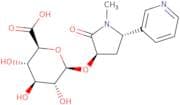
CAS 132929-88-5
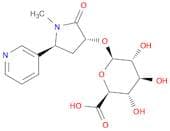
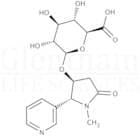
:trans-3′-Idrossicotinina-O-glucuronide
- (3R,5S)-1-Methyl-2-oxo-5-(3-pyridinyl)-3-pyrrolidinyl β-<span class="text-smallcaps">D</span>-glucopyranosiduronic acid
- (3R,5S)-1-methyl-2-oxo-5-(pyridin-3-yl)pyrrolidin-3-yl beta-D-glucopyranosiduronic acid
- 1-O-(trans-3-Hydroxycotinine)-b-D-glucuronide
- trans-3'-Hydroxycotinine O--D-glucuronide
- trans-3′-Hydroxycotinine-O-glucuronide
- β-<span class="text-smallcaps">D</span>-Glucopyranosiduronic acid, (3R,5S)-1-methyl-2-oxo-5-(3-pyridinyl)-3-pyrrolidinyl
- β-<span class="text-smallcaps">D</span>-Glucopyranosiduronic acid, 1-methyl-2-oxo-5-(3-pyridinyl)-3-pyrrolidinyl, (3R-trans)-
- β-D-Glucopyranosiduronic acid, 1-methyl-2-oxo-5-(3-pyridinyl)-3-pyrrolidinyl, (3R-trans)-
- (3R,5S)-1-Methyl-2-oxo-5-(3-pyridinyl)-3-pyrrolidinyl β-D-glucopyranosiduronic acid
- β-D-Glucopyranosiduronic acid, (3R,5S)-1-methyl-2-oxo-5-(3-pyridinyl)-3-pyrrolidinyl
trans-3′-Hydroxycotinine-O-glucuronide
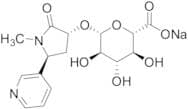
CAS:Formula:C16H20N2O8Colore e forma:SolidPeso molecolare:368.3386trans-3'-Hydroxy Cotinine O-b-D-Glucuronide Sodium Salt
CAS:Prodotto controllatoFormula:C16H19N2O8·NaColore e forma:NeatPeso molecolare:390.21trans-3'-Hydroxy Cotinine O-Beta-D-Glucuronide Ammonium Salt
CAS:Prodotto controllatoStability Hygroscopic
Applications A Nicotine (N412420) metabolite. Carcinogen.
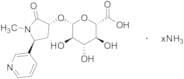
References Le Marchand, L., et al.: Cancer Res., 58, 4858 (1998), Minna, J., et al.: J. Clin. Invest., 111, 31 (2003), Bierut, L., et al.: Hum. Mol. Genet., 16, 24 (2007), Thorgeirsson, T., et al.: Nature, 452, 638 (2008),Formula:C16H20N2O8·x(NH3)Colore e forma:White To Pale Beige SolidPeso molecolare:368.34 + x(17.03)1-O-(trans-3-Hydroxycotinine)-b-D-glucuronide ammonium salt
CAS:The glucuronidation of 1-O-(trans-3-hydroxycotinine)-b-D-glucuronide ammonium salt is mediated by the enzyme UDP-glucuronosyltransferase. This reaction is catalyzed by the transfer of a glucuronic acid residue from UDP-glucuronic acid to a hydroxyl group on the side chain of 1-O-(trans-3-hydroxycotinine)-b-D-glucuronide ammonium salt. The kinetic analysis of human urine samples has shown that this reaction is significant. This metabolite can be detected in urine samples using next generation sequencing and its concentration can be used as an indicator for the consumption of tobacco or nicotine containing products. Epidemiological studies have shown that this metabolite has significant effects on cancer risk. Genotyping and genotype studies have shown that this metabolite is responsible for genetic polymorphisms that are associated with increased cancer risk.
Formula:C16H20N2O8•(NH3)xPurezza:Min. 97%Colore e forma:White PowderPeso molecolare:368.34 g/mol