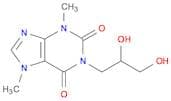
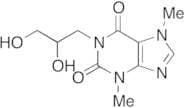
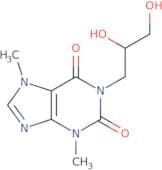
CAS 13460-96-3
:1-(2,3-Diidrossipropil)-3,7-diidro-3,7-dimetil-1H-purina-2,6-dione
Descrizione:
1-(2,3-Diidrossipropil)-3,7-diidro-3,7-dimetil-1H-purina-2,6-dione, comunemente conosciuto come teobromina, è un composto di metilxantina con notevoli proprietà farmacologiche. È una polvere cristallina bianca o bianco sporco che è solubile in acqua e presenta un sapore leggermente amaro. La sostanza si trova principalmente nei semi di cacao ed è un componente chiave del cioccolato. La teobromina agisce come uno stimolante, simile alla caffeina, ma con effetti più lievi sul sistema nervoso centrale. È nota per le sue proprietà vasodilatatrici, che possono portare a un aumento del flusso sanguigno e a una riduzione della pressione sanguigna. Inoltre, la teobromina ha effetti diuretici e può promuovere il rilassamento dei muscoli lisci, in particolare nelle vie respiratorie. La sua struttura molecolare presenta una base purinica con sostituenti idrossile e metile, contribuendo alla sua attività biologica. La teobromina è anche studiata per i suoi potenziali benefici per la salute, comprese le proprietà antiossidanti e gli effetti sul miglioramento dell'umore. Tuttavia, può essere tossica per alcuni animali, come i cani, a causa della loro incapacità di metabolizzarla in modo efficace.
Formula:C10H14N4O4
InChI:InChI=1S/C10H14N4O4/c1-12-5-11-8-7(12)9(17)14(3-6(16)4-15)10(18)13(8)2/h5-6,15-16H,3-4H2,1-2H3
InChI key:InChIKey=RRBSZTYIWIHPST-UHFFFAOYSA-N
SMILES:O=C1C2=C(N(C)C(=O)N1CC(CO)O)N=CN2C
Sinonimi:- 1-(2,3-Dihydroxy-propyl)-3,7-dimethyl-3,7-dihydro-purine-2,6-dione
- 1-(2,3-Dihydroxypropyl)-3,7-dimethylpurine-2,6-dione
- 1-(2,3-Dihydroxypropyl)-3,7-dimethylxanthine
- 1-(2,3-Dihydroxypropyl)theobromine
- 1-(2,3-Dihydroxypropyl-3,7-dimethyl-2,6(1H,3H)-purindion
- 1-(2,3-Dihydroxypropyl-3,7-dimethyl-2,6(1H,3H)-purindion [IUPAC]
- 1-(2,3-Dwuhydroksypropylo)-teobrominy
- 1-(2,3-Dwuhydroksypropylo)-teobrominy [Polish]
- 1-(2,3-dihydroxypropyl)-3,7-dimethyl-3,7-dihydro-1H-purine-2,6-dione
- 1-(beta,gamma-Dioxypropyl)-theobromin
- 1-(beta,gamma-Dioxypropyl)-theobromin [German]
- 1-Dihydroxypropyltheobromine
- 1H-Purine-2,6-dione, 1-(2,3-dihydroxypropyl)-3,7-dihydro-3,7-dimethyl-
- 1H-Purine-2,6-dione, 1-(2,3-dihydroxypropyl)-3,7-dihydro-3,7-dimethyl- (9CI)
- 1H-Purine-2,6-dione, 3,7-dihydro-1-(2,3-dihydroxypropyl)-
- Brn 0284032
- Isobromin
- Nsc 515487
- Theobromine, 1-(2,3-dihydroxypropyl)-
- Theocardin
- Theocardine
- 4-26-00-02370 (Beilstein Handbook Reference)
- 1-(2,3-Dihydroxypropyl)-3,7-dihydro-3,7-dimethyl-1H-purine-2,6-dione
- Vedi altri sinonimi
Ordinare per
Purezza (%)
0
100
|
0
|
50
|
90
|
95
|
100
3 prodotti.
1-(2,3-dihydroxypropyl)-3,7-dihydro-3,7-dimethyl-1H-purine-2,6-dione
CAS:Formula:C10H14N4O4Purezza:98%Colore e forma:SolidPeso molecolare:254.24261-(2,3-Dihydroxypropyl)-3,7-dihydro-3,7-dimethyl-1H-purine-2,6-dione
CAS:Prodotto controllato1-(2,3-Dihydroxypropyl)-3,7-dihydro-3,7-dimethyl-1H-purine-2,6-dione (theophylline) is a bronchodilator and anti-inflammatory agent. It is used to treat asthma and other respiratory conditions. Theophylline is structurally similar to caffeine and theobromine and has been shown to have a similar effect on the heart and blood vessels as these stimulants. It also stimulates the central nervous system in a manner similar to that of theobromine. Theophylline has shown some benefit in congestive heart failure patients but has not been proven effective for treating high blood pressure or fibrillation.Formula:C10H14N4O4Purezza:Min. 95%Peso molecolare:254.24 g/mol