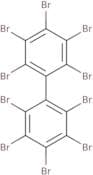
CAS 13654-09-6
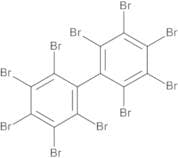
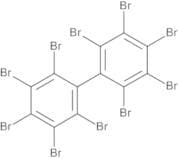
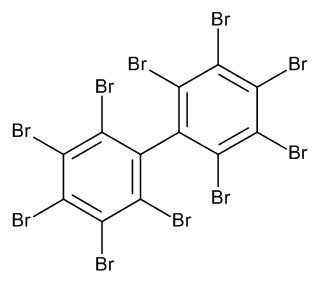
:decabromo-1,1'-bifenile
Descrizione:
decabromo-1,1'-bifenile, con il numero CAS 13654-09-6, è un ritardante di fiamma bromurato che appartiene alla classe degli eteri difenil polibromati. È caratterizzato dal suo alto contenuto di bromo, che ne migliora l'efficacia come ritardante di fiamma inibendo la combustione. Questo composto è tipicamente un solido bianco a bianco sporco a temperatura ambiente ed è insolubile in acqua, ma può dissolversi in solventi organici. La sua stabilità termica è significativa, permettendogli di resistere a temperature elevate senza decomposizione. decabromo-1,1'-bifenile è utilizzato principalmente in varie applicazioni, tra cui tessuti, plastica ed elettronica, per ridurre l'infiammabilità. Tuttavia, le preoccupazioni riguardo alla sua persistenza ambientale e alla potenziale tossicità hanno portato a un maggiore scrutinio e regolamentazione. È noto che si bioaccumula negli organismi viventi, sollevando questioni relative al suo impatto ecologico a lungo termine. Di conseguenza, si stanno esplorando alternative a decabromo-1,1'-bifenile nell'industria per mitigare questi rischi ambientali e per la salute.
Formula:C12Br10
InChI:InChI=1/C12Br10/c13-3-1(4(14)8(18)11(21)7(3)17)2-5(15)9(19)12(22)10(20)6(2)16
InChI key:InChIKey=AQPHBYQUCKHJLT-UHFFFAOYSA-N
SMILES:BrC1=C(C(Br)=C(Br)C(Br)=C1Br)C2=C(Br)C(Br)=C(Br)C(Br)=C2Br
Sinonimi:- 1,1'-Biphenyl, 2,2',3,3',4,4',5,5',6,6'-decabromo-
- 1,1′-Biphenyl, 2,2′,3,3′,4,4′,5,5′,6,6′-decabromo-
- 2,2',3,3',4,4',5,5',6,6'-Decabromobiphenyl
- 2,2′,3,3′,4,4′,5,5′,6,6′-Decabromo-1,1′-biphenyl
- 2,2′,3,3′,4,4′,5,5′,6,6′-Decabromobiphenyl
- Adine 0102
- Bb 209
- Berkflam B 10
- Biphenyl, decabromo-
- Decabromobiphenyl
- Decabromodiphenyl
- Flammex B 10
- Hsdb 7349
- Pbb 209
- Perbromobiphenyl
- Polybrominated biphenyls
- Rbf 102
- Decabromo-1,1'-biphenyl
- Decabromobiphenyl,35 μL/mL in Isooctane
- flammexb10
- adine0102
- DECA-BB
- DECABROMOBIPHENYLS
- decabromo-bipheny
- DECABROMOBIPHENYL (35 UG/ML IN ISOOCTANE)
- PBB NO 209
- Nicotinic Acid Impurity 58
- DECABB (PBB-209)
- 2,2’,3,3’,4,4’,5,5’,6,6’-decabromo-1’-biphenyl
- 11'-Biphenyl22'33'44'55'66'-decabromo-
- Perbromo-1,1'-biphenyl
- PBB-No. 209 25
- PBB No. 209 10 μg/mL in Cyclohexane
- 1,1’-biphenyl,2,2’,3,3’,,4’,5,5’,6,6’-decabromo-(decabromobiphenyl)
- 1’-Biphenyl,2,2’,3,3’,4,4’,5,5’,6,6’-decabromo-1
- Decarbromobiphenyl
- 237-137-2
- 2,2 ', 3,3', 4,4 ', 5,5', 6,6 '- Decabromobiphenyl (BB-209)
- 1,1’-(biphenyl,2,2’,3,3’,,4’,5,5’,6,6’-decabromo-
- PBB-No. 209 50 μg/mL in Isooctane
- Vedi altri sinonimi
Ordinare per
Purezza (%)
0
100
|
0
|
50
|
90
|
95
|
100
6 prodotti.
PBB Mix 5 10 µg/mL in Cyclohexane
CAS:Prodotto controllato- 115245-07-3
- 115245-08-4
- 13029-09-9
- 13654-09-6
- 16400-50-3
- 2052-07-5
- 2113-57-7
- 53592-10-2
- 57422-77-2
- 59080-32-9
- 59080-33-0
- 59080-34-1
- 59080-35-2
- 59080-36-3
- 59080-37-4
- 59080-39-6
- 59080-40-9
- 59261-08-4
- 60044-24-8
- 60044-25-9
- 67888-96-4
- 92-66-0
- 92-86-4
Formula:C12H4Br6Colore e forma:MixturePeso molecolare:627.58PBB No. 209 10 µg/mL in Cyclohexane
CAS:Prodotto controllatoFormula:C12Br10Colore e forma:Single SolutionPeso molecolare:943.17PBB-No. 209 50 µg/mL in Isooctane
CAS:Prodotto controllatoFormula:C12Br10Colore e forma:Single SolutionPeso molecolare:943.17Decabromobiphenyl
CAS:Prodotto controllatoApplications Decabromobiphenyl is a flame retardant and a standard for environmental testing and research.
Not a dangerous good if item is equal to or less than 1g/ml and there is less than 100g/ml in the package
References EPA. Method 1668, (EPA 821-R-00-002) (1999); Zeng, L., et al.: Environ. Sci. Technol. 48, 12586 (2014)Formula:C12Br10Colore e forma:ColourlessPeso molecolare:943.17Decabromobiphenyl
CAS:Prodotto controllatoDecabromobiphenyl is a brominated flame retardant that has been detected in human serum, fish, and sediments. It is used as an analytical method for the determination of polybrominated diphenyl ethers (PBDEs) in environmental samples. Decabromobiphenyl binds to the receptor site for thyroid hormone, which may cause significant cytotoxicity and is associated with a number of health effects. Decabromobiphenyl can be eliminated from the body by treatment with metal hydroxides or fatty acids, although this process may not be complete. Decabromobiphenyl can also bind to cationic polymers such as polystyrene sulfonate and polyethyleneimine, which make it difficult to remove from contaminated water.Formula:C12Br10Purezza:Min. 95%Peso molecolare:943.17 g/mol