CAS 13965-03-2
:Diclorobis(trifenilfosfina)palladio
Descrizione:
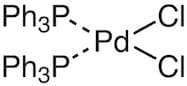
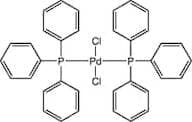
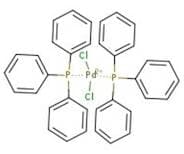
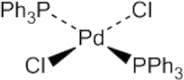
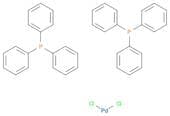
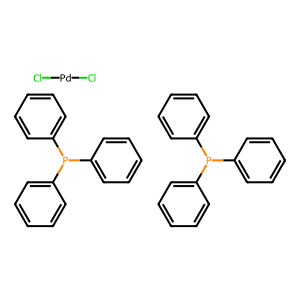
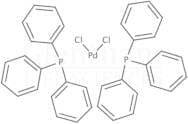
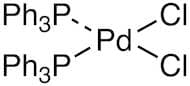
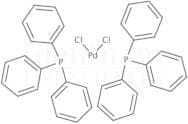
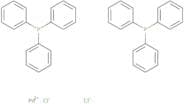
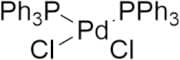
Diclorobis(trifenilfosfina)palladio, comunemente noto come Pd(PPh₃)₂Cl₂, è un complesso di coordinazione del palladio che presenta due ligandi di triphenilfosfina e due ioni cloruro. Questo composto è caratterizzato dalla sua geometria quadrata piana, tipica di molti complessi metallici d⁸, che contribuisce alla sua stabilità e reattività. Viene spesso utilizzato come catalizzatore in varie reazioni organiche, in particolare nelle reazioni di accoppiamento incrociato come le reazioni di Suzuki e Heck, grazie alla sua capacità di facilitare la formazione di legami carbonio-carbonio. La presenza dei ligandi di triphenilfosfina aumenta la solubilità del complesso nei solventi organici e fornisce ingombro sterico, che può influenzare la selettività della reazione. Pd(PPh₃)₂Cl₂ viene tipicamente maneggiato in atmosfere inerti per prevenire la degradazione ed è sensibile all'umidità. Le sue applicazioni si estendono alla sintesi di prodotti farmaceutici, agrochimici e materiali avanzati, rendendolo un composto prezioso sia nella chimica accademica che in quella industriale.
Formula:C36H30Cl2P2Pd
InChI:InChI=1S/2C18H15P.2ClH.Pd/c2*1-4-10-16(11-5-1)19(17-12-6-2-7-13-17)18-14-8-3-9-15-18;;;/h2*1-15H;2*1H;/q;;;;+2/p-2
InChI key:InChIKey=YNHIGQDRGKUECZ-UHFFFAOYSA-L
SMILES:[P]([Pd+2]([P](C1=CC=CC=C1)(C2=CC=CC=C2)C3=CC=CC=C3)([Cl-])[Cl-])(C4=CC=CC=C4)(C5=CC=CC=C5)C6=CC=CC=C6
Sinonimi:- B 1667
- Bis(triphenylphosphine)dichloropalladium
- Bis(triphenylphosphine)dichloropalladium(II)
- Bis(triphenylphosphine)palladium chloride
- Bis(triphenylphosphine)palladium dichloride
- Bis(triphenylphosphine)palladium(II) dichloride
- Bis(triphenylphosphino)-palladium(II) dichloride
- Bis(triphenylphosphino)palladium chloride
- Cis-Bis(Triphenylphosphine)Platinum(Ii) Dichloride
- Dichlorobis(Triphenylphosphine)Palladate (Ii)
- Dichlorobis(Triphenylphosphine)Palladium
- Dichlorobis(triphenylphosphin)palladium
- Dichlorobis(triphenylphosphine)palladium(II)
- Dichlorobis(triphenylphosphine)platinum (II)
- Diclorobis(Trifenilfosfina)Paladio
- Nsc 122924
- Palladium(2+) Chloride-Triphenylphosphane (1:2:2)
- Palladium, dichlorobis(triphenylphosphine)-
- Palladiumbis(triphenylphosphine) dichloride
- Phosphine, Triphenyl-, Palladium(2+) Salt, Dihydrochloride
- Trans-Dichlorobis(triphenyl-phosphine) Palladium(II)
- cis-Bis(triphenylphosphine)platinum(II) chloride
- trans-Bis(triphenylphosphine)palladium dichloride
- Vedi altri sinonimi
Ordinare per
Purezza (%)
0
100
|
0
|
50
|
90
|
95
|
100
Trovati 15 prodotti.
Bis(triphenylphosphine)palladium(II) Dichloride
CAS:Formula:C36H30Cl2P2PdPurezza:>98.0%(T)Colore e forma:Light yellow to Brown powder to crystalPeso molecolare:701.90trans-Dichlorobis(triphenylphosphine)palladium(II), Pd 14.0% min
CAS:Hydrogenation, hydrosilation, carbonylation, oxidation, and C-C bond formationFormula:C36H30Cl2P2PdPeso molecolare:701.90trans-Dichlorobis(triphenylphosphine)palladium(II), Premion™, 99.95% (metals basis), Pd 14.7% min
CAS:As a catalyst of choice in hydrogenation, hydrosilation, carbonylation, oxidation, elimination, reduction, allyl aceate isomerization, dimerization of 1,3-dienes, and C-C bond formation such as Negishi coupling, Suzuki coupling, Kumada coupling, Sonogashira coupling, Heck coupling and Sonogashira-HFormula:C36H30Cl2P2PdPurezza:99.95%Peso molecolare:701.90Bis(triphenylphosphine)palladium(II) dichloride
CAS:Purezza:98%Colore e forma:White to yellow powder or crystalsPeso molecolare:701.90trans-Dichlorobis(triphenylphosphine)palladium(II), 99% (99.9+%-Pd)
CAS:trans-Dichlorobis(triphenylphosphine)palladium(II), 99% (99.9+%-Pd)
Formula:PdCl2(P(C6H5)3Purezza:(99.9+%-Pd)Colore e forma:yellow pwdr.Peso molecolare:701.89Dichlorobis(triphenylphosphine)palladium
CAS:Formula:C36H30Cl2P2PdPurezza:98%Colore e forma:SolidPeso molecolare:701.8969Ref: IN-DA001BFX
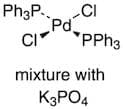
1gPrezzo su richiesta5gPrezzo su richiesta10gPrezzo su richiesta25gPrezzo su richiesta50gPrezzo su richiesta100mgPrezzo su richiesta250mgPrezzo su richiestatrans-Dichlorobis(triphenylphosphine)palladium(II)/potassium phosphate admixture [CatKit single-use vials - 6.32 wt% Pd complex]
CAS:trans-Dichlorobis(triphenylphosphine)palladium(II)/potassium phosphate admixture [CatKit single-use vials - 6.32 wt% Pd complex]
Formula:PdCl2P(C6H5)3K3PO4Colore e forma:off-white pwdr.Peso molecolare:701.89Bis(triphenylphosphine)palladium(II) chloride
CAS:Bis(triphenylphosphine)palladium(II) chlorideFormula:·2C18H15P·Cl2PdPurezza:98%Colore e forma: yellow solidPeso molecolare:701.89692g/molRef: 54-OR30692
1gPrezzo su richiesta5gPrezzo su richiesta10gPrezzo su richiesta25gPrezzo su richiestaBis(triphenylphosphine)palladium(II)chloride
CAS:Formula:C36H30Cl2P2PdColore e forma:Yellow to gold crystalline powderPeso molecolare:701.91PdCl2(PPh3)2 (HPMC encapsulated)
CAS:Formula:C36H30Cl2P2PdColore e forma:White to Light yellow to Light orange capsulePeso molecolare:701.90Bis(Triphenylphosphine)palladium (II) chloride
CAS:Formula:C36H30Cl2P2PdPurezza:98.0%Colore e forma:Solid, Crystalline Powder or PowderPeso molecolare:701.9Ref: 10-F035784
1gPrezzo su richiesta5gPrezzo su richiesta10gPrezzo su richiesta25gPrezzo su richiesta100gPrezzo su richiestaBis(triphenylphosphine) palladium(II) chloride, 99.95% (metals basis)
CAS:Formula:(C6H5)3PPdCI2Purezza:≥ 99.95%Colore e forma:Pale yellow to brown powder or crystalsPeso molecolare:701.89Bis(triphenylphosphine)palladium(II) dichloride
CAS:Bis(triphenylphosphine)palladium(II) dichloride is an organometallic compound that has antibiotic activity. It is the active methylene in a number of drug molecules, including methyldopa, which is used to treat high blood pressure and postural hypotension. Bis(triphenylphosphine)palladium(II) dichloride also has potential use as a target enzyme for cross-coupling reactions. Cross-coupling reactions involve the coupling of organic compounds with organometallic reagents using palladium as a catalyst. The mechanism of this reaction involves the formation of a palladium-carbon bond by oxidative addition and reductive elimination, followed by the release of carbon monoxide. This process leads to the formation of an organometallic compound and an aryl halide. Bis(triphenylphosphine)palladium(II) dichloride can also be used in gel permeation chromFormula:C36H30Cl2P2PdPurezza:Min. 95%Colore e forma:Yellow PowderPeso molecolare:701.9 g/molBis(Triphenylphosphine) Palladium(II) Dichloride extrapure, 14%-15.50% Pd
CAS:Formula:C36H30Cl2P2PdPeso molecolare:701.90Dichlorobis(triphenylphosphine) Palladium (II)
CAS:Prodotto controllatoApplications Dichlorobis(triphenylphosphine) Palladium (II) is used primarily in organometallic catalytic reactions due to the palladium content of the compound. It is also involved in crystalized structures of metallacyclic complexes which show antiinflammatory and antifungal properties.
References Paul, P. et al.: J. Organometal. Chem., 724, 281 (2013); Pandiarajan, D. et al.: J. Organometal. Chem., 708-709, 18, (2012); Shhaheen, F. et al.: J. Organometal. Chem., 693, 315 (2010);Formula:C36H30Cl2P2PdColore e forma:NeatPeso molecolare:701.89